Keys finder circuit

audioguru2

Apr 6, 2004
12,026
Joined
Apr 6, 2004
Messages
12,026
Hi Lapsap,
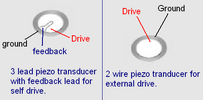
Just get a two-wire piezo transducer designed for external drive. Our project uses it as a microphone then drives it to make a sound.

A CD4069 inverter is just a pair of push-pull complimentary Mos transistors. It makes a pretty good linear amplifier with the negative feedback provided by the resistors from output to input. The feedback makes it self-bias, if the output DC voltage tried to be too low then it feedsback into the input which forces the output up to a voltage about half the supply voltage where its Mos transistors have the most gain. ;D
 
A

Alun

Jan 1, 1970
0
I hope this picture settles the matter. ;D

As long as you don't use a piezo buzzer with an internal driver this circuit will work. You can use either a 2 or 3 lead piezo transducer in this circuit, if you use the 3 lead variety then just connect the feedback to the drive.

piezo.png


audioguru2

Apr 6, 2004
12,026
Joined
Apr 6, 2004
Messages
12,026
I think a 2-wire transducer will make a more sensitive microphone since its useful area is larger and in a single lighter-weight piece. ;D

 
A

Alun

Jan 1, 1970
0
I think there will be very little difference between the two, but I agree the two wire unit will be very slightly better and is a more appropriate choice. I was just pointing out that you can also use a three terminal device if it's more convenient to get hold of. ;D


lapsap

May 28, 2005
19
Joined
May 28, 2005
Messages
19
Posted by: Alun  Posted on: May 28, 2005, 02:20:24 PM
Insert Quote
I forgot to say, the only difference between a piezo transducer and piezo buzzer element it a buzzer element has an extra feedback lead, a transducer just has drive and ground leads. Just connect the feedback and driver together and use the buzzer element as a transducer.


back to my old question, whats the different between transducer ans buzzer?

so it means that this transducer will act as a mic and then become a speaker to produce sound?


audioguru2

Apr 6, 2004
12,026
Joined
Apr 6, 2004
Messages
12,026
A piezo buzzer usually has a transistor oscillator in it and therefore cannot be used as a microphone. Its oscillator will conflict with the oscillator in this project when it is supposed to be a speaker.

Quote: Our project uses it as a microphone then drives it to make a sound.

 
A

Alun

Jan 1, 1970
0
Yes, I agree with audioguru, a piezo buzzer has a built in oscilator that will interfere with things.

A transducer whether it be the 2 lead or three lead type is what you need and I'd go for the 2 lead one if you have the choice.

Sorry about that post, it was badly worded and therefore could be confusing.


lapsap

May 28, 2005
19
Joined
May 28, 2005
Messages
19
:eek:  thx for all the information.

here it say that N4, C3 and R5 will ensures that the circuit will not trigger from common noise, what does it mean? is this consider as a filter? can i change the value so that i would need a high pitch voice to activated it? how is the calculation?
after that it say that the voltage of N4 will increases to hight logcal level what does it means?

sry to trouble you all again due to i lack of knowledge about circuit analysis


audioguru2

Apr 6, 2004
12,026
Joined
Apr 6, 2004
Messages
12,026
Hi Lapsap,
D1 charges C3 very quickly when there is any sound, including common noise. Then the oscillator is started and the piezo transducer makes its sound. The only things in the circuit that I see to reduce sensitivity to low frequency noise is the high frequency resonance of the piezo transducer and the low values of C1 and C2.

I don't think this project will respond very well to high pitched voices, except maybe it will respond to a baby's very high pitched crying. The piezo resonates at 3kHz to 4kHz which is far above an ordinary high pitched voice. The harmonics of the loud voice of an opera singer will probably activate the circuit very well with certain musical notes.
The piezo does have some output at the frequency of a high pitched voice so try it and see if its sensitivity is OK. Increase the values of C1 and C2 and it will be a little bit better.

The circuit description of the operation of N4 and C5 is backwards and poor.
1) Without an input sound, N4 self-biases itself as a linear amplifier with its DC output voltage at about half the supply voltage. The output of N4 is fed through R6 to the base of T1 which turns on with its output voltage low.
2) The low voltage at the input of N5 causes a high voltage at its output which causes a low voltage at the output of N6, stopping the oscillator and turning off T2. With T2 turned off, the piezo is a microphone.
3) N1 to N3 amplify the sound signal from the microphone and D1 passes positive half-cycles to the input of N4 causing it to go high. Therefore the output of N4 goes low and it turns-off T1.
4) With T1 turned-off then N5 and N6 oscillate and drive T2 which drives the piezo for it to make a whistle sound.

The project describes pretty well how D4, C7 and D3 turn-off the N1-N3 amplifier, and how C3 slowly discharges into R5 to stop the piezo whistle after a few seconds.

Did you figure out what is a fizzle?
I think it is the jingling sound made by keys shaking together. ;D ;D


lapsap

May 28, 2005
19
Joined
May 28, 2005
Messages
19
thank you very much, i have really understand the circuit now.

as for the fizzle sound,  when i connect the circuit with a buzzer, there is some sound coming out from non stop. but it is very soft, i think that should be the fizzling sound.


audioguru2

Apr 6, 2004
12,026
Joined
Apr 6, 2004
Messages
12,026
What kind of soft sound is it making, is it talking to you? ;D


lapsap

May 28, 2005
19
Joined
May 28, 2005
Messages
19
it sound like
ZZZZZZZZZZZZZZZZZZZZZZZZZZZZZZZZZZZZZZZzzzzzzzzzzz

almost sound like tat, i dunno how to put it in words


lapsap

May 28, 2005
19
Joined
May 28, 2005
Messages
19
haha...
my place here is almost reaching sleepying time, maybe thats why that kind of sound is coming out. 8)


lapsap

May 28, 2005
19
Joined
May 28, 2005
Messages
19
i have tested manually by turning on the T1, n let T2 on, in this case, you say that it will be triggered.but the sound is so soft can i increase the volume.

but when i connect acorrding the circuit diagram given, the sound is also be triggered without any wistle. but the only different compare with T1 off, is that,
when T1 is off, when is battery is connected the piezo start buzzing.
when connect acorrding circuit, the sound is seem like charging up n start buzzing.

another question is that normally the piezo will be connect at the collect and not the emitter. why?

is the N5 and N6 part is the osillator? the connection is also differen from what i have found.

thx you for your help...


audioguru2

Apr 6, 2004
12,026
Joined
Apr 6, 2004
Messages
12,026
Hi Lapsap,
Without any sound, T1 is on and T2 is off. You can test its sound by shorting the base of T1 to ground, which N4 does when the microphone hears a sound.
You can make the sound louder by increasing the supply voltage, by housing the piezo in a resonant cavity adjusted to the same frequency as the piezo's resonance and by tuning the oscillator's frequency to the piezo's resonance by adjusting the value of R9.

The piezo is connected to T2's emitter instead of its collector so that the base current of T2 doesn't load-down the output voltage of N6. If the high output voltage of N6 is not high enough then it can't shut off the N1-N3 preamp.

N5 and N6 are a "Classic Cmos Oscillator" like millions that I have seen and used. ;D


lapsap

May 28, 2005
19
Joined
May 28, 2005
Messages
19
sorry to trouble you again, i have just reconnect the circuit few times, but now when i gound the base of T1, it also do not have any sound. do you mind to explain everything? can i test the oscillator it self? with only the N5 N6 R8 R9 C5 how should i connect it to do piezo? connect the terminal of piezo to 12 and C5?


audioguru2

Apr 6, 2004
12,026
Joined
Apr 6, 2004
Messages
12,026
Hi Lapsap,
N5 N6 R8 R9 C5 are a 4kHz oscillator and drive T2 which drives the piezo to make sound.
When you ground the base of T1 then its collector is open-circuit which allows the oscillator to work. C5 is 1.5nF which is 0.0015uF. R10 is 4700 ohms.


lapsap

May 28, 2005
19
Joined
May 28, 2005
Messages
19
now i only connect N5, N6 R8, R9, C5. n connect the pie at output of N6 to the ground. there is a buzzing sound coming out. is this suppose to be the output sound?

in this circuit T1 n T2 is suppose to be acts as switch? when the T2 turn on, the piezo is going to triggered, why and how? where is the signal come from to trigger the piezo?

can i test the mic function by oscilloscope? how? which point should i connect?


audioguru2

Apr 6, 2004
12,026
Joined
Apr 6, 2004
Messages
12,026
Hi Lapsap,
The output of N6 isn't very strong and won't directly drive the piezo very well. The circuit uses T2 as a emitter-follower current-booster so that the piezo produces an amplified  strong 4kHz whistle, not just a little buzz. The piezo is used as a speaker and T2 is its ampliier/driver to make the sound of the 4kHz N5-N6 oscillator.

If your T1 and T2 transistors don't work then maybe you have their pins mixed-up. Look at the picture of the BC547B on its datasheet to see which pin is what.

You can connect an oscilloscope to pin 6 of N3 to see the amplified output when the piezo is used as a microphone. The DC voltage should be about half of the supply voltage and the AC output will be the highest when the sound is near the piezo's resonant frequency of about 4kHz. ;D

View attachment 37185

 
Top