Linear Voltage Regulator Design

cyw1984

Sep 7, 2005
63
Joined
Sep 7, 2005
Messages
63
7uk79419.jpg


If I want to output 0-30V

Vin =
 
Last edited by a moderator:

audioguru2

Apr 6, 2004
12,026
Joined
Apr 6, 2004
Messages
12,026
An LM358 is very slow, about the same speed as the output transistor. A modern faster opamp would have better transient response. It wouldn't be difficult to compensate it with a little capacitor across the 40k resistor.

40k isn't a standard value so instead I would use 33k in series with a 15k or 20k trimpot, to adjust the gain of the circuit to exactly 3.000000. (Lots of bits in the DAC) ;D

The poor little PNP transistor #3 doesn't have a resistor to limit its base and collector currents. An emitter resistor for it would accomplish both.

The darlington connected output transistors #1 and #2 don't have resistors to turn them off. If they get warm then they will have thermal runaway without resistors. Their reaction time will be very slow without resistors. :(

 
Last edited by a moderator:
A

Alun

Jan 1, 1970
0
audioguru said:
An LM358 is very slow
13V/us isn't that slow.

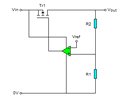
This thread has an interesting discussion on linear regulators, you don't have you build the voltage doubler if you don't want to, you could use a p-channel MOSFET as you're not bothered about the dropout voltage and on resistance.

Low_dropout_FET.GIF


audioguru2

Apr 6, 2004
12,026
Joined
Apr 6, 2004
Messages
12,026
Hi Alun,
An old LM358 is half an old LM324. They are about the 1st low-power opamps ever made so sure they are darn slow.
They slew 2.5V in 5us which is only 0.5V/us. Their output is slew-rate limited above only 5kHz. :'(

Your P-channel Mosfet in a low-dropout regulator is a good idea to keep the supply voltage of the opamp down to its max rating. ;D

View attachment 37596

 
A

Alun

Jan 1, 1970
0
Sorry, my mistake I was thinking of the LF351 for some reason.

I agree a faster op-amp would be better and as the load is connected to the drain of the MOSFET which is faster than most op-amps it will help speed things up even more. ;D


cyw1984

Sep 7, 2005
63
Joined
Sep 7, 2005
Messages
63
audioguru said:
Hi Alun,
An old LM358 is half an old LM324. They are about the 1st low-power opamps ever made so sure they are darn slow.
They slew 2.5V in 5us which is only 0.5V/us. Their output is slew-rate limited above only 5kHz. :'(

Your P-channel Mosfet in a low-dropout regulator is a good idea to keep the supply voltage of the opamp down to its max rating. ;D
Then....Which op-amp should I use?????
 

cyw1984

Sep 7, 2005
63
Joined
Sep 7, 2005
Messages
63
Alun said:
Try the CA3140E and have a go with my idea if have any p-chanel MOSFETs available.
i SEE....It 's 4.5M high speed Op- amp
....Is your design need remove 555 timer ??
Also, which P-channel MOSFETs and Diode do you used??
 
Last edited by a moderator:

cyw1984

Sep 7, 2005
63
Joined
Sep 7, 2005
Messages
63
Srj80224.png

It is my new design for my circuit

If LM358 is slow op-amp...which opamp should I use???


Also, how to add on somthing to improve this circuit . Such as capicator to reduce noise and zener diode make the voltage stable???

Thanks a lot
 

ante1

Jan 24, 2004
4,138
Joined
Jan 24, 2004
Messages
4,138
What’s the DAC look like? How many bits?  ???


audioguru2

Apr 6, 2004
12,026
Joined
Apr 6, 2004
Messages
12,026
Hi Cyw,
You didn't finish your circuit with the important stuff I mentioned, so I added/changed a few things.
About the only thing that remains is adding current limiting or regulation. If you draw too much current or short the output, it will blow-up! ;D

View attachment 37598

 
Last edited by a moderator:
A

Alun

Jan 1, 1970
0
Just one question, why use so many transistors?
The op-amp already has a very high gain, adding more transistors won't increase the performance much, infact such a high open loop gain is likely to lead to instabiliy and oscilation. I think you'll find that one p-channel MOSFET will out perform all those transistors. ;D


Staigen1

Oct 26, 2003
695
Joined
Oct 26, 2003
Messages
695
Hey boys, and old man Audioguru
Lets stop a while and think, and dont rush away
There is so much we dont know about this regulator, but there is at least some data given. We know:
The input voltage is 40 Volts
The output voltage: 0 to 30 Volts, depending on Vref
Vref: 0 to 10 Volt from a DAC

Something we dont know, and i belive we must know:
Output current
In some instances the output resistance of the DAC

Something that would be nice to know:
Data about the DAC(not necessarily needed, except above)

The 3140 IC have a max voltage rating of only 36 Volt, so why stress it above that, use an another IC


Audioguru, i have seen a lot of commercially designed circuits with 2N3055, both switched and linear, and the resistor between base and emitter has been in the range of 100 to 220 ohms, dont you think that 10 K is a little bit high? And also the resistor between the 2N3053:s base and the output, its usally betwwen 1 K and 1,5 K? What is the purpose of the 1 K resistor between the base of the 2N3053 and the collector of the 2N3906? And no offset adjust?

Alun, your circuit is a good one, exept that the 3140 IC are not guaranteed for 40 Volts and there is no voltage limit on the MOSFET:s gate! And no offset adjust.

Whats so wrong with the original circuit, exept that it have the wrong IC and no resistors from the base to the emitter on some transistors? It also lack protection for the base on one transistor and it have no offset adjustment! But, it have output short protection, so it is much safer! The shematic is here under:

//StaigenView attachment 37599


cyw1984

Sep 7, 2005
63
Joined
Sep 7, 2005
Messages
63
audioguru said:
Hi Cyw,
You didn't finish your circuit with the important stuff I mentioned, so I added/changed a few things.
About the only thing that remains is adding current limiting or regulation. If you draw too much current or short the output, it will blow-up! ;D
Thanks a lot...But I have few question about this....

1. DC sypply voltage only 36V, Is ir really suitable???

2. How to caculate the resistor values (10K) between PNP Base and Emitter and NPN base to output(10K and 100K)???

3. What is the values of capacitor should I use??

4.I know it haven't current limiting....I just for testing . did you added current limiting on it??

Thanks a lot...Sorry for my trouble and poor english
 

cyw1984

Sep 7, 2005
63
Joined
Sep 7, 2005
Messages
63
Staigen said:
Hey boys, and old man Audioguru
Lets stop a while and think, and dont rush away
There is so much we dont know about this regulator, but there is at least some data given. We know:
The input voltage is 40 Volts
The output voltage: 0 to 30 Volts, depending on Vref
Vref: 0 to 10 Volt from a DAC

Something we dont know, and i belive we must know:
Output current
In some instances the output resistance of the DAC

Something that would be nice to know:
Data about the DAC(not necessarily needed, except above)

The 3140 IC have a max voltage rating of only 36 Volt, so why stress it above that, use an another IC

Audioguru, i have seen a lot of commercially designed circuits with 2N3055, both switched and linear, and the resistor between base and emitter has been in the range of 100 to 220 ohms, dont you think that 10 K is a little bit high? And also the resistor between the 2N3053:s base and the output, its usally betwwen 1 K and 1,5 K? What is the purpose of the 1 K resistor between the base of the 2N3053 and the collector of the 2N3906? And no offset adjust?

Alun, your circuit is a good one, exept that the 3140 IC are not guaranteed for 40 Volts and there is no voltage limit on the MOSFET:s gate! And no offset adjust.

Whats so wrong with the original circuit, exept that it have the wrong IC and no resistors from the base to the emitter on some transistors? It also lack protection for the base on one transistor and it have no offset adjustment! But, it have output short protection, so it is much safer! The shematic is here under:

//Staigen
It is 12BIT DAC 0-10V
also........It about 0-2V
but....current limit I will design later
 
A

Alun

Jan 1, 1970
0
Staigen said:
Alun, your circuit is a good one, exept that the 3140 IC are not guaranteed for 40 Volts
Use a higher voltage IC or a separate power supply for the IC.

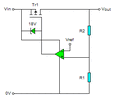
and there is no voltage limit on the MOSFET:s gate!
Just add a zenner, see attachment.

And no offset adjust.
Why do you need to offfset adjust? Any error in the output can be taken care of with a small trimmer resistor.

Whats so wrong with the original circuit, exept that it have the wrong IC and no resistors from the base to the emitter on some transistors?
You could also power the IC from a zenner diode shunt regulator to get round the voltage problem but this won't work with my MOSFET circuit, however I can solve this problem too.

I chose a MOSFET because it's simpler, will work out cheaper, has a lower drop out voltage (not important here though), will have a lower quesant current and a far better transient response.

current limit I will design later
Even though you haven't considered limiting the current at this stage it's still very important to know the magnitude, this will give you an idea of the componant ratings the design techniques you should use. By looking at the componats you've used and your origional design I assume you want the output current to be around 10 amps or so, is the correct?Low_dropout_FET.GIF

 
Last edited:

cyw1984

Sep 7, 2005
63
Joined
Sep 7, 2005
Messages
63
Alun said:
Use a higher voltage IC or a separate power supply for the IC.


Just add a zenner, see attachment.


Why do you need to offfset adjust? Any error in the output can be taken care of with a small trimmer resistor.


You could also power the IC from a zenner diode shunt regulator to get round the voltage problem but this won't work with my MOSFET circuit, however I can solve this problem too.

I chose a MOSFET because it's simpler, will work out cheaper, has a lower drop out voltage (not important here though), will have a lower quesant current and a far better transient response.


Even though you haven't considered limiting the current at this stage it's still very important to know the magnitude, this will give you an idea of the componant ratings the design techniques you should use. By looking at the componats you've used and your origional design I assume you want the output current to be around 10 amps or so, is the correct?
I want the output current to be around 2 to 3 AMPS.....Your 's enclose can the output achieve to 0-30V???
Also Use a higher voltage IC ................which IC should be suitable on it?? And which  you used??
 
Top