Linear Voltage Regulator Design

audioguru2

Apr 6, 2004
12,026
Joined
Apr 6, 2004
Messages
12,026
Hi nearly old man Staigen,
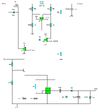
You are absolutely correct! I was way off with my selection of high-value "turn-off" resistors for the output transistors in my "fixed" circuit. I have now chosen lower value resistors based on what is inside a TIP120 darlington.

I used a 1k resistor in series with the collector of the 2N3906 to limit its collector current and dissipation if the project's output is shorted. It will still provide enough drive to the output transistors to blow a fuse if the output is shorted.

I think the circuit can deliver 30V at 1.5A with a 34V supply to protect the 36V max-rated opamp.

It would be fun to try to stop this extremely high gain circuit from oscillating. ;D


Hi Alun and Cyw,
I don't think a single 2N3055 or power Mosfet can dissipate more than about 60W even on a pretty big heatsink. Therefore the max current is only 2A at low output voltages. That's why I proposed using 2 output transistors in our 0V-30V modified project for 3A output, and using 3 output transistors on our modified for 5A project.

View attachment 37601
 
A

Alun

Jan 1, 1970
0
audioguru said:
Hi Alun and Cyw,
I don't think a single 2N3055 or power Mosfet can dissipate more than about 60W even on a pretty big heatsink.
That's why I'd use a large MOSFET like the IRF9131 or IRF9531 they can safely dissipate 75W and the dropout voltage will be only 0.9V at 3A, while yours will be at least 3.6V ;D
 
Last edited:

audioguru2

Apr 6, 2004
12,026
Joined
Apr 6, 2004
Messages
12,026
Hi Alun,
Those little Mosfets can't dissipate 75W safely, in practise. They are rated for 75W if their case is held somehow at 25 degrees C. You can't find a heatsink that is infinitely large to do the job of perfect cooling, so your heatsink will get hot and you must follow the power derating curve. You might be able to allow a dissipation of 50W if you use a big heatsink plus a fan. With a supply of 31V, the max current would be only 50/31 = 1.6A.

A 115W-rated 2N3055 would be able to dissipate 60W with a big heatsink and without a fan. Since they have a metal case, their chip is allowed to go to 200 degrees C vs only 150 degrees C for the plastic case.

I like 300W-rated Mosfets that will do a good job, but they are expensive. Actually, I haven't seen P-channel 300W Mosfets, only N-channel. ;D

 
A

Alun

Jan 1, 1970
0
Just parallel them then - it's also far easier to do this with MOSFETS than BJTs.


audioguru2

Apr 6, 2004
12,026
Joined
Apr 6, 2004
Messages
12,026
Yeah, When you parallel Mosfets then the hottest one increases its resistance so it allows the cooler one to carry more of the current. ;D

 
A

Alun

Jan 1, 1970
0
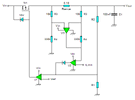
Here's an idea to make the current limit programable.

U3 is a differential amplifier with a gain of R4/R3, this measures the volagate across

Low_dropout_FET_3.GIF


cyw1984

Sep 7, 2005
63
Joined
Sep 7, 2005
Messages
63
Here's an idea to make the current limit programable.

U3 is a differential amplifier with a gain of R4/R3, this measures the volagate across
 
Last edited by a moderator:

cyw1984

Sep 7, 2005
63
Joined
Sep 7, 2005
Messages
63
audioguru said:
Hi nearly old man Staigen,
You are absolutely correct! I was way off with my selection of high-value "turn-off" resistors for the output transistors in my "fixed" circuit. I have now chosen lower value resistors based on what is inside a TIP120 darlington.

I used a 1k resistor in series with the collector of the 2N3906 to limit its collector current and dissipation if the project's output is shorted. It will still provide enough drive to the output transistors to blow a fuse if the output is shorted.

I think the circuit can deliver 30V at 1.5A with a 34V supply to protect the 36V max-rated opamp.

It would be fun to try to stop this extremely high gain circuit from oscillating. ;D


Hi Alun and Cyw,
I don't think a single 2N3055 or power Mosfet can dissipate more than about 60W even on a pretty big heatsink. Therefore the max current is only 2A at low output voltages. That's why I proposed using 2 output transistors in our 0V-30V modified project for 3A output, and using 3 output transistors on our modified for 5A project.
Thank you for your help....

Can the cirucit deliver 30V at 2A??

On the other hand, I would like to use LM358 for testing, Is it OK??

any op-amp is prefectly on this cirucit??
As I know CA3140 is 4.5MHz, BiMOS Operational Amplifier with MOSFET
 
Last edited by a moderator:
A

Alun

Jan 1, 1970
0
cyw1984 said:
Which U1, U2, U3, diode and P-channel MOSEFT is prefect in this circuit???Thanks
The MC34071 will be fine for U1, but U2 needs to swing down to below 0.6V and U3 needs to swing as low as possible, I was going to suggest the the CA3130 but it's only rated to 16V, :( perhaps audioguru can think of a suitable op-amp.
 

audioguru2

Apr 6, 2004
12,026
Joined
Apr 6, 2004
Messages
12,026
Hi Alun,
It is difficult to select U3 for your circuit.
It needs inputs that operate near the positive supply, and an output to ground. Cmos opamps do this, but have limited supply voltage rating.
If its 10k input resistors were increased so that they have 1.8V or more voltage drop then an MC34071 opamp could be used if you can tolerate its output going only as low as about 0.1V. ;D


cyw1984

Sep 7, 2005
63
Joined
Sep 7, 2005
Messages
63
audioguru old man,

I have tied your circuit....It has some problem......
It use 15K resistor series as DAC input....
The Vref is not between 0-10V.voltage drop on the resistor

Also....the output is exactly the same of Vin
What is the cause???

I used the LM358 to test (Vin 36V and Gnd it)


Staigen1

Oct 26, 2003
695
Joined
Oct 26, 2003
Messages
695
Hi there again

Maybee the LM358 blow, its only good for 32 Volts, and you put 36 Volts on it!

Hey cyw1984, cant you read? The datasheet clearly says its max voltage is 32 Volts!

And Audioguru, why didn't you included some type of voltage regulation or something for the poor little IC? A zener and a resistor and a cap will do that!

//Staigen


audioguru2

Apr 6, 2004
12,026
Joined
Apr 6, 2004
Messages
12,026
Hi Staigen,
Yeah, the LM358 is blown-up. It is supposed to have a gain of 3.0.

I didn't regulate the supply for the opamp because the MC34071 that I recommended and most other modern opamps have a + power supply rejection ratio of about 82dB at the rectifier ripple frequency. So 1V of ripple on the supply will cause only 0.1mV of ripple at its output. ;D


cyw1984

Sep 7, 2005
63
Joined
Sep 7, 2005
Messages
63
thanks again

8Bt37150.png


I get a problem here...
If my Vin 30 or 32V..can the output achieve 30V???
how to change the circuit...because I want to common the VCC and GND to supply voltage....

And what values of filter is suitable???
thanks


audioguru2

Apr 6, 2004
12,026
Joined
Apr 6, 2004
Messages
12,026
cyw1984 said:
If my Vin 30 or 32V..can the output achieve 30V?
Of course not. The max output voltage will be 3V to 4V lower than its supply voltage.

how to change the circuit...because I want to common the VCC and GND to supply voltage?
I don't know what you mean.

And what values of filter is suitable?
You'll have to try different values until its transient response isn't too slow, and that it doesn't oscillate.
 

cyw1984

Sep 7, 2005
63
Joined
Sep 7, 2005
Messages
63
audioguru said:
Of course not. The max output voltage will be 3V to 4V lower than its supply voltage.


I don't know what you mean.


You'll have to try different values until its transient response isn't too slow, and that it doesn't oscillate.
I want to common the Opamp VCC and GND to the Vin and GND
how to do that- -sorry fot my poor english
 

ante1

Jan 24, 2004
4,138
Joined
Jan 24, 2004
Messages
4,138
Hi Guys,

How about the MAX420 it might work here! ::)


audioguru2

Apr 6, 2004
12,026
Joined
Apr 6, 2004
Messages
12,026
cyw1984 said:
I want to common the Opamp VCC and GND to the Vin and GND. How to do that?
The MC34071 opamp (or MC34072 dual or MC34074 quad) that I recommend has a max supply voltage of 44V. Its inputs can work fine down to ground. Its output can swing almost to ground.
Just connect its supply pins to Vin and ground. ;D

Hi Ante,
The MAX420 is a chopper stabilized opamp that is very slow. I have never used a thingy like that. I am amazed that its offset voltage is only a few uV. I wouldn't use it here.
 
A

Alun

Jan 1, 1970
0
cyw1984 said:
I get a problem here...
If my Vin 30 or 32V..can the output achieve 30V???
how to change the circuit...because I want to common the VCC and GND to supply voltage....
With your circuit?
No.

But with my MOSFET circuit, yes but is depends on the on resistance of the MOSFET and Rsence.
Vdropout  = current drawn * (Rsence + RMOSFET)
For example if you want 3A @ 30V and the MOSFET's on reistance is 0.4ohms and Rsence is 0.1ohms:
Vdropout = 3 * (0.1 + 0.4) = 1.5V
So the input voltage must be at least 31.5V for the output to be 30V when 3A is drawn.

Hi Alun,
It is difficult to select U3 for your circuit.
It needs inputs that operate near the positive supply, and an output to ground. Cmos opamps do this, but have limited supply voltage rating.
If its 10k input resistors were increased so that they have 1.8V or more voltage drop then an MC34071 opamp could be used if you can tolerate its output going only as low as about 0.1V. ;D
Then (I know it's a pain) but build a little negitive power supply for it, I don't know why I didn't think of this before. ;DLow_dropout_FET_3.GIF

 
Top