Low voltage sine wave output

CDRIVE

Hauling 10' pipe on a Trek Shift3
May 8, 2012
4,960
Joined
May 8, 2012
Messages
4,960
Why didn't you draw it as Bob did? It would be much, much easier to follow. You're only difference would have been the location of V+ and V-. Putting them in a box to indicate two OpAmps per chip isn't necessary. SOP is to just name them U1A and U1B. ;)

Chris
 

dvhenry

Jul 25, 2013
17
Joined
Jul 25, 2013
Messages
17
Hi Chris,
To explain why, I should explain that it has been some years since I have had electronics as a hobby, even then I had virtually nothing to do with op-amps.
The data sheet for the IC shows what I now Know to be Vcc- and Vcc+ on this IC as OFSET N1 and OFSET N2 with a note:
(OFSET N1 and OFSET N2 are only available on TLE2241x devices.) I don't know what these ofsets do. so what were they on a TLE2142x I wanted to ensure I had pin positions correct.

I also wanted to know Where the pins are on each op-amp and on the package they come in (2 op-amps = 10 pins, one dual package = 8 pins, so what was the internal wiring and how did that relate to Bob's diagram).

With my limited knowledge I find my variation on Bob's diagram easier to follow for assembling the circuit.

So really, I was after confirmation that I was not making fundamental errors in my conversion between the two drawings.
Future drawings submitted will, I hope closely resemble Bob's, within my limits of using software that is new to me. (Note that the software I'm using does not allow a 0.0x value)

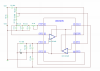
The following drawing is my copy of Bob's
snapshot27.png

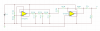
This drawing shows Changes suggested by Kris, the addition of C6 and C7, and changing R8 to 10k.
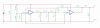
snapshot28.png

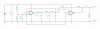
This shows my understanding of suggestions made by Bob for output frequency adjustment (replacing R3 with P1) and output voltage adjustment (replacing R7 with P2).
Am I replacing the correct resistors, are these values etc OK?
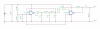
snapshot29.png
 
Last edited:

dvhenry

Jul 25, 2013
17
Joined
Jul 25, 2013
Messages
17
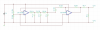
Also, as you can probably tell, I found the symbol editor, which helped even in cleaning up my drawing, a little any way.

snapshot30.png


.
 

CDRIVE

Hauling 10' pipe on a Trek Shift3
May 8, 2012
4,960
Joined
May 8, 2012
Messages
4,960
The reason you're having trouble with naming them U1A & U1B is because you're using a generic OpAmp, not the TLE2142. The TLE2142 is found on the Spice Macro tab - Operational Amplifiers - TLE2142. This is important not only for how Tina displays the component names, pinouts and such but it's imperative to run any analysis.

Also, be careful when editing the Symbol Data Base. You'd be surprised at some of the unexpected and sometimes undesirable results. If you must edit it then enter it through a right click on the component and select Edit Symbol from the drop down. Once open click on File and then Properties from the drop down. Rename the symbol MyOpAmp or whatever you like. This way if your changes causes undesirable behavior the original symbol still exists. This means that the next time you put another model of the same component on the schematic it will be the original (unedited) symbol.

Since doing the above means that any subsequent TLE2142 symbols placed on the schematic would have to be edited again you can eliminate that by copying your model directly from the schematic and pasting it back to the schematic. Doing it this way enables you to make as many copies as you like for that .TSC file. You can also open another or new .TSC and paste your symbol in there too.

Chris
 

dvhenry

Jul 25, 2013
17
Joined
Jul 25, 2013
Messages
17
My first drawings used the TLE2142 from the database and looked like this

snapshot31.png

so I used the generic op-amp symbol and edited that to get a drawing closer to Bob's, the analyze options are vast and likely for me not mostly needed, I was unable to find an option that would display output frequency.

I will keep in mind your tips for when I need to edit a symbol in the future.
I get along well with its drawing and editing methods, and importantly for me it works well run through wine in the Linux OS.

Thanks for the tips.
 

dvhenry

Jul 25, 2013
17
Joined
Jul 25, 2013
Messages
17
Getting of the subject of software and back to the project itself, does anyone have any input as to weather or not P1 is of a suitable value and correctly placed for frequency adjustments?
And the same with P2 for voltage?
Are there any other areas where making adjustments may be useful?
For example, because this will need to run 24/7 would R8 being adjustable potentially allow for better battery life?

snapshot29.png

Thanks.
 
Last edited:

BobK

Jan 5, 2010
7,682
Joined
Jan 5, 2010
Messages
7,682
Yes, those pots should work for frequency adjust and level adjust.

I have had some more thoughts about this circuit. It produces a very nice sine wave in simulation, but I am not so sure about it in the real world, it might clip if the gain of the op amp is too good ad 60 KHz. You might have to add a feedback resistor directly from the output to the - input and an input resistor between the feedback network and the - input to set the gain. Theoretically the gain needs to be 29 for it to just oscillate.

Bob
 

dvhenry

Jul 25, 2013
17
Joined
Jul 25, 2013
Messages
17
Thanks Bob,
I will order a few pots and other items I'm lacking and should be able to do some testing soon.
I will give your comments about a feedback resistor and an input resistor consideration during testing, and am likely to be back with more questions.
Thanks again.
 

BobK

Jan 5, 2010
7,682
Joined
Jan 5, 2010
Messages
7,682
Do you have a scope so we can see the output once you wire it up?

Bob
 

dvhenry

Jul 25, 2013
17
Joined
Jul 25, 2013
Messages
17
Yes, I bought a Siglent SDS 1102CNL after some searching for a cheap but reasonable basic scope. I had searched for second hand scopes but nothing in my area so freight would have brought the cost to about the same.

It seems like a nice, simple to use and accurate enough scope for anything I may want to do with it.
 

BobK

Jan 5, 2010
7,682
Joined
Jan 5, 2010
Messages
7,682
Great! I look forward to seeing it working.

Bob
 

dvhenry

Jul 25, 2013
17
Joined
Jul 25, 2013
Messages
17
An update,
I am waiting for a few capacitors to arrive before continuing.

In the mean while, my wife bought me a book from a garage sale that covers the basics, (Introductory DC/AC electronics) which has showed me just how much I had once known about amplifiers and forgotten!

The urgency of this project for me has also greatly decreased (thankfully) as my last Xrays show for the first time, a clear and obvious improvement that is backed up by the ability to use the ankle in question, (the problem turns out to be an issue with my GP,s lack of understanding and ability to convey the data from the specialist, not an acceptable situation ,and so I started conversing only with the specialist.)

I want to finish this project for three main reasons, the first is the time and effort already given by those who have helped me, the second is to justify to my wife the expense (eg. $328,AU for the oscilloscope.) the third is to increase my knowledge.

I should also state that even starting this project, even not finished, removed a major depression issue I had about months of no improvement shown on the Xrays, by this alone your help is much appreciated, now one wants to believe they have no say,or ability to change the likely outcome of an injury

Thanks to all for sticking with me on this.
 
Last edited:
Top