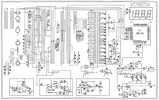
Multimeter DT-9205AA

bertus

Moderator
Nov 8, 2019
3,837
Joined
Nov 8, 2019
Messages
3,837
Hello,

This is the schematic copied from that site:

meter_dt9205a.gif

Bertus
 

bertus

Moderator
Nov 8, 2019
3,837
Joined
Nov 8, 2019
Messages
3,837
Hello,

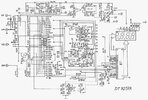
The following schematic seems to be closer:
DT9207A.jpg

Bertus
 

Bluejets

Oct 5, 2014
7,374
Joined
Oct 5, 2014
Messages
7,374
Thanks , but my problem not in measuring Amp. but not measuring AC&DC.
Note: checked c13,Q1,Q4,Q5 in circuit - measured shorted completely.checked out circuit ok and still completely shorted at thier solderig joints on circuits.I think that short from processor IC.Are those elements relative to AC& DC measuring? I have no circuit diagram.
As I said, it may or may not be the problem with voltage measurement but one thing is certain, it should NOT be cut in half.
 

Bluejets

Oct 5, 2014
7,374
Joined
Oct 5, 2014
Messages
7,374
Thats right, I'm so thankful and apprechiate yr.effort to help me but pls.try to get for DT9205AA
There are a LOT of circuit diagrams for the model you quoted.
I have no idea why other than that model has been cloned by so many ( most plausible)
Try it for yourself on a Google search.

Still think you are better of throwing the thing in the bin and forget it.
 

Harald Kapp

Moderator
Moderator
Nov 17, 2011
14,273
Joined
Nov 17, 2011
Messages
14,273
it should NOT be cut in half.
Doesn't look like "cut in half" to me:
1726808378375.png
Looks more like an intended notch to adjust the resistance for accuracy of the current measurement. There is still some metal left connecting both ends of the thick wire.
Try it for yourself on a Google search.
+1 for that. @bertus posted 2 schematics. If none of these is close to your model, find a more fitting one using your favorite search engine (by which I don't mean Bertus;)).

It doesn't read vac & vdc
Sounds more like a general problem, very likely with the IC itself. I agree with the other's comments that it is probably not worthwile trying to fix this. There are many different models all labeled DT9205. One example of a very inexpensive model is 01.22 € here.
 

73's de Edd

Aug 21, 2015
3,730
Joined
Aug 21, 2015
Messages
3,730
Sir Khamis . . .

Delta . . . .Primus . . . . Maximus
The 10A shunt . . .bare copper wire only comes into play if the meter lead is plugged into the 10A connector.
Look at the 1st 1/3 of the shunt wire . . . . . . notice the CRIMP indentation . . . in its initial manufacture . . .that basic shunt wire loop was plugged into a manufacturing test jig and its resistance was PURPOSEFULLY being slightly lower than desired.
It was monitored while progressively micro applied crimping pressure increased the wire resistance to fall into the desired resistance spec thereby an in spec shunt resistor was trimmed to its final required spec.

Meter Schematic . . . . . see if my old one . . .will fill the bill . . . (Left click mags up to 3x5 Meters )

https://maker.pro/forums/proxy.php?image=https%3A%2F%2Fi.ibb.co%2F3rBQTWQ%2FCombo-DT9205-and-A.png&hash=506be603bf3bd5ca9f26a5b9fdfddb85

Khamis . . .

What you have there is a basic 200 MV DC meter that receives its input at pin 39 of the 7106 DVM I.C. . . .via a 1 meg resistor.
As you switch between DC voltage ranges voltage divider resistors are scaling higher voltages DOWN into that range.
If you go to AC function, a precision rectifier function of an op amp converts AC to DC, to be fed into that 200MV range also.
The same is true of other functions such as the transistor HFE test and capacitance test functions that switch in dedicated function blocks hat feed into that same 200 MV input.
Look around the periphery of the schematic for those building block circuits.

What I wanna know, when AC and DC voltage testing . . . is, what numbers are showing on the display and are numbers changing ?
Try ohms function and its ranges to see if that circuitry is still working, as well as capacitance function and do a transistor HFE test as its ancillary circuitry is absolutely simplistic.

I want to guess that you crunched a diode or transistor by misuse or mis settings of the unit.
Extreme left bottom corner Q1 is suspect while . . . . . . . PTC1 thermistor is not suspect.
After your feedback . . . I would want you to check the 7106 input functionality by injection of ~ 150 MV DC into it to see if it responds accurately.

73's de Edd . . . . .

Snoring is just basically bragging that you are asleep.

.
 

Khamis

Jun 24, 2024
14
Joined
Jun 24, 2024
Messages
14
Sir Khamis . . .

Delta . . . .Primus . . . . Maximus
The 10A shunt . . .bare copper wire only comes into play if the meter lead is plugged into the 10A connector.
Look at the 1st 1/3 of the shunt wire . . . . . . notice the CRIMP indentation . . . in its initial manufacture . . .that basic shunt wire loop was plugged into a manufacturing test jig and its resistance was PURPOSEFULLY being slightly lower than desired.
It was monitored while progressively micro applied crimping pressure increased the wire resistance to fall into the desired resistance spec thereby an in spec shunt resistor was trimmed to its final required spec.

Meter Schematic . . . . . see if my old one . . .will fill the bill . . . (Left click mags up to 3x5 Meters )

https://maker.pro/forums/proxy.php?image=https%3A%2F%2Fi.ibb.co%2F3rBQTWQ%2FCombo-DT9205-and-A.png&hash=506be603bf3bd5ca9f26a5b9fdfddb85

Khamis . . .

What you have there is a basic 200 MV DC meter that receives its input at pin 39 of the 7106 DVM I.C. . . .via a 1 meg resistor.
As you switch between DC voltage ranges voltage divider resistors are scaling higher voltages DOWN into that range.
If you go to AC function, a precision rectifier function of an op amp converts AC to DC, to be fed into that 200MV range also.
The same is true of other functions such as the transistor HFE test and capacitance test functions that switch in dedicated function blocks hat feed into that same 200 MV input.
Look around the periphery of the schematic for those building block circuits.

What I wanna know, when AC and DC voltage testing . . . is, what numbers are showing on the display and are numbers changing ?
Try ohms function and its ranges to see if that circuitry is still working, as well as capacitance function and do a transistor HFE test as its ancillary circuitry is absolutely simplistic.

I want to guess that you crunched a diode or transistor by misuse or mis settings of the unit.
Extreme left bottom corner Q1 is suspect while . . . . . . . PTC1 thermistor is not suspect.
After your feedback . . . I would want you to check the 7106 input functionality by injection of ~ 150 MV DC into it to see if it responds accurately.

73's de Edd . . . . .

Snoring is just basically bragging that you are asleep.

.
Actually apprechited .
But I'd like to get explanation of tracing baths for measurments, at least for one AC range using schem. till reading at LCD
 

73's de Edd

Aug 21, 2015
3,730
Joined
Aug 21, 2015
Messages
3,730
Sir Khamis . . .

INITIALLY . . . . .

On my prior post upgrade my 10 amp shunt referencing UPWARDS to a 20 amp shunt.
ALSO . . . . .
You did not fully answer my earlier questions.
Tell me your native language . . .Thai ? Arabic ?
What are the I.C.s being used in your meter . . . . as I cannot read them from the photos.
Excepting the bottom left corners LM358 ? which is being a dual op amp, but I will also guess that the mid board 8 pin unit is being the same LM358.
I also might guess that the top 14 pin unit is being a LM324 quad op amp or CMOS HC7014 hex schmitt inverter.
As I said . . .the main portion . . . . ICL7106 Chip On Board. . . . is being a basic 200mv dc voltmeter function . . . . . all of the rest of the DVM are being dedicated function blocks that are switched into circuit and then will feed into that BASIC 200MV DC voltmeter circuitry of the ICL7106.
The input of that 7106 voltmeter circuit is being initially routed through a series R7-1 meg resistor, going into pin 31 with pin 32 as negative ground, so that resistively isolated INPUT is being almost bullet proof ! . . . . . excepting accidental direct HIGH voltage inputs !
HOWEVER there is also being a critical voltage reference that is needed by the 7106 on its pins 43 and 44.
and Q1 is involved with its B+C and E junctions acting as a "quasi" zener diode across the reference supply.
Now it also happens that Q1 is electrically located right at the very bottom of a string of divider resistors for your higher voltage scales . . . .shifting each higher voltage scale down to a 200MV DC input of the 7106

You said . . . .
Note: checked c13,Q1,Q4,Q5 in circuit - measured shorted completely.


You just read about my suspicions of Q1 and C13 must be shunting across a shorted Q1.
Q4 and Q5 are being interconnected, and also, do note the very nearby REF + - test probe points, routing on up to the 7106..
NOW ! . . . . what are the chances that you erroneously applied a billion millivolts to your meter probes with the function knob being in
. . . . . ¿ whatever position ? . . . . . and thereby, totally crunched Q1, Q4 and Q5 ? . . . . . . C13 sez " HEY! what about me ?" . . . . .well, you just might be all right . . . . . with a new Q1 having been installed. .

ADDITIONALLY . . . .
Look at the building block for transistor HFE test .
EVERYTHING is out of circuit in that test position except that exotic transistor plug in socket and a base biasing resistor pair with HFE read out as a DC reading on the 7106's 200 MV DC input.
Testing 2 NPN and 2 PNP transistors should give 4 uniformly repeatable readings if the 7106 was unaffected . . . . .NOT SO . . . . if the referencing is in error.

Thaaaaaaaasssit . . . . .

73's de Edd . . . . .


1727645812020.png

.
 
Last edited:
Top