Doctor Hufflepuff
- Feb 28, 2016
- 2
- Joined
- Feb 28, 2016
- Messages
- 2
Hello
For a project I am creating a plasma speaker complete with lights (specifically RBG LEDs) which are supposed to flash with the music. Rather than creating the speaker circuit and the three channel color organ circuit, which are well beyond my capabilities to make from scratch, I am using ones found online (http://www.instructables.com/id/LED...om/id/LED-Color-Organ-Triple-Deluxe/?ALLSTEPS and http://www.instructables.com/id/Make-a-Plasma-Globe-out-of-a-Light-Bulb/)
To make this project unique, I plan to utilize the multi-color ability of the LEDs to have two main settings: one for customizing preferred color for each of the three music frequencies (for example, setting the LEDs for low frequency to red, medium to purple, and high to blue, or any other combination), and the other for using the proportions of low, medium, and high frequencies to select the proportion of red, blue, and green in each LED, effectively playing a different color for each sound.
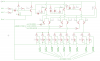
To do this I have developed the following circuit, which is essentially the color organ circuit connected to an array of voltage dividers. My question: can anyone who has experience/knowledge of how this circuit would behave tell me whether or not it will work, and does anyone have any suggestions on how to improve the design, preferably without increasing the price of components?
Notes: The switch I plan to use to alternate between modes is in the top right corner of the picture. I do not know if I need to add resistors between the switch and the TIP31 transistors I am using as electronic switches to direct the flow of power. If anyone knows, please teach me HOW to find the resistor values, as I am using this project for a learning experience as much as a fun way to pass the time.
If I left anything out please just ask. Thank you to anyone who can offer any help/input. Thanks
For a project I am creating a plasma speaker complete with lights (specifically RBG LEDs) which are supposed to flash with the music. Rather than creating the speaker circuit and the three channel color organ circuit, which are well beyond my capabilities to make from scratch, I am using ones found online (http://www.instructables.com/id/LED...om/id/LED-Color-Organ-Triple-Deluxe/?ALLSTEPS and http://www.instructables.com/id/Make-a-Plasma-Globe-out-of-a-Light-Bulb/)
To make this project unique, I plan to utilize the multi-color ability of the LEDs to have two main settings: one for customizing preferred color for each of the three music frequencies (for example, setting the LEDs for low frequency to red, medium to purple, and high to blue, or any other combination), and the other for using the proportions of low, medium, and high frequencies to select the proportion of red, blue, and green in each LED, effectively playing a different color for each sound.
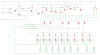
To do this I have developed the following circuit, which is essentially the color organ circuit connected to an array of voltage dividers. My question: can anyone who has experience/knowledge of how this circuit would behave tell me whether or not it will work, and does anyone have any suggestions on how to improve the design, preferably without increasing the price of components?
Notes: The switch I plan to use to alternate between modes is in the top right corner of the picture. I do not know if I need to add resistors between the switch and the TIP31 transistors I am using as electronic switches to direct the flow of power. If anyone knows, please teach me HOW to find the resistor values, as I am using this project for a learning experience as much as a fun way to pass the time.
If I left anything out please just ask. Thank you to anyone who can offer any help/input. Thanks