Oscilloscope samples/sec and memory depth parameter

Electric1

Nov 29, 2025
50
Joined
Nov 29, 2025
Messages
50
Please confirm me on the oscilloscope settings is correct or not, suppose the maximum frequency of the hall signal is 300 Hz which correspond to 1/300Hz = 3ms. As the frequency of the signal is less if i keep the oscilloscope settings to 100K samples/sec which according to me 1/100,000 = 10uS and hence it can measure any signal with width > 10uS*2. This will help to increase the memory depth, i mean storage of the signal. Is it correct? I can go well below 100kSamples / sec is it correct?
 

Delta Prime

Jul 29, 2020
2,988
Joined
Jul 29, 2020
Messages
2,988
This will help to increase the memory depth, i mean storage of the signal. Is it correct?
Yes.
I can go well below 100kSamples / sec is it correct?
Yes.
(RIGOL DHO924)too many pages just for specifications and way too long for me to(RTM) :cool:Bandwidth describes the range of frequencies you’re oscilloscopes’ analog front end can accurately measure; from the tip of your scope probe to (in your case) the input of the analog to digital converter (ADC).
It is defined as the frequency at which a sinusoidal input signal is attenuated to 70.7% of its original amplitude, which is also known as the -3 dB point. (does VRMS 0.707 ring a bell? “Pun Intended.”
Now we get into (Nyquist) you can
Look that one up.
I recommended that the bandwidth of your oscilloscope be three to five times the highest frequency component of interest in the measured signal to capture the signal with minimal amplitude error.
Now the Acquisition system of your scope; sample rate and memory depth.
If you want to save memory you want to capture just one period & that of course is application specific.
example : If your scope has 1 Mpts
“1 million points” of memory.
At 1GS/s you can only record for one millisecond.
At 100kS/s you can record for 10 seconds.
Which of course, is more memory, but you can see glitches or anomalies for capturing slow moving data protocols (like I2C & UART). Again, application specific.
 
Last edited:

Delta Prime

Jul 29, 2020
2,988
Joined
Jul 29, 2020
Messages
2,988
suppose the maximum frequency of the hall signal is 300 Hz
Never seen a hall signal.
Unless you mean a hall effect sensor or transducer that varies its output voltage in response to a magnetic field.
;)
 
Last edited:

Electric1

Nov 29, 2025
50
Joined
Nov 29, 2025
Messages
50
I have few doubts
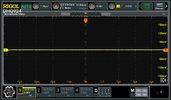
1770036675395.png
Here before T there are negative values of time (-3us, -2us, -1us, 0, 1us, 2us etc) what does it indicate?
After i changed the T position by moving the position button the time becomes positive
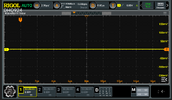
1770036777035.png
what does this indicate? which one should i set?
Also
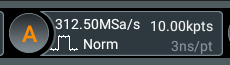
1770036839374.png
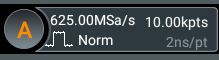
1770036860317.png
The number of points remain the same only after reducing the sampling rate further does the kpts increase why? Can you please explain? Thank you in advance for your time.
 

danadak

Feb 19, 2021
1,064
Joined
Feb 19, 2021
Messages
1,064
Here before T there are negative values of time (-3us, -2us, -1us, 0, 1us, 2us etc) what does it indicate?
After i changed the T position by moving the position button the time becomes positive

Unlike an analog scope a DSO is constantly acquiring data. When a trigger occurs a frame
of the data is captured, frame size a f(sample rate). Then scope displays the frame. Middle
of frame is trigger point, the sample where trigger occurred. So you see before and after
samples of the waveform. You ,move the time observation slider/arrow (whatever it is) on
screen and you control. relative to trigger point in fram what you see.

Now`another effect of DSO, is unlike an analog scope that shows Realtime what a trace
is doing, the DSO because of the frame/process going on has a frame update rate, these days
typically several hundred K frames/sec to low mega frames/sec. Take a look at this :


Last edited:
Top