Hi all, newb to the forum, thanks for reading my post.
I am a mild electronics hobbyist (I fix computers, Roombas, random electronics) but am certainly not a circuit designer or an electrical engineer. By trade I am an Automotive Technician (Teslas, specifically), so I think I'm pretty handy.
One of my current projects is a joint manipulation tool (pictured below)
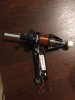
used by my chiropractor. It is surprisingly more complicated under the hood than you might initially think. It has a PCB with a hot and neutral AC wired directly to the board, with what looks like maybe 16-18 gauge wire. There is also a 10 amp fuse soldered onto the board. Due to the somewhat lackluster design of the power connections, the stress relief wasn't up to snuff and the hot lead pulled off the PCB, knocking into a 0 ohm resistor on its way out. I managed to re-solder the resistor to the board and ran some new wire for the hot. The ground is fine. I did my best to engineer a new stress relief with the limited space available, using some hot glue and kinking the wires to make sure any tugging on the cable was pulling against the dried glue and not the PCB. That worked out great, except that I spliced the new wires to the old cable with poor technique and the solder joints failed. I could put it back together with an ugly bulge under the insulation with some crimp-solder connectors, but I said to myself if I have to go back into this device, I'm going to re-engineer the power input with some kind of threaded detachable connection, like this - http://www.in2connect.uk.com/st12_ip67_threaded_coupling.html

The problem is, and excuse my total newb-ness, everything I find like this is rated for DC applications, the only stuff that mentions AC applications is all IEC (like this)
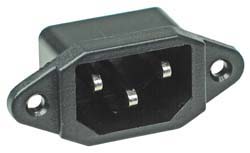 or mounts for "Cheater cords" like you'd find on the back of your PS2/PS3 or stereo with built-in PSU.
My requirements are fairly straight-forward. The profile of the female connection can't exceed 15-18mm square into the tool. 20mm would be pushing it. I only need 2 pole, as this is an ungrounded AC circuit. The power rating should be at least 10A / 120V. I doubt this tool draws more than a few amps max, though it is fused for 10.
So, what do you guys think? Can I use any old connector from Frys / Radio Shack / any electronics supplier online as long as it gets close to my needs?
Thanks!
I am a mild electronics hobbyist (I fix computers, Roombas, random electronics) but am certainly not a circuit designer or an electrical engineer. By trade I am an Automotive Technician (Teslas, specifically), so I think I'm pretty handy.
One of my current projects is a joint manipulation tool (pictured below)
used by my chiropractor. It is surprisingly more complicated under the hood than you might initially think. It has a PCB with a hot and neutral AC wired directly to the board, with what looks like maybe 16-18 gauge wire. There is also a 10 amp fuse soldered onto the board. Due to the somewhat lackluster design of the power connections, the stress relief wasn't up to snuff and the hot lead pulled off the PCB, knocking into a 0 ohm resistor on its way out. I managed to re-solder the resistor to the board and ran some new wire for the hot. The ground is fine. I did my best to engineer a new stress relief with the limited space available, using some hot glue and kinking the wires to make sure any tugging on the cable was pulling against the dried glue and not the PCB. That worked out great, except that I spliced the new wires to the old cable with poor technique and the solder joints failed. I could put it back together with an ugly bulge under the insulation with some crimp-solder connectors, but I said to myself if I have to go back into this device, I'm going to re-engineer the power input with some kind of threaded detachable connection, like this - http://www.in2connect.uk.com/st12_ip67_threaded_coupling.html
The problem is, and excuse my total newb-ness, everything I find like this is rated for DC applications, the only stuff that mentions AC applications is all IEC (like this)
My requirements are fairly straight-forward. The profile of the female connection can't exceed 15-18mm square into the tool. 20mm would be pushing it. I only need 2 pole, as this is an ungrounded AC circuit. The power rating should be at least 10A / 120V. I doubt this tool draws more than a few amps max, though it is fused for 10.
So, what do you guys think? Can I use any old connector from Frys / Radio Shack / any electronics supplier online as long as it gets close to my needs?
Thanks!


