Power Relay needed

jngtt

Jul 14, 2016
15
Joined
Jul 14, 2016
Messages
15
Hi guys,

I have a problem which i need to make a relay which turns on (close the circuit) to a LED when the VDC is over 1.5 VDC.
When the voltage falls below 1.5 VDC, it turns off the LED. The max VDC that will be going though the circuit will be 28VDC.

Please let me know if there are any relays that does this or is there a way to program a micro controllers to handle it.

Thank you very much guys.
 

Alec_t

Jul 7, 2015
3,817
Joined
Jul 7, 2015
Messages
3,817
Welcome to EP!
Depending on the LED spec, it may be easier/cheaper to use a transistor instead of a relay to turn on the LED.
How accurate does the '1.5V' really need to be?
It would be very simple to use a transistor plus diode to have a 1.2V (approximately) threshold instead of 1.5V.
 

jngtt

Jul 14, 2016
15
Joined
Jul 14, 2016
Messages
15
Welcome to EP!
Depending on the LED spec, it may be easier/cheaper to use a transistor instead of a relay to turn on the LED.
How accurate does the '1.5V' really need to be?
It would be very simple to use a transistor plus diode to have a 1.2V threshold instead of 1.5V.
It needs to be on 1.5 VDC and below to turn off the LED
 

Alec_t

Jul 7, 2015
3,817
Joined
Jul 7, 2015
Messages
3,817
How much tolerance on the 1.5V? 10%? 1%? 0.001%? ......
What is the LED spec?
 

jngtt

Jul 14, 2016
15
Joined
Jul 14, 2016
Messages
15
How much tolerance on the 1.5V? 10%? 1%? 0.001%? ......
What is the LED spec?
For the tolerance, I would like it to be as low as possible,
The LED specs have not been picked out yet but I will be looking for one that can withstand 28VDC.
 

Bluejets

Oct 5, 2014
7,374
Joined
Oct 5, 2014
Messages
7,374
Most LED's need at least 1.5v to turn on.(1.7v standard red LED)
Are you powering the drive to the LED from another supply?
 

Alec_t

Jul 7, 2015
3,817
Joined
Jul 7, 2015
Messages
3,817
For the tolerance, I would like it to be as low as possible,
Why?
That will require at least a precision voltage reference and a precision comparator. VDC would need to be extremely stable, so that LED current doesn't pull it down, otherwise the circuit would go into oscillation. What is your budget for this?
 

jngtt

Jul 14, 2016
15
Joined
Jul 14, 2016
Messages
15
Most LED's need at least 1.5v to turn on.(1.7v standard red LED)
Are you powering the drive to the LED from another supply?
No I will be just using the same power.

Why?
That will require at least a precision voltage reference and a precision comparator. VDC would need to be extremely stable, so that LED current doesn't pull it down, otherwise the circuit would go into oscillation. What is your budget for this?

Well the budget is around 150 US dollars. Its for an aviation testing circuit.
 

jngtt

Jul 14, 2016
15
Joined
Jul 14, 2016
Messages
15
All I am trying to do is to turn a LED on when the voltage is above 1.5VDC. When it falls on 1.5 VDC and lower, the LED will turn off.

The range of the Voltage will be 0 to 28 VDC.

The reason I need the tolerance to be low as possible, is to be accurate as much as possible.
 

Alec_t

Jul 7, 2015
3,817
Joined
Jul 7, 2015
Messages
3,817
The reason I need the tolerance to be low as possible, is to be accurate as much as possible.
That's obviously desirable, but the method used will depend on the allowable tolerance. Give us a number to work with.
 

BobK

Jan 5, 2010
7,682
Joined
Jan 5, 2010
Messages
7,682
Most LEDs will not light up at 1.5V. What color is the LED? Hopefully red, they are the lowest, but typically they still need about 1.8 to 2.0V. You might need something like a Joule Thief to get it to run reliably at 1.5V.

Then you have the problem of comparing the voltage. A standard comparator will not operate at 1.5V.

Is it a strict requirement that the LED and associated circuitry run off the input voltage? Everything is a lot simpler if it does not.

Bob
 

jngtt

Jul 14, 2016
15
Joined
Jul 14, 2016
Messages
15
Is it a strict requirement that the LED and associated circuitry run off the input voltage?

Bob
Yes, Because there are no other power source. In other words, it is just an indicator conditioning circuitry.

All i need is when the voltage drops 1.5 VDC, the LED turns off. That's it. But like you mention, some leds do not work under 1.5 VDC, but can they handle 28 VDC?

Sorry, I am a bit new to circuits.
 

Sunnysky

Jul 15, 2016
573
Joined
Jul 15, 2016
Messages
573
When you define that it must be self powered and the lack of indication implies power failure, and you want high accuracy, with LED indication at a voltage above 1.5V which is below where LEDs turn on bright, you must realize you have defined a very restrictive set of requirements.

For $150 you can include a battery yes?
Then the solution is a trivial, LDO+ comparator to drive any LED and costs $5
 

Bluejets

Oct 5, 2014
7,374
Joined
Oct 5, 2014
Messages
7,374
Most LEDs will not light up at 1.5V. What color is the LED? Hopefully red, they are the lowest, but typically they still need about 1.8 to 2.0V. You might need something like a Joule Thief to get it to run reliably at 1.5V.

Then you have the problem of comparing the voltage. A standard comparator will not operate at 1.5V.

Is it a strict requirement that the LED and associated circuitry run off the input voltage? Everything is a lot simpler if it does not.

Bob
I hope the penny drops for the Op soon Bob.o_O
 

Alec_t

Jul 7, 2015
3,817
Joined
Jul 7, 2015
Messages
3,817
If the tester is intended as a portable one, not permanently connected to the DUT, do yourself a favour and spend some of your budget on a PP3 battery. Then you can build this for ~5$ :) :-
1V5-switch.JPG
If you insist on having no external voltage source then, as mentioned above, a Joule thief circuit could be used to derive a supply of several volts for powering a tester.
 

jngtt

Jul 14, 2016
15
Joined
Jul 14, 2016
Messages
15
If the tester is intended as a portable one, not permanently connected to the DUT, do yourself a favour and spend some of your budget on a PP3 battery. Then you can build this for ~5$ :) :-
View attachment 27982
If you insist on having no external voltage source then, as mentioned above, a Joule thief circuit could be used to derive a supply of several volts for powering a tester.

Your circuit can work but would love to have the circuit without additional battery so it can become maintenance free.

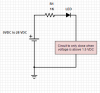
I have inserted a diagram on what i want to do and in the box were the note is, i would like to have the relay or transistor to do the switching off when it falls below 1.5VDC.

upload_2016-7-19_9-36-10.png
Sorry i didnt add the image earlier.
It should be simple right?

John
 

Sunnysky

Jul 15, 2016
573
Joined
Jul 15, 2016
Messages
573
Your circuit can work but would love to have the circuit without additional battery so it can become maintenance free.

I have inserted a diagram on what i want to do and in the box were the note is, i would like to have the relay or transistor to do the switching off when it falls below 1.5VDC.

View attachment 27985
Sorry i didnt add the image earlier.
It should be simple right?

John
You dont seem to understand what I've told you.
An Ultrabright Red LED needs 2V, (the old GaAs dim red 1.8)
This means it goes out below 1.8V or barely visible

Your circuit exceeds the recommended 20mA above 22V
Do you understand Ohm's Law?
 

jngtt

Jul 14, 2016
15
Joined
Jul 14, 2016
Messages
15
You dont seem to understand what I've told you.
An Ultrabright Red LED needs 2V, (the old GaAs dim red 1.8)
This means it goes out below 1.8V or barely visible

But i need it to go out at 1.5V not 1.8V
 
Top