problem with a rectifier

shekhar_dandya

Jun 18, 2004
136
Joined
Jun 18, 2004
Messages
136
Hi All,
A Happy 2005.
I recently made a small adjustable power supply with a voltage range from 3V to 24V and a current range of 1A using the rectifier-filter-LM317 combination.
I tested its outpput on a multimeter with its knob on"DC V" and it showed me the correct voltages.Then I turned the knob on "AC V" and found that it showed me an ac voltage of 56V! at the o/p of LM317.It also shows some 11V DC at the o/p of secondary (Knob kept on DC V) and a 71V AC at the filter(Knob kept on AC V).

Should'nt the o/p of LM317 show 0V AC or atmost a few mV AC(The ripple)?
Why am I getting a DC voltage at the o/p of secondary?despite the "AC V" shows the correct RMS value of 24V(RMS secondary).
Due to lack of a CRO I cannot view the waveforms and have to rely on my DMM.is it faulty?It is not a true RMS meter.I guess it is directly coupled inside for ac voltages.

I have used a capacitor of 3300uF and tests are carried out in no load condition.Is this making any difference?maybe the cap is not discharged?

Thanks
-Shekhar


ante1

Jan 24, 2004
4,138
Joined
Jan 24, 2004
Messages
4,138
Hi shekhar,
A happy 2005 to you too.

This can be noise, sometimes it can be cured by adding 10nF cap over each of the rectifier diodes.

 
A

Alun

Jan 1, 1970
0
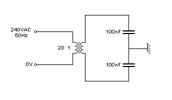
This could be some voltage getting through the interwinding capacitance of the mains transformer, try earth bonding the output, or you could connect a 100nf capacitor to protective earth on either side of the secondary on the mains transformer.

I've had a similar problem before when I used an antique mains transformer, I held one leg of a neon lamp and connect the other to the transformer and it glowed dimly. I connected all of the windings to earth via capacitors and bingo

x-former.GIF


surajbarkale

Aug 5, 2004
256
Joined
Aug 5, 2004
Messages
256
Check your multimeter. If you are measuring DC voltage on AC range some multimeters display double the value (this was true with older analog ones). While measuring AC ripple put a 0.1uF cap in series with probes.


shekhar_dandya

Jun 18, 2004
136
Joined
Jun 18, 2004
Messages
136
Hi Alun,
I am trying to solve the problem as you told in the image.But by mistake I bought 100uF caps.could they help or should I strictly connect 100nF caps?
Exactly what is the theory behind earthing the interwinding capacitance?how about using resistors instead of caps?do the caps form a certain kind of tuning circuit with the secondary windings?If so what effect does it have at 50 Hz?
-Shekhar


ante1

Jan 24, 2004
4,138
Joined
Jan 24, 2004
Messages
4,138
Hi shekhar,

I must advice against using the 100uF caps.

 
Y

Yevgenip

Jan 1, 1970
0
Why not? An explenation would make your suggestion much more reliable.

Not that I should doubt your suggestions... ;D


ante1

Jan 24, 2004
4,138
Joined
Jan 24, 2004
Messages
4,138
Hi Yevgeni,

Yes you are correct:
With a high value like this (100uF) they will conduct, get very hot and be destroyed! (blow up)!

 
A

Alun

Jan 1, 1970
0
Hi Alun,
I am trying to solve the problem as you told in the image.But by mistake I bought 100uF caps.could they help or should I strictly connect 100nF caps?
The value isn't critical, I would suggest trying anything between 10nf and 1
 
Last edited:

ante1

Jan 24, 2004
4,138
Joined
Jan 24, 2004
Messages
4,138
Hi Alun,

There is a big difference between 100nF and 100uF and I suspect that they are electrolytic caps. A current will flow through these caps at 50Hz and you state that the value is not critical well I think it is. 8)

 
A

Alun

Jan 1, 1970
0
Ante,
I mean non-critical in that they don't have to be exactly 100nf. I did mention that 100

 
Last edited:

shekhar_dandya

Jun 18, 2004
136
Joined
Jun 18, 2004
Messages
136
Hi Guys again,
This time I checked the o/p of my 317 by keeping the DMM knob on
'AC -V'. WHen I connect positive of DMM to positive supply terminal and -ve to ground,I see 29V AC(RMS?).When I reverse the connections(+ve t o ground & -ve to +ve) my DMM shows 0V! what exactly is the nature of this voltage and why is it affecting?
Thanks,
Shekhar

 
A

Alun

Jan 1, 1970
0
I can't think of any reason as to why a DMM on the AC setting will read 29V when connected up one way and 0V when connected up the other.

Are you sure its set to AC?

The switch might be broken?

Even if its set to DC it shroud read +29V one way and -29V the other.

Try using a different meter.

29V could be caused by any of the following:

Connect a load to the output, i don't know about the LM317 but some regulators require a minimum load to operate in the correct manner, use a light bulb or even a 1K resistor, then measure the output voltage.

The RMS output of the transformer off load could be around 29V. Maybe one or more of the diodes in the bridge rectifier is conducting in both directions, if this is the case the regulator would fail and possibly output AC, the filter capacitor will get very hot and explode. But the filter capacitors are still intact I don't think this is the case.

If the adj pin becomes disconnected:
24*1.4-3 = 29.5V
where 1.4 is the 2 diode drops and 3 the the regulator drop-out voltage.
Continuity check all of the connections with a DMM, also check all the diodes.

Did you try out any of our suggestions?

It could be possible that when the transformer was capacitively coupling the AC mains to the secondary it damaged the regulator. The voltage between the adj and output pins should always be about 1.2V when the power is applied, try replacing it,

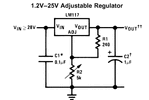
The regulator part of the circuit should look something like the circuit below taken from the LM317 data sheet.

Reg.GIF


shekhar_dandya

Jun 18, 2004
136
Joined
Jun 18, 2004
Messages
136
Hi everyone,
Well I did not require to use caps to earth for secondary.Its not showing any dc voltage now.But at the o/p I still get 6V ac when dc o/p is 3V and 56V ac when dc o/p is 25V(both no load.).Also the conditions did not improove with a load of 330 ohm resistor as a load.
when the DMM connections are reversed(i.e +ve lead to -ve of 317 and -ve lead to +ve of 317)I am still getting 0V.
(Whereas I expect at least a -ve voltage).Can this be due to bad soldering? My soldering is horrible.I don't have a
scanner to show you people.
The dc voltage between o/p and adj pins is 1.25Vdc.When measured with DMM knob kept on ac it reads 2.2V.Again,with the DMM leads polarity reversed it reads 0V.
The dc o/p at the i/p of 317 ie across the filter capacitor is 31Vdc.when measured with knob kept on ac it reads almost 68V.
Again the same thing ,you reverse the connections and it reads 0V.

Somewhere in the ongoing thread Suraj said :

Check your multimeter. If you are measuring DC voltage on AC range some multimeters display double the Value (this was true with older analog ones).
.COuld this be the case with DMM's?


Help needed.
Thanks
-Shekhar
 

Kevin Weddle

Feb 23, 2004
1,620
Joined
Feb 23, 2004
Messages
1,620
Typically you will have large ripple if the diodes don't produce enough impedance. Try using larger diodes and you will get less ripple. Then you should have a stable DC to run the lm317. It also sounds like you have turned the lm317 into a voltage follower. This happens if you hook the regulator up wrong. I have experienced this phenomenon with linear regulators. The reason I accidentally hooked it up wrong is because the TO-3 package pinout was unavailable over the internet. And coincidentally, I think I actually destroyed the regulator by hooking it up wrong. I could not be sure of this, so I ordered more regulators because I felt I had received bad parts. To this day I could not tell you what the pinout is for the 7912, but I did get it working.


shekhar_dandya

Jun 18, 2004
136
Joined
Jun 18, 2004
Messages
136
Hi Kevin,
I am using a TO 220 package and have connected pins properly.
I have no problems with d.c.
How does 317 ener voltage follower mode ?
I have used a 240 ohm resistor from o/p tp adj and a 330ohm in series with a pot of 4.2K from adj to ground.I have also pput a 10uF cap at the o/p to reduce the ripple.
Can I just neglect this thing happening for practical applications?
I heard that people making adapters(ac-dc converters) do not bother to use a regulator as well.
Am I expecting too much from my cheap circuit?
more help needed.
-Shekhar


audioguru2

Apr 6, 2004
12,026
Joined
Apr 6, 2004
Messages
12,026
Kevin,
The size and impedance of the rectifier diodes don't affect the ripple. The size (value) of the filter cap and amount of load current affect the ripple. ::)

Hi Shekhar,
Maybe you have a high-power radio or TV transmitter nearby that is picked-up by your wiring and showing on your DMM.
If not, then your DMM is behaving strangely, try another meter.

Why is your soldering horrible? Aren't you using "electronic" SN63/PB37 rosin-cored solder? Don't you keep your soldering iron's tip tinned and while it is hot, wipe it to clean it on a wet sponge?

If your circuit needs voltage regulation, use a regulator, it should operate perfectly. The DC output voltage from unregulated AC-DC adapters changes a lot when their load current is changed.

 
Top