Program launch: "Get Paid to Publish your Project!"

mixos1

Administrator
Jul 13, 2003
581
Joined
Jul 13, 2003
Messages
581
Get Paid to Publish your Project!

We are proud to announce the "Get Paid to Publish your Project" program here at Electronics-Lab.com. Every project published under project section will get an instant PayPal payment of 80$ USD.

steps.png


Get ready to submit your project at Electronics-Lab. To participate send your project to webmaster @ electronics-lab.com with "Get Paid to Publish your Project" in subject line and your project as attachment. Common file types (.doc, .jpg, .pdf etc) are accepted. After reviewing your project and approved for publication it will be published under project section and you receive the payment to your PayPal account. So simple!

A project to be valid should be:
- A high quality project.
- Designed by you.
- Not published elsewhere on the web.
- Has clear schematics, photos, description and PCB.

Every project approved will be published and will receive the payment. You will notified by email if your project is accepted.

If you have any questions, don't hesitate to contact us

Check submitted projects here

 
Last edited by a moderator:

Hero999

Oct 28, 2007
2,433
Joined
Oct 28, 2007
Messages
2,433
$80 dosen't sound much for a project, multiply it by ten and I might be interested.

What about quality control? I notice that there are many projects on this site which contain errors. How are you going to ensure that this doesn't happen again?


indulis

Nov 21, 2005
488
Joined
Nov 21, 2005
Messages
488
To Hero999's point, the first project (Temp data logger)...

It says:

1. GP0 (Pin 7, I/P): This pin will be used to read the temperature value from DS1820 sensor
Pin 7 in the schematic is hard wired to +5V... how is that going to work?? Or is it just to early in the morning and I need more coffee?
 

Hero999

Oct 28, 2007
2,433
Joined
Oct 28, 2007
Messages
2,433
I agree, it seems like no one is checking the projects, a capacitor is also connected upside down, you don't have to be an expert to see that.

There again, what do you expect when you're only paying someone $80 to design a project for you? You can't expect people to sell their best designs at that price.

If you think I'm being harsh, there's a thread about it on another forum I visit.
http://www.eevblog.com/forum/index.php?topic=1153.0

 
Last edited by a moderator:

mojo_chan

Sep 1, 2010
6
Joined
Sep 1, 2010
Messages
6
What is the deal with not publishing elsewhere? Say I wanted to put it on my personal web site at a later date... How long are we talking? Forever? A couple of months?

I would like to submit some projects but ultimately they will all end up on my personal site. I don't mind delaying them and they meet the criteria.


audioguru2

Apr 6, 2004
12,026
Joined
Apr 6, 2004
Messages
12,026
It is a "gentleman's agreement" that you will not publish your project elesewhere.
It will be too expensive to sue you if you break the agreement but you will probably be banned from here.

I submitted a few projects here when there was a contest. I did not win but it doesn't matter because I am happy that my projects were useful for other people.

Other websites copy projects. Some of the copied projects do not work.


Hero999

Oct 28, 2007
2,433
Joined
Oct 28, 2007
Messages
2,433
The exact wording is "Not published elsewhere on the web." but it doesn't say that you can't put it on your own site after it's published here.

I've noticed the same error in another project by the same author.

The 10

 
Last edited by a moderator:

Hero999

Oct 28, 2007
2,433
Joined
Oct 28, 2007
Messages
2,433
I can't confirm either way, it was not my idea.

I think you should send mixos a private message.

EDIT:
Don't worry, I've sent him a private message asking the same question.

 
Last edited by a moderator:

loveuc

Aug 31, 2010
4
Joined
Aug 31, 2010
Messages
4
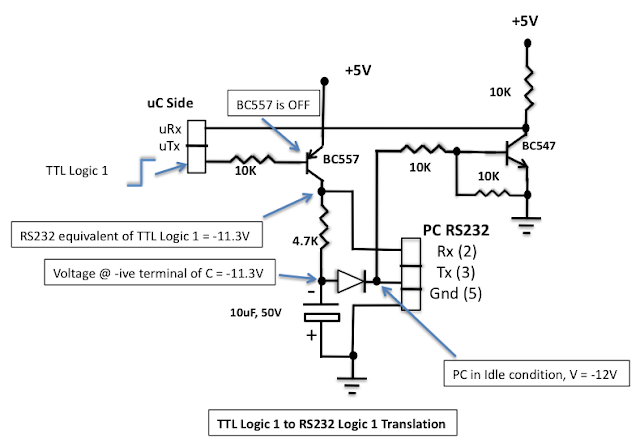
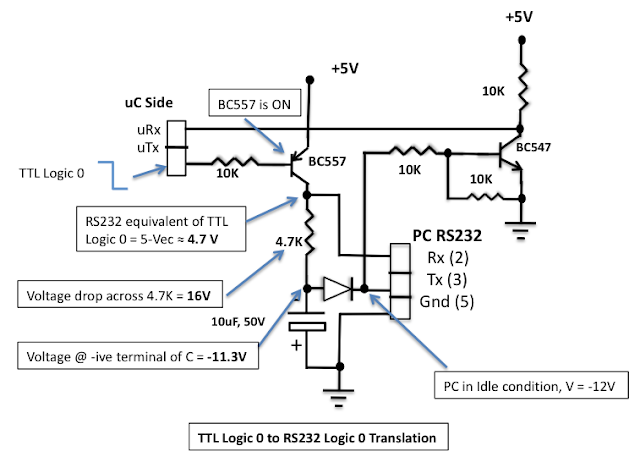
I am seeing few people commenting on the polarity of two capacitors that are used in two of my projects posted here, namely Learning board for PIC12F683 and Single chip temperature logger.  Both are 10uF, 50V capacitors and are used in TTL to RS232 Level shifting sections of my projects. It seems like they are connected upside down, but that's not true.

In order to translate TTL logic '1' (which is 5V) to RS232 logic '1' (which is -3 to -12V), I need negative voltage supply. Since I don't have one on my board, I am stealing it from the TX pin of PC RS232 port. At idle condition (when PC is not transmitting), the TX pin is at logic '1', i.e., at -3 to -12V. I am taking that negative voltage and feeding it back to its RX pin through a 4.7K resistor. So the +ive terminal of the capacitor is grounded, and the -ive terminal is connected to negative voltage supply, which is a proper way to connect a capacitor.

The pictures attached here describe how this works exactly.
Picture+2.png


Picture+3.png

And, when the PC is transmitting, the reverse biased diode connected between the TX and -ive terminal of the capacitance protect  it from charging in opposite direction. I didn't mention all these details in the project because I thought it would be too much to put on a hobbyist corner. I hope this answered why the capacitance is connected the way it is.

Thanks.
Raj

View attachment 41151

View attachment 41152


Hero999

Oct 28, 2007
2,433
Joined
Oct 28, 2007
Messages
2,433
You're right, thanks for signing up and offering an explanation.

I didn't understand how it worked but now you've explained it properly I get it.

I'm glad to see that the web master has changed it back.

I'm sorry about making the mistake but it actually further proves my point: if a design is not subject to a proper peer review, then it can easily contain errors. Just having one or two people review the circuit before it gets published is not good enough. We need to discuss new designs first, as we're doing here so we can iron out any errors before they are published.

There were some other changes I made to the schematic which I feel would make it work more reliably which have now been put reverted. I'll repost them and if you agree, I'll ask the web master to change it.

1) There should be no need for a resistor in series with the piezo buzzer, it's a high impedance device so there shouldn't be any need to limit the current. Was it just to loud and you needed to reduce the volume? If so I think you could offer an explanation,

2) Is it a piezo buzzer with a built in oscillator or just a piezo speaker which needs a squarewave to work?

3) It will probably work with 4k7 but the transistor will run cooler with a 470R base resistor because the saturation voltage will be lower.

4) Again, it might work without a 100nF capcitor in parallel with the PIC but it's always good design practise to include one.,

5) The minimum operating voltage for the LM7805 is 7V, below that it will fail to regulate and the output will fall, so that should be 7V to 12V not 6V to 12V. Source: datasheet http://www.fairchildsemi.com/ds/LM/LM7805.pdf

I have another question about the other project you've posted.
http://www.electronics-lab.com/projects/test/012/index.html

The circuit is powered from three 1.5V batteries so shouldn't the power supply voltage be 4.5V, not 5V?

Have you also checked that the temperature sensor gives accurate enough readings as the battery voltage drops?

The data sheet specifies an accuracy of 0.5

View attachment 41153


H3LIO

Sep 21, 2010
9
Joined
Sep 21, 2010
Messages
9
In my project PWM fan controller, I'm seeing people complain because my choose of components.

I use a LM358 because it's a general purpose Am-pop, probably it's a common component most off us have. The typ SR of LM358 it's 0.6 V/


Hero999

Oct 28, 2007
2,433
Joined
Oct 28, 2007
Messages
2,433
I use a LM358 because it's a general purpose Am-pop, probably it's a common component most off us have. The typ SR of LM358 it's 0.6 V/
 

loveuc

Aug 31, 2010
4
Joined
Aug 31, 2010
Messages
4
Hero999,
I am sorry I was quite busy in past couple of days, so could not respond you. I liked the changes you made in the PIC12F683 board circuit. The piezo that I used requires square waves to create sound and the series resistor is unnecessary. The decoupling capacitor is a good practice, I forgot that. The input to LM7805 should be 7-12V, that was my mistake. You are welcome to post the revised version of the circuit and I appreciate for doing this.

About my data logger project, I am going to test few things with it this weekend and will ask the administrator to update on website, if required.

At last, I also agree with the fact that peer review is important for a good design, but this advertisement asks us to submit the projects that we have already designed and built. Some of them may have some design issues because not all of them were designed by professionals. The three projects I submitted were lying somewhere at the corner of my room for a while. I thought, in this recession, if I can make some extra money by selling them here, then why not, I would buy few more components for my future projects. That was my motivation. And let me tell you one more thing, a good quality, error free, peer reviewed, and purposed to sell project would worth more than $80, and you know that.

Thanks,
Raj

(I hope you didn't mind calling you Hero999 as that's the only name I know of you)


Hero999

Oct 28, 2007
2,433
Joined
Oct 28, 2007
Messages
2,433
At last, I also agree with the fact that peer review is important for a good design, but this advertisement asks us to submit the projects that we have already designed and built.
Yes I know and it also says it can't be published anywhere else on the Internet so it's not possible to get a peer review until it's published here.

Some of them may have some design issues because not all of them were designed by professionals. The three projects I submitted were lying somewhere at the corner of my room for a while. I thought, in this recession, if I can make some extra money by selling them here, then why not, I would buy few more components for my future projects. That was my motivation. And let me tell you one more thing, a good quality, error free, peer reviewed, and purposed to sell project would worth more than $80, and you know that.
Yes I agree.

I've attached the final version with all of my red pen removed.

I have one more suggestion: perhaps a more common transistor could be suggested if they are unable to find the S8050? I've added the BC338 which is pretty popular.

I'll make some changes, post them on the forum and if you or anyone else thinks I've made a mistake they can let me know. Once we've finalised the design, I'll email it to the webmaster and he can update it.

Hi, IView attachment 41157

View attachment 41158
 
Last edited by a moderator:

H3LIO

Sep 21, 2010
9
Joined
Sep 21, 2010
Messages
9
Thanks Hero999, I will try this weekend or next week and then I will let you know how it works.

I'm attaching the code some part of the code is comment because  I'm testing a few things. the code is in basic.


H

PWM.txt


Attachments

  • PWM.txt
    3.6 KB · Views: 2

Hero999

Oct 28, 2007
2,433
Joined
Oct 28, 2007
Messages
2,433
Thanks for that.

I think all projects containing programmable devices published on this site should have source code; not much can be learnt from a hex file, except disassembly, which is not easy.


bogdanfirst

Sep 28, 2010
4
Joined
Sep 28, 2010
Messages
4
I intend to send a project for publishing, and I've got a couple of questions:

1. As the project will also be published on my personal site, it sometimes gets mentioned on other websites. I've had projects mentioned, for example, on the Electronics Lab blog, or other sites such as Hack a day. Is that acceptable, considering that I did not submit my project to the respective sites?

2. If the project is published on Electronics Lab and i get paid, does electronics lab have any rights upon my project, or does it remain my intellectual property?

3. When can I publish the project on the personal site? Is there any restriction such as that it has to be published after electronics- lab ?

 
Top