Re: Alun's low voltage alarm

audioguru2

Apr 6, 2004
12,026
Joined
Apr 6, 2004
Messages
12,026
Hi Alun,
I'm glad that you are learning here. 8)
You have a very good idea to use the sagging supply voltage to help with hysteresis. I keep thinking of circuits with a regulated supply, but this application uses a non-regulated battery supply.
Circuits with slowly changing inputs that use comparators almost always oscillate at a high frequency as they go through their linear region. Hysteresis fixes it as explained in the datasheet for the LM393 in the link you posted.

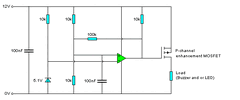
View attachment 36750

 
Last edited by a moderator:
A

Alun

Jan 1, 1970
0
Yes, with an unregulated supply you get feedback in the form of a voltage change when the load changes. With a low voltage alarm you get negative feedback from the power supply which increases the stablity and reduces oscillation. But with a low voltage cutout you have positive feedback from the supply which causes instability and oscillation.

A regulated supply uses DC voltage amplifier with negative feedback to stableise the supply, thus the supply voltage no longer changes with the load so feedback from the supply is removed. Adding a feedback resistor to introduce more negative feedback either way because it will make it less senertive to other loads, ie if a light is turned on it will cause a voltage drop and the increased will prevent it from triggering the circuit. Aldo I would recommend adding a 100nf capacitor from the + pin to ground to further reduce the noise.


audioguru2

Apr 6, 2004
12,026
Joined
Apr 6, 2004
Messages
12,026
Hi Alun,
Yes, I completely forgot about the project's missing very important supply bypass cap.  ;D

 
A

Alun

Jan 1, 1970
0
Yes I agree a power supply bypass capacitor will help but I ment adding one accross the potential divider would help reduce noise even more.

Low_Volt_alarm.GIF


audioguru2

Apr 6, 2004
12,026
Joined
Apr 6, 2004
Messages
12,026
Hi Alun,
Your schematic is much better now, except:
I think that the cap at the divider spoils the hysteresis. :eek:

 
A

Alun

Jan 1, 1970
0
A capacitor will have no affect at DC or slowly changing power supply voltages but at high frequencies the capacitor will form an RC filter with the potential divider and the circuit won't react. This is usefull because if a load like an audio amplifier or DC motor draws a varying current an AC voltage will appear on the power suplly line, and the circuit will ignore this AC voltage and won't falsely trigger.


audioguru2

Apr 6, 2004
12,026
Joined
Apr 6, 2004
Messages
12,026
Hi Alun,
Picture the non-inverting input at the moment of switching, with and without a capacitor there. Without the capacitor it has positive feedback for a quick "snap" action.

 
A

Alun

Jan 1, 1970
0
And with the capacitor the voltage on this non-inverting input will alter more slowly but as it has a very high gain the output will still saturate quickly enough. I still don't see how this makes a difference.


audioguru2

Apr 6, 2004
12,026
Joined
Apr 6, 2004
Messages
12,026
Hi Alun,
For an opamp that switches fairly slowly, the capacitor probably won't make much difference. But for a high-speed comparator that oscillates when linear, you need it to switch with the positive feedback as quickly as it can.
You can still filter noise from the supply by making the upper resistor of the divider two resistors and adding the filtering at their junction.  8)

 
A

Alun

Jan 1, 1970
0
Well Iv'e done a simulation and the capacitor dosen't affect it much except for high frequencies. But you might be better off just useing two resistors and adding a capacitor in paralell with one as you said for  stability.


audioguru2

Apr 6, 2004
12,026
Joined
Apr 6, 2004
Messages
12,026
Wait a minute, Alun. We're not finished discussing it yet!

 
Last edited by a moderator:
A

Alun

Jan 1, 1970
0
audioguru said:
Wait a minute, Alun. We're not finished discussing it yet!  :eek:

How about using an ordinary, cheap 741 opamp, with its pinout shown on the schematic.
Your choice of an all-Cmos opamp would probably (its datasheet doesn't spec output current with less than a 15V supply) limit its output current with a 12V or less supply.
I don't think a 741 opamp would need a Mosfet to drive a little relay and LED (but even a 741 opamp doesn't spec its output current with less than a 30V supply). Due to this question about output current, use half of an LM358 dual opamp.
I don't know about output currents, I mentioned the cmos op-amp because of it's rail to rail swing. What about the affect of loading the opamp? Woundn't this affect the hysteresis?

What bout useing a bipolar PNP transistor to drive a relay? I thought of a FET because it won't load the op-amp but bipolar transistors are cheaper, but you would need to connect a couple of diodes or a potential divider to ensure it turns off properly because some op-amps might not bring the base up close to  +V.

The resistor powering the 20mA zener diode should be changed to 300 ohms when using a 12V supply, or a 5mA BZX79C6v2 zener diode could be used with the existing 1K resistor.
A revised parts list is also required and a corrected note about its range of adjustment.
Or you could go for a proper voltage reference?

I would use a 1M feedback resistor for about only 30mV of hysteresis, instead of your 100K resistor providing a whopping 292mV of hysteresis, plus a percentage of how much the battery voltage drops when the relay loads it down.  ;D
30mV sounds a bit small to me. ;D

Can't the output from a zener diode change by more than 30mV by varying the current through it and teperature changes?

Doesn't this depend also on the nature of the load and power supply?

An amplifeir run from a lead acid battery coud cause the voltage to alter by more than 30mV, so could a moter in a small power tool, and both of these devices could superimpose an AC waveform >30mV on the supply.
 

audioguru2

Apr 6, 2004
12,026
Joined
Apr 6, 2004
Messages
12,026
Hi Alun,
This topic got moved and only its best parts were deleted!
Did you notice that your fix for the original project got hijacked?  :eek:
Let's watch and see if the project's schematic is corrected with it. It is too bad that it uses an open collector comparator instead of an opamp so it can't easily have just a single resistor added for hysteresis.

Don't forget that the original project has a low-current piezo buzzer and LED for a load, not a relay. So I think that an ordinary opamp is fine.

In their LM393 datasheet, National Semi recommends hysteresis of only a few mV, my recommended 30mV is more to make certain and your 300mV is much too high.

A 6V zener operating at its tested current is actually a pretty good voltage regulator. Lower voltage zeners are much worse. Its voltage would change very slowly when the battery runs down, it is almost temp-stable at that voltage and won't be affected much by load current changes.  ;D

 
A

Alun

Jan 1, 1970
0
The pin numbers weren't wong but the +/- signs were. This is very confusing especially for a newb. I think the circuit on this site should be corrected for this reson.


audioguru2

Apr 6, 2004
12,026
Joined
Apr 6, 2004
Messages
12,026
Hi Alun,
The project isn't corrected yet and still calls its quad open-collector comparator an opamp.

 
A

Alun

Jan 1, 1970
0
How can we go about getting it corrected then?

Who we need to ask?


audioguru2

Apr 6, 2004
12,026
Joined
Apr 6, 2004
Messages
12,026
Hi Alun,
Click on "Contact" at the top of each page. Mike (his handle is Mixos) is the site's owner in Greece. His biblio was on the home page but I can't find it anymore.  ;D

 
A

Alun

Jan 1, 1970
0
Well I've sent the following message in the contact form:

Hi Mike, audioguru found a problem with the low voltage alarm project on the electronics-lab web-site.

http://www.electronics-lab.com/projects/sensors/023/

The +/- inputs on the comparator were the wrong way round even though the pin numbers were correct and it kept calling the LM393 quad comparator chip  a OP-AMP chip. I have corrected the problem for you and audioguru and I have been discussing this on the forum in the following threads.

http://www.electronics-lab.com/forum/index.php?topic=2994.0
http://www.electronics-lab.com/forum/index.php?topic=2974.0

Could you please correct the project on the web-site.

Thanks in advance,

Alun Jones.

I hope he sorts it out for us.


audioguru2

Apr 6, 2004
12,026
Joined
Apr 6, 2004
Messages
12,026
Hi Alun,
That should get the project corrected but your corrected schematic was deleted from the 1st topic, and the quad comparator is actually an LM339.  ;D

 
Top