audioguru said:
...You don't believe what is stated in datasheets and you operate ICs above their ratings.
..... I design and use parts within their ratings for assurance that every circuit will work...
I have never said I do not believe a data sheet. I have also never exceeded the specs. However, when a data sheet only gives you specs on a device for 24 degree C at 1 volt and you plan to use a different voltage and run the device over the complete temperature range, there is not much use from what you have in the data sheet. A data sheet is never a complete story. It is only a beginning. Just like theory is never a complete story. It is only a starting place to push something to the bench. Engineers look at this from a different angle than audioguru. I am sure you have very good results with limiting yourself to the min values in data sheets and never using different voltages or temperature range than used in the test specs in a data sheet. But then, if the Engineering world did this, technology would be about 50 years behind what it is now.
Go beyond the paper...... A data sheet in many cases will not give you enough information for your specific use of the product. In some cases it might. Data sheets are not made to limit you. They are there to give you an initial start.
This thread started with a comment that a specific project would not work. I think audioguru is trying to save his reputation by still finding a problem with it. In the beginning, he did not look at the data sheet. Now he seems to be looking at it too hard to still find fault.
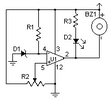
I have breadboarded this project and it works fine. No problem turning on the LED and no problem buzzing the buzzer. You are not reading the data sheets for these parts in the true perspective that they were written.
Just to let you know- I had to take a course specifically on data sheets before I got my degree in Engineering. These are the worst nightmare for most technicians and Engineers alike. No two are written alike.
To give you a little background, I own an electronics business which designs, builds and ships worlwide. I have never had a problem with specs in a design. But then I also take into consideration, as a general rule, altitude, barometric pressure, temperature, and humidity. Look at the data sheet and tell me how to be safe with these unknowns. Most components are effected by some or more of these parameters as well. This is the basis behind further testing on my bench. Not in trying to push a part beyond the spec sheet.
BTW- your boss made a bad decision. First, he added too much cost to the device. For safety, you could have clamped the supply pin of the chip with a zener rated lower than the max value and saved board space and component costs. If you need to worry about temperature compensation, you could use one of the many temperature compensated zeners which are sold in packages that look like a transistor and called reference voltage chips. Your regulator is just dumping 10 volts to ground and converting it to heat unnecessarily. Two thirds of your potential is being dumped to ground.
MP