Re: Music VU Meter

sparky3489

Aug 1, 2009
10
Joined
Aug 1, 2009
Messages
10
Not too shabby for a "too simple of a circuit". Notice the blur, I sure don't.


Oh, and the chips don't get hot either. Where do get all that from?

________________________________

The whole story.

http://s81.photobucket.com/albums/j230/sparky3489/VU%20Meter/

http://s81.photobucket.com/albums/j230/sparky3489/LED%20Panels/

http://s81.photobucket.com/albums/j230/sparky3489/New%20Box%20-%20VU%20meter/


audioguru2

Apr 6, 2004
12,026
Joined
Apr 6, 2004
Messages
12,026
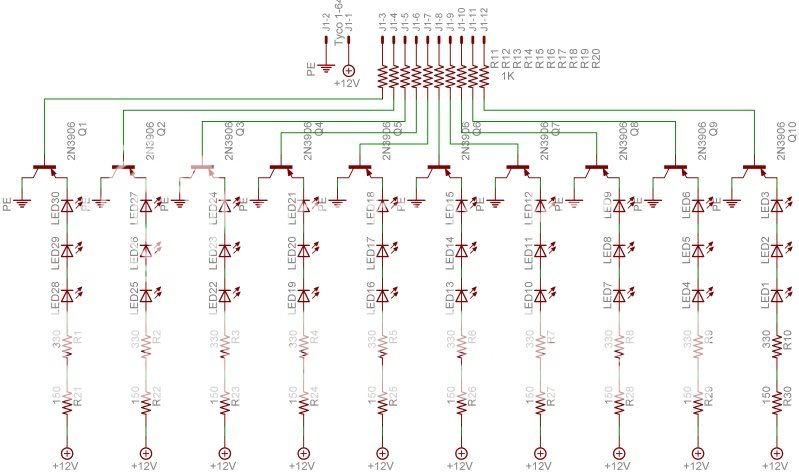
The first schematic shows green LEDs driven from two LM3916 ICs set for an output current of only 8mA. The input of the IC is a half-wave rectifier so the LEDs average only 4mA when the music is blasting.

If the green LEDs are 2.2V and the car battery is 13.8V then each output transistor in the IC dissipates an average of (13.8V - 2.2V) x 4mA= 46.4mW. The IC dissipates a little more than 464mW when all 10 LEDs are lighted and the music is blasting. The max allowed dissipation of the IC is 1365mW.

My Sound Level Indicator uses a peak detector that lights the LEDs continuously instead of half-wave. They are set for 25mA each so the IC gets hot. I added a power resistor in series with its power pin to share the heat.

EDIT:
Don't post your schematics over at PHOTOBUCKET. Their images disappear after a while. Instead attach your schematics here to your posts.
Here is the first schematic that was saved as a fuzzy JPG file type:  

View attachment 40558

 
Last edited by a moderator:

sparky3489

Aug 1, 2009
10
Joined
Aug 1, 2009
Messages
10
The first schematic didn't use green LEDs, all I had were yellow and red to test my prototype. The actual output of the LM3916s drives 3906 transistors to run blue and yellow/red LEDs.

Schematic.jpg


LEDLayout.jpg


100_3293.jpg


All home made.

I've had my photos at photobucket for over two years with no problems and only change because I changed them. I wanted a rapid response so I opted out of a peak detetctor. This actually increases LED efficiency and longevity as well.

The "fuzzy" is from selecting a low resolution when I converted from my CAD program to JPG.

The rest of the pics - http://s81.photobucket.com/albums/j230/sparky3489/New%20Box%20-%20VU%20meter/

 
Last edited by a moderator:

audioguru2

Apr 6, 2004
12,026
Joined
Apr 6, 2004
Messages
12,026
Don't you know that images at PhotoBucket disappear? Sometimes that website is asleep.
But images posted here stay with your thread here and open immediately.

JPG file type is for photos not schematics and has fuzzy losses. PNG has no losses and is very clear for schematics. Why don't you switch to very clear?


audioguru2

Apr 6, 2004
12,026
Joined
Apr 6, 2004
Messages
12,026
Here is a copy of the fuzzy first JPG schematic you posted on another website. It lights the green LEDs half the time because it is half-wave and does not have a peak detector circuit. The LEDs average only 4mA. The LEDs are a dim blur without the peak detector circuit.

View attachment 40559


sparky3489

Aug 1, 2009
10
Joined
Aug 1, 2009
Messages
10
WOW!!!!!

My photos at Photobucket have NEVER disappeared in the 3 years I've used it. Never had a problem with them, maybe it's your ISP causing your problems.

What green LEDs are you talking about? There are no green LEDs in that circuit whatsoever. Never have been. NONE!  AND as I've explained the ouptut drives a transistor not an LED.

I didn't want a peak detector because it's better for the LEDs as it makes them more efficeint and increases their life span. I'm not sure where you are getting they are a dim blur?!?!? They are very bright in fact.


So the schematic is fuzzy, I'm not going to change it. I don't need to. I have the schematic in my CAD program and that's good enough for me.

 
Last edited by a moderator:

audioguru2

Apr 6, 2004
12,026
Joined
Apr 6, 2004
Messages
12,026
My last post shows a copy of your schematic that you posted with green LEDs operating at a low current.

Your low level LEDs are bright. But the high level LEDs are dim because they are turned on for such a short amount of time that our vision can barely see them. When the pulse width is less than 20ms then they look dimmed. Many pulses are less and on your simple circuit they cannot be seen.

A peak detector circuit turns on every LED long enough to be seen brightly and clearly.

Your LEDs are lighted for half the time because the input is a rectifier. Then your brightest LEDs are also dimmed.

The datasheet for the LM3915 bar graph driver recommends using a peak detector circuit. Every "VU" meter circuit I have made has it. You should try it.


sparky3489

Aug 1, 2009
10
Joined
Aug 1, 2009
Messages
10
Try going by what I have connected instead of what I have drawn.


It's apparent you don't understand the advantages of making LEDs efficient. My LEDs are lit for half the time because I wanted the efficiency. My LEDs are just fine, but thanks anyway. The effect is still there.

http://www.youtube.com/user/sparky3489

Good day.


audioguru2

Apr 6, 2004
12,026
Joined
Apr 6, 2004
Messages
12,026
Leds that are turned on for half the time by rectification are efficient only because they are dimmed by the 50% duty-cycle. Most of my LED circuits use pulse-width-modulation for adjustable dimming. But they can increase the duty-cycle to 100% for full brightness, yours cannot.


sparky3489

Aug 1, 2009
10
Joined
Aug 1, 2009
Messages
10
I don't need them to, that's the difference.

Why complicate a "SIMPLE CIRCUIT" that works just fine for what I need? If it ain't broke, don't fix it.

I am working on an adjustable PWM for my internal LEDs using an AVR, probably an ATTINY2313.

 
Last edited by a moderator:

sparky3489

Aug 1, 2009
10
Joined
Aug 1, 2009
Messages
10
OMG!!!!  It's obvious you don't know how a TRUE VU meter works. It's supposed to be analog since music is analog as is my meter (as close as possible visually).

IT WORKS THE WAY I DESIGNED AND WANT IT TO, GEEEEEZ!!!

LET IT REST!!!!!!

 
Last edited by a moderator:

audioguru2

Apr 6, 2004
12,026
Joined
Apr 6, 2004
Messages
12,026
I don't like the ballistics of an old mechanical VU meter.
I like the electronic peak reading meter instead.

The old one allows peaks to be clipped with severe distortion because the peaks are not shown.
The peak detector allows the peak voltage to be seen clearly so that clipping is avoided.


sparky3489

Aug 1, 2009
10
Joined
Aug 1, 2009
Messages
10
Ummm, yeah.

Clipping in mobile audio is minimized by proper gain settings so clipping isn't an issue. This allows the true measurement of a VU meter.

__________________________________

The purpose of the gain is to match the signal volts RMS coming from the source (CD player, etc.) to the input of the amp for correct power matching and to minmize clipping.

Here is a guide that will help you set the gain correctly http://www.box.net/shared/uchv4dbk88

You'll need a multi-meter (AC voltmeter, $15 from Radio$hack), Microsoft Excel and a way to burn an audio CD from an MP3 (test tone included).

If you don't have Excel, you can download (free) OpenOffice by Java (Sun Micro systems) from here to read spreadsheets (and you thought spreadsheets were for business) - http://download.openoffice.org/index.html

The best way to set the gain is with an O-scope, but not everyone has a $2000 scope so that's why I made this.

______________________________________

All about PEAK power.

First off, ignore peak or max watts.

For speakers:

Peak or Max watts represents the absolute maximum wattage a speaker can handle for a split second. Since music doesn't play at this wattage at long intervals, it's not a good representation of true power handling.

For amplifiers:

Peak or Max watts represents the maximum wattage an amp can push for a split second and since music plays an average signal longer than a split second, it isn't a true measurement of actual power.


Continuous or RMS (Root Mean Square) is the true output power. Especially on CEA-2006 compliant amplifiers.

Being CEA compliant is a voluntary action by the manufacturer to have their amp tested by the CEA (Consumer Electronics Association) using standardized test methods. Those amplifiers that are not CEA compliant can put whatever they want for power ratings as they use tricky methods for testing which are unregulated. You know exactly what you're getting from a compliant amp.

Some speaker/sub manufacturers have also gone with CEA testing for loudspeakers to ensure pruduct claims.

 
Last edited by a moderator:
Top