Rheostat power rating

Kerrowman

Dec 13, 2020
70
Joined
Dec 13, 2020
Messages
70
Hi Harry,

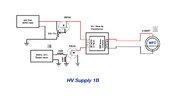
I'm not clear where your two variable resistors are and in the attached Pic 1 I have put where I think one is. My supply is set at 50V and the gate pulses at 200Hz, 50% so 'hoping' to be able to get 750-1kV out at the secondary when connected to the electrolysis cell.

As I come from a Physics background and not electronics I'm trying to understand why increasing the current in the primary will increase the voltage across the cell. Is the problem that the 530 is throttling both the voltage and the current and hence the multiplication by the secondary?

From my limited experience of Spice I think one can have a pot in the design together with a simple statement that increments the value of a resistor R. I attach a grab of an early attempt (Pic 2) at a regulator using this approach that someone else advised me on together with the relevant files (not sure which is essential so I've provided three). Perhaps you can incorporate some bits of it into your simulation?

I appreciate your efforts, thank you,

Regards,

Julian
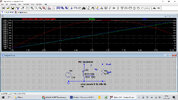
Pic 2.jpg

Pic 1.jpg

View attachment V Adjust Circuit.asc
View attachment V Adjust Circuit.log
View attachment V Adjust Circuit.net

 
Last edited by a moderator:

HarryA1

Mar 4, 2009
481
Joined
Mar 4, 2009
Messages
481
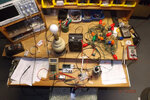
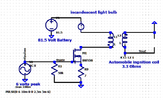
Don't laugh that is an emulation of your circuit. I was thinking that there is not enough load in the circuit
with only the coil (the mosfets are acting like switches only off or on) so I started out with 7 watt incandescent
lamps but could not get two mosfet to work so I switched to only one; that works well.
In the photo at the lower right is an automobile ignition coil and the big black thing is an 80 volt battery (borrowed from my chainsaw).

Working up to 13 bulbs (normally 7 watt bulbs) I got 0.571 ma through a 7 ohm resistor. Switching to a 100 watt
bulb got 0.594 ma, the IRF530 got up to 32 degrees C.  I do not have any IRF580's. The input signal is 6 volts peak. The 50k resistor is a pot. max'ed out.

I turn the input up from low to high to prevent any inrush of current into the lamp(s), I do not know if that is necessary or not.

emulation circuit.JPG

one mosfet and lamp.png

 
Last edited by a moderator:

Kerrowman

Dec 13, 2020
70
Joined
Dec 13, 2020
Messages
70
Harry, that's very industrious of you to build a physical version of the circuit.

Have you have substituted my upper 530 for a light bulb because it is just acting as a variable resistor?

Also could you clarify if you got a high voltage on the secondary of the ignition coil? If you did, even with the small currents you measured in the primary, what does this all mean for my current design 'HV Supply 1B' shown a few posts back?

Julian


HarryA1

Mar 4, 2009
481
Joined
Mar 4, 2009
Messages
481
Using the 100 watt bulb and two different ignition coils this is what I got:

AC Output(VOM) 1 meg load        Input sig. 204 Hz   Peak voltage  across 7ohms      coil type
67.4 v                                             6.0v                          1.84  v                                    std auto ignt. coil
159.8 v                                           9.68 v                        5.44 v

17.4  v                                            8.0                            4.0 - 4.2 v                             Capacitor discharge coil

The std auto coil is a 12 volt and a few amperes coil. While for the CDI coil I am running it via discharging a 1 mfd capacitor charged to  350 volts in my experimental chain saw ignition system. So neither are designed for what  you are doing. Speaking of coils/transformers Scherz and Monk have information on transformers in their "Practical Electronics for Inventors" you may check it out the next time you are in a book store.

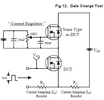
I think using a incandescent lamp (as a ballast resistor) and controlling the current via the input signal is useful but  using a mosfet as  current regulator  maybe useful also. This regulator is from the IRF530 pdf sheet. I use a similar circuit in my ignition system floating a 9 volt battery at 350 volts.

current regulator.png

The 12 volts at the battery got cut off.

 
Last edited by a moderator:

Kerrowman

Dec 13, 2020
70
Joined
Dec 13, 2020
Messages
70
Harry , I need to unpick what you have found. The highest output across the secondary of your coil was 159.8V, when I presume one would expect several kV? (I don't know what the turns ratio is in such a coil but ignition systems are designed to produce 5-15kV)

Am I correct in saying that to get a higher secondary output one will need a bigger primary current - to store more energy in the primary coil? Also are you saying that the current in the primary is a function of the Gate frequency - perhaps a lower frequency will allow more current into the primary?

What's DUT?

Regards,

Julian


HarryA1

Mar 4, 2009
481
Joined
Mar 4, 2009
Messages
481
We know the output voltage is related to the ratio of the number of turns. And the output current related to the inverse of the number of turns. The more voltage gives one more current at the primary so in an ideal transformer the power is the same on both sides of the transformer. But in a pulse transformer is it not the rate of change of current in the primary that gives rise to the change  in magnetic flux that produces the voltage?  I need to learn more about pulse transformers.

I had in mind trying out different frequencies on the automobile  coil/transformer  but had a problem when I connect the second probe to the current monitoring resistor while the first probe  was floating on the output of the coil. The  100 watt lamp when full brightness and it when down  hill from there. I will  continue later.

Anyway I had put a voltage divider across the output of the auto. coil (a 1094k and a 9.84k) and got + and - 32.8  volts peaks on the scope at the 9.84k. I calculate the output voltage at +3679 volts  and -3679 volts peaks.

DUT  device under test?


Kerrowman

Dec 13, 2020
70
Joined
Dec 13, 2020
Messages
70
It's interesting that you, in effect, got + and - 3.7kV across the output of the coil. That is certainly the sort of level I would expect, in which case I would expect more than the 3V I get when I attach my secondary to my load (water cell). Which brings me full circle to my earlier question, why am I getting only 3V across my water cell terminals when your simulation and your ignition coil experiments show much more?

Perhaps I should build a Tesla coil and zap my water cell with that?

As a square wave can be thought of a complex mix of different frequencies of sine waves (Fourier analysis) I think using a square wave in a transformer will result in higher losses at the higher frequency end so producing a rounded square wave output with some enhanced ripple. When that encounters the water cell that will undoubtedly modify the waveform but I haven't observed that yet.


HarryA1

Mar 4, 2009
481
Joined
Mar 4, 2009
Messages
481
Your getting  just 3 volts suggest an impedance mismatch between the transformer and the cell.  In looking at using automobile ignition coils for high voltage I see a number of videos and articles where they get huge sparks from the coils that I can not get. I feel like you; where is the spark! I am thinking my coil is a dud!

See for example: https://www.youtube.com/watch?v=PTt5sM3moqQ  There are a number of similar videos there  using ignition coils for  high voltages.


Kerrowman

Dec 13, 2020
70
Joined
Dec 13, 2020
Messages
70
Thanks Harry,

I will certainly look into using ignition coils or perhaps a Tesla coil.

If it's a question of impedance matching then surely I only have the option to up the secondary coil's impedance. Given that at the moment its resistance is about 1 Ohm, then does it make sense to add a 1 MOhm resistor in series with it to bring it more in line with the 1.6 MOhm resistance of the water cell? Or will that not work or introduce other problems?

Julian


HarryA1

Mar 4, 2009
481
Joined
Mar 4, 2009
Messages
481
There is something about pulse transformers dealing with the pulse width. If the input pulse width is two short
the current never has time to build up completely do to the lagging current in an inductor/coil. That would look like an impedance mismatch also.

If the pulse is to wide current is wasted when the coil is fully energized.

For example see  https://www.youtube.com/watch?v=vvXbTIqBY4o


Kerrowman

Dec 13, 2020
70
Joined
Dec 13, 2020
Messages
70
Hi Harry,

That makes sense but in the case of the ignition coil HV systems, like in the link you gave, they can operate at a similar frequency of say 200-500Hz and still give very powerful sparks so is the construction of an ignition coil, and also a flyback transformer, different to such a degree that they avoid this pulse width issue?

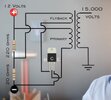
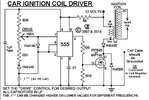
I'm inspired to build one or other of the attached, although the 555 based one has some useful duty and frequency adjustment. Maybe one of these will deliver 10+kV to my cell without significant losses?

Julian

Flyback HV Supply.jpeg

HV Ignition Coil Driver.jpeg

 
Last edited by a moderator:

uziao1

Apr 28, 2021
2
Joined
Apr 28, 2021
Messages
2
Hello friends. Very interesting topic you have here. You can model the electrodes underwater as an capacitor in parallel with a resistor (a leaky capacitor). Maybe this is why he used a bifilar coil... Bifilar coils are self resonant coils because of their capacitance. You can see this article here:

https://sci-hub.st/https://doi.org/10.1002/cta.2830

The autor proposed a resonant tank circuit without the capacitor, using only the capacitance of the bifilar coil.

If the electrodes underwater behave like a true capacitor, he wouldnt need 2 coils... Only one coil would do the job... Maybe the trick lies in the coils only...

 
Top