Hi Harry,
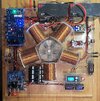
That’s good of you to do a spice test and if I was starting from scratch then using a microprocessor would have been the way to go. However, I should have made it clear that I already have the cap discharge circuit in operation, that charges up a bank of capacitors to 24V then releases the stored energy as a high current pulse down to 17V. You can see the unit in the bottom left corner of the unit in the pic.
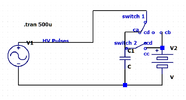
So I presently have a system of delivering the HV pulses to the batteries directly (with swapping) or the high current pulses from the ‘cap dump circuit’ but not mixed in the way I have described in my brief and post.
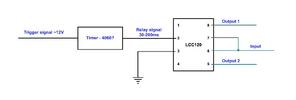
Therefore I’m looking to revise the main PCB with some additional elements to do the timed routing I described and not change the cap dump circuit. Hence my suggestion of an SSRelay with a timing circuit. Using an Arduino would take up too much space whereas an SSR and some timing component’s I can fit onto the present PCB format.
Incidentally I credited your help in the past, amongst others, in the Acknowledgments in my ‘replication manual’ for this device. This is part of the scientific process for results publication in the future so that any one can replicate the findings.
You can see the manual here:
https://www.dropbox.com/sh/td55b8675vvqtbg/AADzPSKMOI8q_YM1cFUT2T07a?dl=0
(I have temporarily removed the PCB files while I explore the circuit revision)
Assuming the SSR idea is sound then I’m trying to figure out how to set the relay with a short 4ms pulse (as per the earlier diagram) and then reset it after the adjustable period (30-200ms). Perhaps I need a latching relay instead but haven’t found a small DIP 8 format one.
Your thoughts are appreciated.
Julian