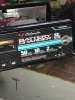
schumacher se-5212a charger

radioguy

Mar 10, 2018
5
Joined
Mar 10, 2018
Messages
5
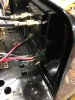
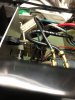
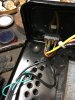
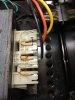
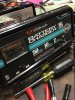
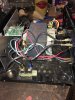
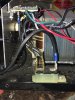
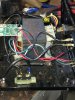
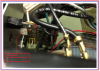
A friend got his charger caught in his truck fan and it ripped out the positive and negative cables. I am not able to see where they go and cant find a wiring diagram for this specific model. Can anyone help me? thanks in advance.
 

Attachments

  • IMG_3140.JPG
    IMG_3140.JPG
    252.4 KB · Views: 138
  • IMG_3141.JPG
    IMG_3141.JPG
    222.3 KB · Views: 127
  • IMG_3142.JPG
    IMG_3142.JPG
    187.7 KB · Views: 138
  • IMG_3143.JPG
    IMG_3143.JPG
    271.7 KB · Views: 136
  • IMG_3144.JPG
    IMG_3144.JPG
    220.5 KB · Views: 129
  • IMG_3145.JPG
    IMG_3145.JPG
    311.9 KB · Views: 126

dave9

Mar 5, 2017
1,191
Joined
Mar 5, 2017
Messages
1,191
I'm sure I could figure it out if it were sitting in front of me, maybe across the internet from pics too but those have too much contrast and the thing sorely lacking is pics from further away so the whole thing is seen as a whole, top down and on each side.

However, the two most likely points to look at reattaching the cables is one to the ground output from the transformer (after one or more rectification diodes) and the other to wherever that wire goes that comes from the front panel ammeter gauge.

How did these cables terminate inside it, where they cut apart and some length remains inside, or they had connectors that pulled off somewhere, or were soldered to a PCB or ring terminals still attached via bolt and nut somewhere?
 
Last edited:

radioguy

Mar 10, 2018
5
Joined
Mar 10, 2018
Messages
5
There are no traces of anything hooked or soldered in anywhere. The connection in pic 3160 wan bent over so I figured that was one of the locations. The wires were pulled out of a connector from what I can tell and the connectors must have fallen out of the bottom holes. I hooked the positive and negative wires up (notice the blue on the connectors in picture 3160). I am getting over 9 almost 10 volts output with the cables not hooked to anything.
 

Attachments

  • IMG_3155.JPG
    IMG_3155.JPG
    287.1 KB · Views: 192
  • IMG_3156.JPG
    IMG_3156.JPG
    412.4 KB · Views: 129
  • IMG_3157.JPG
    IMG_3157.JPG
    412.5 KB · Views: 141
  • IMG_3158.JPG
    IMG_3158.JPG
    366.5 KB · Views: 123
  • IMG_3160.JPG
    IMG_3160.JPG
    301.3 KB · Views: 139
  • IMG_3161.JPG
    IMG_3161.JPG
    282.3 KB · Views: 118
  • IMG_3163.JPG
    IMG_3163.JPG
    315.7 KB · Views: 75
Last edited:

73's de Edd

Aug 21, 2015
3,730
Joined
Aug 21, 2015
Messages
3,730
Sir radioguy . . . . .

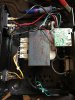
You split up the picture on me . . . . but confirm that lower 1/2 of the the 1st pictures current cut off has the LARGE BLACK 1000V (you dream) wire, that is routing over to the current meter at the front metering, with it being 1 if two connections there. (Ignoring the light gauge illumination lamp and switch connections)
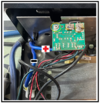
On photo 2 you then see the meter, and now observe if that meter is missing one of its its wire connections being pushed onto a vacant spade connector, that is being one of the missing output battery cable connections.

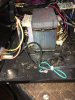
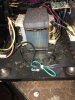
Now refer to photo 3 where you see the large aluminum heat sink plate for its rectifiers.
This is the DC output from the rectifiers and has a large BLACK insulator block that makes a very short carry, torries to the mini PCB connected to it.
Directly down below on that mini PCB is being another push on connector, which should be the connector to the other battery output cable.

Do a dynamic test with a load / lamp / or/ loose headlight lamp if you really want to evaluate .
Confirm proper wire polarity of the connections.
The rectifier plate should be the + polarity output and the push on meter terminal should be the negative.

NOW . . . . .check . . . it . . .OUT !

73's de Edd
.....
 

radioguy

Mar 10, 2018
5
Joined
Mar 10, 2018
Messages
5
Yep, I hooked up the positive to that one and the negative to the open part of the circuit breaker which was bent over. I assumed that was because the wires were ripped out of it.
 

kinggreene

Dec 11, 2014
2
Joined
Dec 11, 2014
Messages
2
Yep, I hooked up the positive to that one and the negative to the open part of the circuit breaker which was bent over. I assumed that was because the wires were ripped out of it.
if you havent figured it out yet i have the same exact charger in the garage, let me know if you need help still and i will take pics tomorrow.
 

radioguy

Mar 10, 2018
5
Joined
Mar 10, 2018
Messages
5
if you havent figured it out yet i have the same exact charger in the garage, let me know if you need help still and i will take pics tomorrow.
If you dont mind, I would like to make sure that it is correct. Thanks
 

Cmvalerius

Apr 25, 2024
2
Joined
Apr 25, 2024
Messages
2
if you havent figured it out yet i have the same exact charger in the garage, let me know if you need help still and i will take pics tomorrow.
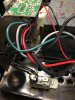
I had the same thing happen… Does the positive go to the circuit board or to the white relay thank you I called the company and they did not know
 

73's de Edd

Aug 21, 2015
3,730
Joined
Aug 21, 2015
Messages
3,730
Sir Cmvalerius


Hopefully . . .TOTALLY CLARIFIED, this time. . . .See bottom of page . . .

the white relay . . . . . . . is actually being a thermal, auto timeout and self reset overload breaker . . . .

1714115746482.png
Encountered on two different units, in past times.

ALSO
be sure to check out the electro-mechanical integrity of that . . .YELLOW CIRCLED . . . . pop rivet, as two dissimilar metals are being joined here and the total current of the charger passes thru it.

On mine, I additionally used a stranded 10 ga wire jumper to a terminal lug at the alum-i-ninny-yum-yum plate, with the other wire end soldered to the pcb pad.

FACTOID !
This full wave pulsating DC unit has no filtering . . . . .so don't expect some higher DC voltage reading without the battery connected.
Then, the connected battery will supply the "filtering" action and you will see the charging battery voltage incrementally increase as a charged condition is experienced.

Thaaaaasssit . . . .


73's de Edd . . . . .


1714117687139.png
.
 
Last edited:

Cmvalerius

Apr 25, 2024
2
Joined
Apr 25, 2024
Messages
2
Sir Cmvalerius


Hopefully . . .TOTALLY CLARIFIED, this time. . . .See bottom of page . . .

the white relay . . . . . . . is actually being a thermal, auto timeout and self reset overload breaker . . . .

View attachment 63421
Encountered on two different units, in past times.

ALSO
be sure to check out the electro-mechanical integrity of that . . .YELLOW CIRCLED . . . . pop rivet, as two dissimilar metals are being joined here and the total current of the charger passes thru it.

On mine, I additionally used a stranded 10 ga wire jumper to a terminal lug at the alum-i-ninny-yum-yum plate, with the other wire end soldered to the pcb pad.

FACTOID !
This full wave pulsating DC unit has no filtering . . . . .so don't expect some higher DC voltage reading without the battery connected.
Then, the connected battery will supply the "filtering" action and you will see the charging battery voltage incrementally increase as a charged condition is experienced.

Thaaaaasssit . . . .


73's de Edd . . . . .


View attachment 63422
.
Thank you!
 
Top