Seeking Advice on PCB Design Issue: Trace Width and Thermal Problems

Ne Quin

Jul 16, 2025
1
Joined
Jul 16, 2025
Messages
1
Seeking Advice on PCB Design Issue: Trace Width and Thermal Problems


Hey everyone, I'm working on a PCB design for a small IoT project, and I've run into some issues that I could use some community input on. I'm relatively new to PCB design, so bear with me if these are rookie mistakes!


The Setup


  • Board Specs: 2-layer FR4, 1.6mm thickness, 1 oz copper.
  • Components: ESP32 module, a few sensors (DHT22, BMP280), and a 3.3V LDO regulator.
  • Power: 5V input via USB, stepped down to 3.3V for the ESP32 and sensors.
  • Application: Basic environmental monitoring with data sent over Wi-Fi.


The Problem


  1. Trace Width Concerns: I'm using 0.3mm (12 mil) traces for most of my signal lines and 0.5mm (20 mil) for power lines. The LDO is supplying about 300mA max to the ESP32 when Wi-Fi is active. I ran some trace width calculations using an online calculator (based on IPC-2221), and it suggested 0.8mm for the power traces at this current. My 0.5mm traces are heating up slightly (warm to the touch). Should I be worried about this? Is 0.8mm overkill for a small board like this?
  2. Thermal Issues: The LDO regulator (a generic 1117-3.3) is getting pretty hot during operation, especially when the ESP32 is transmitting. I’ve got a small heatsink on it, but I’m wondering if I should switch to a different regulator or add more thermal relief. My PCB layout has the LDO near the edge of the board, but there’s not much copper pour around it for heat dissipation. Any suggestions for improving this?
  3. Ground Plane: I’ve got a ground pour on the bottom layer, but I’m not sure if I’m utilizing it effectively. There are a few areas where the pour is broken up by signal traces, and I’m worried about ground loops or EMI issues. How critical is it to have a completely unbroken ground plane for a low-frequency IoT board like this?


What I’ve Tried


  • I double-checked my schematic and layout in KiCad, and everything seems to be connected correctly.
  • I increased the power trace width to 0.6mm on a second prototype, but I’m still seeing some warmth.
  • I added some vias to connect the ground pour to the top layer, but I’m not sure if they’re placed optimally.


Questions


  1. Are my trace widths sufficient, or should I bump them up to the calculated 0.8mm for power lines?
  2. Any recommendations for a better LDO or ways to manage the heat without redesigning the whole board?
  3. How do I ensure my ground plane is effective? Should I stitch it with more vias or rearrange my signal traces?
  4. Any other common pitfalls I should watch out for as a beginner?

I’d really appreciate any advice or pointers from folks who’ve tackled similar issues. If it helps, I can share snippets of my KiCad layout or schematic. Thanks in advance!

 

Harald Kapp

Moderator
Moderator
Nov 17, 2011
14,271
Joined
Nov 17, 2011
Messages
14,271
  1. When the traces get warm, this is a sign of excess power dissipation. Which in turn means there is a significant voltage drop along the trace and the device(s) at the end of the trace will not be provided with the expected supply voltage. -> increase the trace width to the calculated value or even wider.
  2. Another LDo will not solve the issue. The basic physics behind the heating is the power dissipated by the LDO. This power dissipation is determined by the voltage across the LDO and the current through the LDO, both of which will not change with another LDO. When you stick to an LDO, only more thermal relief (heat sink, copper area below) can help. An energy efficient alternative is a switch mode regulator, though not as easy to handle as an LDO.
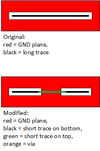
  3. A ground plane ideally should be continous, not interrupted by traces. Clearly almost impossible with a 2-layer design. Ideally you put as many signal traces on top as possible, reducing the number of breaks in the ground plane. For the remianing traces embedded within the ground plane
    - keep them as short as possible
    - interrupt lenghty traces by creating a bridge on top connected by vias to the trace below, then fil the gap below the bridge on bottom with GND to create an additional path for return currents, see image below.
  4. Build a prototype, measure it and see where it needs improvement.
1754028797582.png
 

ahsrabrifat

Jan 18, 2025
76
Joined
Jan 18, 2025
Messages
76
Seeking Advice on PCB Design Issue: Trace Width and Thermal Problems


Hey everyone, I'm working on a PCB design for a small IoT project, and I've run into some issues that I could use some community input on. I'm relatively new to PCB design, so bear with me if these are rookie mistakes!


The Setup


  • Board Specs: 2-layer FR4, 1.6mm thickness, 1 oz copper.

  • Components: ESP32 module, a few sensors (DHT22, BMP280), and a 3.3V LDO regulator.

  • Power: 5V input via USB, stepped down to 3.3V for the ESP32 and sensors.

  • Application: Basic environmental monitoring with data sent over Wi-Fi.


The Problem


  1. Trace Width Concerns: I'm using 0.3mm (12 mil) traces for most of my signal lines and 0.5mm (20 mil) for power lines. The LDO is supplying about 300mA max to the ESP32 when Wi-Fi is active. I ran some trace width calculations using an online calculator (based on IPC-2221), and it suggested 0.8mm for the power traces at this current. My 0.5mm traces are heating up slightly (warm to the touch). Should I be worried about this? Is 0.8mm overkill for a small board like this?
  2. Thermal Issues: The LDO regulator (a generic 1117-3.3) is getting pretty hot during operation, especially when the ESP32 is transmitting. I’ve got a small heatsink on it, but I’m wondering if I should switch to a different regulator or add more thermal relief. My PCB layout has the LDO near the edge of the board, but there’s not much copper pour around it for heat dissipation. Any suggestions for improving this?
  3. Ground Plane: I’ve got a ground pour on the bottom layer, but I’m not sure if I’m utilizing it effectively. There are a few areas where the pour is broken up by signal traces, and I’m worried about ground loops or EMI issues. How critical is it to have a completely unbroken ground plane for a low-frequency IoT board like this?


What I’ve Tried


  • I double-checked my schematic and layout in KiCad, and everything seems to be connected correctly.

  • I increased the power trace width to 0.6mm on a second prototype, but I’m still seeing some warmth.

  • I added some vias to connect the ground pour to the top layer, but I’m not sure if they’re placed optimally.


Questions


  1. Are my trace widths sufficient, or should I bump them up to the calculated 0.8mm for power lines?

  2. Any recommendations for a better LDO or ways to manage the heat without redesigning the whole board?

  3. How do I ensure my ground plane is effective? Should I stitch it with more vias or rearrange my signal traces?

  4. Any other common pitfalls I should watch out for as a beginner?

I’d really appreciate any advice or pointers from folks who’ve tackled similar issues. If it helps, I can share snippets of my KiCad layout or schematic. Thanks in advance!
Your trace width isn’t the real issue here — at 0.3 A, even a 0.5 mm trace only dissipates a few milliwatts, so the warmth you’re feeling is almost entirely from the LDO. The 1117-3.3 is dropping 1.7 V at 0.3 A, which means it’s burning about 0.5 W as heat. On a small board with a limited copper pour, that’s enough to make it uncomfortably hot. A better fix than widening traces is either switching to a buck regulator or improving the thermal path with large copper pours and thermal vias under the regulator pad.


For power integrity, your current 0.5–0.6 mm traces are acceptable, but using a pour for high-current nets spreads heat and reduces resistance further. Similarly, a continuous ground plane stitched with vias improves both thermal performance and signal return paths. Even though this is a low-frequency IoT board, ground integrity still matters, especially near the ESP32’s antenna and decoupling capacitors.


Here is a great write-up on these exact issues: https://www.pcbway.com/blog/PCB_Design_Layout/Considerations_for_High_Power_PCB_Design_25a54c5a.html . It explains how to size traces, manage thermal dissipation with copper pours, and design robust ground/power planes. Adopting these practices in your layout will go a long way toward keeping the regulator cool, stabilizing your supply rails, and avoiding common pitfalls in beginner PCB designs.
 
Top