Should a 555 timer ever get hot?

KTW

Feb 22, 2015
273
Joined
Feb 22, 2015
Messages
273
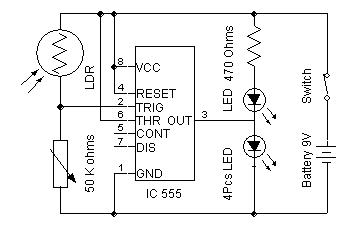
I wired up two different 555's to a circuit, one and then the second after removing the first and both of them got really hot to the touch.
I thought I may have fried the first one so I tried the second and the results are the same.
Is there a way to test these?

automatic%20street%20light.jpg
 

Gryd3

Jun 25, 2014
4,098
Joined
Jun 25, 2014
Messages
4,098
I wired up two different 555's to a circuit, one and then the second after removing the first and both of them got really hot to the touch.
I thought I may have fried the first one so I tried the second and the results are the same.
Is there a way to test these?

automatic%20street%20light.jpg
I would expect it to get hot depending on it's switching frequency, or the current it may be sourcing or sinking...
I do not see a current limiting resistor on the output of your 555. I would assume this may be the culprit. (Of course, I could be wrong :p)
 

(*steve*)

¡sǝpodᴉʇuɐ ǝɥʇ ɹɐǝɥd
Moderator
Jan 21, 2010
25,510
Joined
Jan 21, 2010
Messages
25,510
The main problem is that the lower LED does not have a resistor in series with it.

When the output goes high, there is nothing to limit the current to the LED.

What eventually limits the current will be a mix of various distributed resistances that you normally don't consider. These will include:
  1. Internal resistance of the battery
  2. resistance in the wiring
  3. resistance in internal to the 555
  4. V vs I curve of the LED.
Whichever one dominates will probably get the hottest. In your case it is the internal resistances in the 555. This is probably dominated by the voltage drop across the transistor switching current to the LED, although there will be other things contributing to it. If you measure your battery voltage you will also probably note that it drops significantly.

As an aside, if you powered this circuit using a 12V car battery, I expect you would pretty much immediately see smoke coming from the 555 and really bad things happening to the LED. It would be an interesting race to see which managed to fail open circuit first. You might even get one (or possibly both) to go *BANG*.

Yeah, having series resistors is a really good idea.
 

ADRT

Nov 25, 2014
192
Joined
Nov 25, 2014
Messages
192
I must be missing something. Seams to me that both LED's would be on all the time in this circuit as long as the switch is closed.
 

Gryd3

Jun 25, 2014
4,098
Joined
Jun 25, 2014
Messages
4,098
I must be missing something. Seams to me that both LED's would be on all the time in this circuit as long as the switch is closed.
If the output stage were low, the bottom LED would not light.
If the output voltage is high, then the bottom LED will see a higher than expected voltage and the top LED would most likely turn off.
If the output of the 555 does not sink or source current, then both LEDs would light.
 

(*steve*)

¡sǝpodᴉʇuɐ ǝɥʇ ɹɐǝɥd
Moderator
Jan 21, 2010
25,510
Joined
Jan 21, 2010
Messages
25,510
When the output goes low, the bottom LEDs are effectively shorted. This the top LED is effectively connected to the battery with its 470 ohm resistor.

When the output goes high, the bottom LEDs are effectively connected across the battery without any series resistor. The transistor in the 555 acts as this resistor, possibly passing more than its rated maximum current. The package dissipation is also quite likely to be exceeded and the 555 will get hot (or very hot). The LEDs may also be damaged due to excessive current.

Note that if power was disconnected from the 555 it may be possible that all the LEDs would be turned on. Certainly, if you removed the connection to pin 3 of the 555 third would be observed.
 

ADRT

Nov 25, 2014
192
Joined
Nov 25, 2014
Messages
192
Ok so the output will actually absorb the current when low? Allowing current to flow through 555 to ground?
 

KTW

Feb 22, 2015
273
Joined
Feb 22, 2015
Messages
273
I should have mentioned that I omitted the bottom led just to see if I could get one to work but everything else in the circuit is the same.
The light comes on at 3 volts but the LDR can't control it and it stays on.
The 555 was getting quite hot and I've never used one before so I don't know what to expect but it at least seemed to be wired wrong or working too hard.
 

Gryd3

Jun 25, 2014
4,098
Joined
Jun 25, 2014
Messages
4,098
I should have mentioned that I omitted the bottom led just to see if I could get one to work but everything else in the circuit is the same.
The light comes on at 3 volts but the LDR can't control it and it stays on.
The 555 was getting quite hot and I've never used one before so I don't know what to expect but it at least seemed to be wired wrong or working too hard.
Just to confirm, you left the bottom LED out... so that would be an open circuit? Can you please draw the modification?
 

pebe

Sep 3, 2013
83
Joined
Sep 3, 2013
Messages
83
I should have mentioned that I omitted the bottom led just to see if I could get one to work but everything else in the circuit is the same.
The light comes on at 3 volts but the LDR can't control it and it stays on.
The 555 was getting quite hot and I've never used one before so I don't know what to expect but it at least seemed to be wired wrong or working too hard.
The LDR does not control it because you have not connected the THR pin6. pins 2 and 6 should be connected together.
 

(*steve*)

¡sǝpodᴉʇuɐ ǝɥʇ ɹɐǝɥd
Moderator
Jan 21, 2010
25,510
Joined
Jan 21, 2010
Messages
25,510
Trigger (2) and threshold (6) should be connected together. Threshold (6) should not go to Vcc.

Just make sure you haven't accidentally connected discharge (7) to Vcc
 

(*steve*)

¡sǝpodᴉʇuɐ ǝɥʇ ɹɐǝɥd
Moderator
Jan 21, 2010
25,510
Joined
Jan 21, 2010
Messages
25,510
Aaaaagh! that's even worse. Now you're shorting pin 3 to ground.
 

Gryd3

Jun 25, 2014
4,098
Joined
Jun 25, 2014
Messages
4,098
Aaaaagh! that's even worse. Now you're shorting pin 3 to ground.
But we know why it's heating up ;)
It would have been best if you built the original circuit and simply unplugged the bottom LED. This would have left the Top LED to connect to ground through the 555 when the output is low. This also would have left pin3 disconnected from ground.
 

Gryd3

Jun 25, 2014
4,098
Joined
Jun 25, 2014
Messages
4,098
It doesn't like that either.
Still getting hot and not killing the led.
It's one of the potential problems, but it's not the heating problem.
Pins 2 and 6 are almost always connected together. Both internal Comparators are responsible for triggering the flip flop inside the 555. Without tying pins 2 and 6 together, you will find that the flip flop does not actually flip and flop ;) it will simply just flop.
The big thing we want to address right now is the output of the 555. You scared Steve, and I'm again certain that the output is the trouble making pin on your 555. Consider yourself lucky that the 9V battery cannot put out much current ;)
You can perform a test mentioned further up... Measure the voltage on the battery with your circuit powered up, you may realize that the 9V battery drops considerably. This would be a good indicator that the circuit is drawing too much current.
 
Top