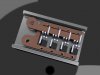
Bolting them to a 4mm thick casing *may* be sufficient.
Let's say you have an Rds(on) of 0.1 ohms and you parallel 4 of these devices. Whilst the current is flowing, the mosfets will dissipate 490 watts. That's an enormous amount of energy to dissipate.
However, if they have an Rds(on) or 0.02 ohms, and you parallel 10 if them, the heat you need to dissipate falls to under 40W. Depending on the ON time (and the duty cycle) the case itself may have enough thermal inertia to keep the devices cool, even if it can't easily radiate all that heat. As long as the off time is long enough, the case will cool between events.
You're probably going to want to pick a mosfet that can handle a fairly huge maximum current too. There is certainly the possibility that all the mosfets may not switch at exactly the same time (although that would be your target).
Switching the +ve side is not a problem. Typically P channel MOSFETS are used for that. P channel devices have somewhat lower specs than N channel devices, but this may not be a huge issue.
Here is a device that *might* work. You may also be able to select fewer mosfets with a lower channel resistance, but that's a design issue for you. This one is rated at 55V 74A and 0.02 ohm channel resistance (but watch the gate voltage needed for this).
You could also look at something like
this, which has a channel resistance about half of the above, and can handle twice the current.
If you employ a suitable driver, you can use an N channel device, and maybe something a little exotic like
this. However, you do need to concern yourself with details like.. Are the legs of the device going to melt with 140A flowing through them?