The Day The Symbol Changed

Minder

Apr 24, 2015
3,561
Joined
Apr 24, 2015
Messages
3,561
I look at both chasis ground and earth ground being the same.
I'm looking at a pc board with a flat wire connector. The one post is marked "GD". could this be chasis ground or earth ground? Oh my! Just food for thought.

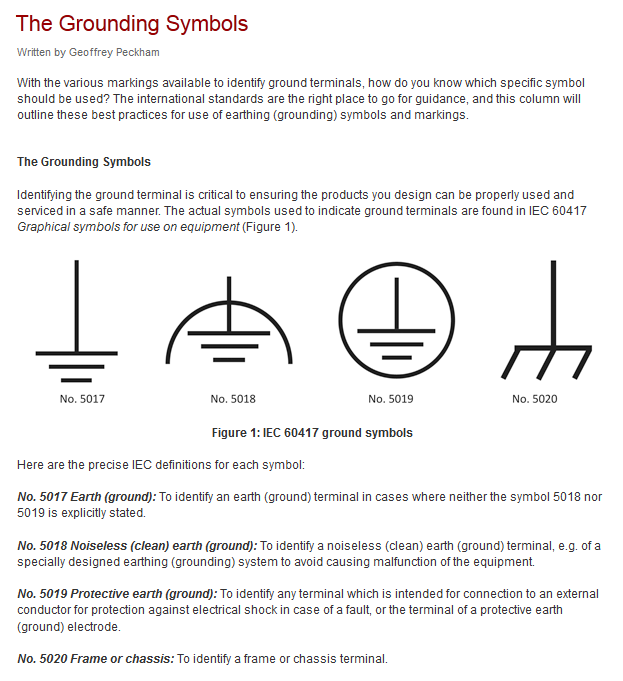
The NEC and NFPA79 spell it out the IEC symbols.
The IEC 5020 is for equipotential bonding of equipment and does not indicate in and of itself that it is earth grounded.
In UK for example the term Earth Conductor is used as opposed to N.A. where Ground is used for both earth grounded and ungrounded circuit common plane, or chassis ground..
M.
.
fuPYB.png
 

amalgamated

Jun 5, 2009
3
Joined
Jun 5, 2009
Messages
3
Or better still, from my experience working with other engineers. Todays CAD programs such as Altium have made us lazy in some respect as well as high density circuit design where unnecessary symbols, normally the ones with single ended arrows are removed and replaced with a wire and netlist attached to it. The ground symbols are of no exception, since the idea is to remove graphical clutter and get to the point of what the topology is saying. Since the CAD program relies on netlist for the PCB design. These netlists can also be assigned track widths and planes. Considering that there are also many different variants of the ground plane such 0V, GND, COM, CHASSIS, DG and AG throwing extra symbols to represent these ground planes would end up as confusing clutter, so a wire terminated with a ground plane netlist is an easier solution.
 

Minder

Apr 24, 2015
3,561
Joined
Apr 24, 2015
Messages
3,561
On Schematic capture and PCB design s/w such as Kicad, I use the exact same symbol throughout, the Logic Common symbol, if the circuit consists of systems isolated from each other, the label itself is enough to identify the various commons for the board capture.
M.
 

Scott Hall

Apr 6, 2016
2
Joined
Apr 6, 2016
Messages
2
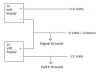
You can have two different "grounds" in a circuit -- the safety or earth ground (such as from a power a power supply), and a signal ground. Consider a 2-rail amplifier requiring +/- power. The signal ground may be floating above the earth ground (or chassis ground), and would need to use capacitors or optoisolators to connect with stages that are 1-rail powered. Modifying a diagram from a poster above, here would be the power supply for such a 2-rail amp:
upload_2016-4-6_16-41-15.png
This same supply could be providing 24V to the rest of the system.
 

CDRIVE

Hauling 10' pipe on a Trek Shift3
May 8, 2012
4,960
Joined
May 8, 2012
Messages
4,960
There are times, actually most times when I wonder if some poster's actually read the thread title and text contained within the OP's original post or do anything but skip read through the subsequent replies. o_O

Chris
 

Scott Hall

Apr 6, 2016
2
Joined
Apr 6, 2016
Messages
2
I don't get the point of your response, but I was trying to illustrate that even though the earth ground symbol was common to represent earth ground, chassis ground and signal ground up to the 1930's (at least in the US), a separate signal and chassis ground symbol was needed just for circuits where two grounds can be at different potentials.

It's not that the symbol changed -- it did not -- but common vernacular use standardized more starting in the 1930's and more so in the 1940's. The modern signal ground symbol came into more vernacular use starting in the 1960's due to greater semiconductor use requiring 2-rail supplies.

So I disagree with the whole premise that the symbols between chassis ground and earth ground changed. Rather proper standardization became more prevalent as more and more schematics were viewed by more and more persons.

I cite as example quite a number of old Sams Photofact schematics, repair technician manuals for Sears TV and Radio repairman, and old textbooks from EE classes at my Alma-mater Purdue University.
 

CDRIVE

Hauling 10' pipe on a Trek Shift3
May 8, 2012
4,960
Joined
May 8, 2012
Messages
4,960
Hello Scott and welcome to Electronics Point.

My point (a pun) of my last post was that I've never argued the existence of definitive symbols to define ground type. The point of my thread is that what is now internationally accepted as Earth Ground was universally used to represent Chassis Ground (in the U.S.) for over 100 years. Right or wrong it is the way it was and you can't change history or old dogs either... WOOF! :D

Chris
 
Top