You don't note the units on the ohm range. Your meter almost certainly autoranges.
I would assume the values between pins 1 and 3 are in MΩ. The others are probably kΩ. OL means there is no detectable (by your meter) conductance between these pins. Be careful that you don't touch the metallic parts of the probes or your own body's resistance can affect the readings (I don't think that happened here).
The diode check range is the most useful. You can typically distinguish the collector from the emitter by the lower forward voltage. In this case, both base to collector readings are lower than the base to emitter readings.
All TO3 outline BJT transistors have the same lead arrangement. The case is connected to the collector. From that the other connections are obvious.
There is also the
datasheet which clearly tells you which connection is which on the first page.
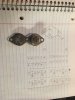 So, I have two PNP transistors model MJ15004G. Trying to see if they are operational but this realm of electronics has me scratching my head. I have tried to research testing these but cannot find any useful guides to differentiate B,E, and C. I tested them with a model 87 Fluke DMM on diode setting and m-Ω. Attached picture shows results. Any expertise? Thanks in advance.


