Triggering a passive infrared sensor?

tomadom

Jan 18, 2013
81
Joined
Jan 18, 2013
Messages
81
Maybe someone can interpret the model number? I see that the specs indicate that the minimum voltage starts at 2.2 volts.. Youtube commentaters on this item say that it's effective from 3volts. I figure that's the most important part? Does everyone agree?
 

tomadom

Jan 18, 2013
81
Joined
Jan 18, 2013
Messages
81
Just in case anyone comes across this thread and is looking for the specs for the Nicera PIR sensor 200F12, Nicera in Shanghai sent me the specs. See attached.
 

Attachments

  • RE200F-Y12规格书(2).pdf
    478.7 KB · Views: 1

Delta Prime

Jul 29, 2020
2,987
Joined
Jul 29, 2020
Messages
2,987
I'm at the point of determining whether there at the location of the connection of that PIR sensor to the circuit board, whether any sensor just connected to it is just 'closing a circuit' as opposed to applying a current?
??
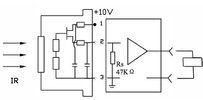
Here’s your PIR
IMG_0230.jpeg
You’re gonna have to get a multimeter out and verify that there is 10 V going to your sensor from the board and it would be connected to pin one.
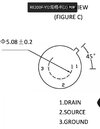
This is bottom view figure C pin, one (Drain) .
IMG_0231.jpeg
This is what I was referring you to…

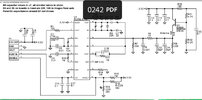
IMG_0229.jpeg Reference the schematic P1,we will be using pins 2,3 and four.
You will not be able to use both the PIR and the microwave simultaneously it’s either one or the other to keep it simple but that board is very large so that is another matter you have to deal with.
Also, if you decide to go forward, we will be operating in 3 to 4 GHz. This is microwave. No mistakes can be made while making solder connections and your connections themselves must be perfect at these frequencies.
 

Attachments

  • 0242.pdf
    263.6 KB · Views: 1
Last edited:

roughshawd

Jul 13, 2020
616
Joined
Jul 13, 2020
Messages
616
Power trigger the camera by interrupting the supply with a motion detector circuit. It's hard to prefab built-in sensors... Nearly impossible. Why behind glass if the cameras are exterior.... Vandals? Then raise the camera...
 

tomadom

Jan 18, 2013
81
Joined
Jan 18, 2013
Messages
81
??
Here’s your PIR
View attachment 65542
You’re gonna have to get a multimeter out and verify that there is 10 V going to your sensor from the board and it would be connected to pin one.
This is bottom view figure C pin, one (Drain) .
View attachment 65545
This is what I was referring you to…

View attachment 65544 Reference the schematic P1,we will be using pins 2,3 and four.
You will not be able to use both the PIR and the microwave simultaneously it’s either one or the other to keep it simple but that board is very large so that is another matter you have to deal with.
Also, if you decide to go forward, we will be operating in 3 to 4 GHz. This is microwave. No mistakes can be made while making solder connections and your connections themselves must be perfect at these frequencies.
I'm planning on building in a switch to switch between sensors.

The Doppler sensor will attach to the outside of the unit. via a 3-bar magnetic connector..

So yes, I agree. It's either one sensor or the other. The Doppler sensor itself will be placed at the window and connecting to the camera unit via a three core cable..

That's at least how I'm thinking it will go. But we will see.

These are indoor cameras and I don't want to leave it outside anyway.
 

roughshawd

Jul 13, 2020
616
Joined
Jul 13, 2020
Messages
616
Pardon... Duh, passive systems are usually triggered by the ground circuit,or fault. rather than the power circuit. That being said, all these sensors must be powered, for them to work, and usually they are not triggered at all but always on. That means you can't hack them. I always look for an on/off option ... That's generally called a secondary, I don't know if that's illegal or not, but frankly, I try not to argue with true bypasses, sometimes they win....
 
Top