Using 2 C005 Timer modules for an on-off timer switch, alternatives for timing, low power?

TobiH

Dec 7, 2022
4
Joined
Dec 7, 2022
Messages
4
I think it is still up to date, even if an old topic. I still have not found a way of creating a super-low-power and accurate timer circuit for those candle-thingies.
Best results I got recently was using the newer ATTiny412 or similar: the internal RC clock (or whatever) is extremely fine tuned, so you can reach about 15 minutes drift per 24 hours. SpenceKonde has a fantastic library on GitHub https://github.com/SpenceKonde/megaTinyCore
I have had a great discussion with him on the exact-timing of the internal RTC that you can find here https://github.com/SpenceKonde/megaTinyCore/discussions/1171
 

David0101

May 10, 2020
9
Joined
May 10, 2020
Messages
9
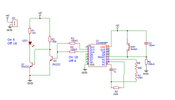
Got this cd4060 design to work on a breadboard, using 100nf, and 5.6K, 1K, as the timing to test in seconds rather than hours.
Maybe not cheaper than the 4 cent mc above!
 

Attachments

  • Schematic_cd4060-Clock-Project-v1_2025-08-19 (5).png
    Schematic_cd4060-Clock-Project-v1_2025-08-19 (5).png
    21.2 KB · Views: 1

poor mystic

Apr 8, 2011
1,106
Joined
Apr 8, 2011
Messages
1,106
Still on the lookout for another way to do it. Thinking a CD4060 may be possible, but the designs i've see online are a bit confusing. I need to dive into how the 4060 works i guess...
Hi :)
See if you can get some old Forrest Mims books on using digital IC's.
something like https://www.amazon.com/Forrest-Mims-Circuit-Scrapbook-Vol/dp/1878707485 would help.
You still have to do some thinking and play with some (cheap) IC's

PS
Some people made a complete hobby out of this stuff in the olden days. It's simple and gives good results.
 
Last edited:

danadak

Feb 19, 2021
1,063
Joined
Feb 19, 2021
Messages
1,063
App info and precautions for the CD4060 - https://www.ti.com/sitesearch/en-us...ngPref=en-US&nr=23&searchTerm=cd4060#q=cd4060

Keep in mind the 4060 osc. accuracy, RC based, is very poor over T and V due to part tolerance,
drift, the Vth of the inverting gates used for amps.....

Electrolytics have large variation with T, from ChatGPT

The temperature sensitivity of capacitance depends strongly on the dielectric material used in the capacitor. A “typical” 1 µF capacitor could mean very different things depending on whether it’s ceramic, film, or electrolytic. Here are the general cases:


1. Ceramic capacitors


  • Class I (C0G/NP0):
    Very stable. Capacitance change is typically ±30 ppm/°C (0.003%/°C).
    → Over –55 °C to +125 °C, variation is <±0.6%.
    But 1 µF is rarely available in pure C0G, usually much smaller values.
  • Class II (X7R, X5R, Y5V, Z5U, etc.):
    Much less stable. Typical sensitivity: ±15% from –55 °C to +125 °C for X7R.
    For Y5V or Z5U, change can be –80% to +22% over the full temp range.
    Most 1 µF ceramics in small packages are X7R or X5R.


2. Film capacitors (polypropylene, polyester, etc.)


  • Polypropylene (PP): about –200 ppm/°C (–0.02%/°C). Very stable.
  • Polyester (PET): about +400 ppm/°C (+0.04%/°C).
    → Over 100 °C, you might see 2–4% change.


3. Aluminum electrolytic


  • Much larger variation. Can change ±20% (or more) across operating range, not just due to temperature but also due to frequency and applied voltage.
  • Typical temperature coefficient is not specified in ppm/°C like precision parts; datasheets usually just give capacitance tolerance over temp range (e.g., –40 °C to +85 °C: –20% to +80%).


✅ Summary:


  • Stable precision: C0G/NP0 ceramic or polypropylene film → ~±0.02–0.003%/°C.
  • General-purpose 1 µF ceramic (X7R/X5R) → up to ±15% over full temp range.
  • Electrolytics → large changes (±20% or more).


Do you want me to narrow this down to the most common case for a 1 µF capacitor today (which would usually be an X7R ceramic in SMD form), and give you the typical capacitance vs. temperature curve for that?

For a 1 µF electrolytic capacitor (which is usually a small aluminum electrolytic or sometimes tantalum), the capacitance vs. temperature sensitivity is quite large compared to film or C0G ceramics.


Typical values (from datasheets):​


  • Aluminum electrolytic (small can, 1 µF):
    • At +20 °C → nominal capacitance.
    • At –40 °C → capacitance may drop 40–60% (sometimes even lower).
    • At +85 °C or +105 °C → capacitance may increase +10–20%.
    • In other words, ΔC is on the order of –0.5%/°C to +0.2%/°C, but not linear (it’s highly nonlinear, with the biggest drop at low temperatures).
  • Tantalum electrolytic:
    • More stable than aluminum.
    • Typical variation: about ±10% from –55 °C to +125 °C.
    • Effective slope: ~0.1%/°C worst case.


✅ So a “typical” 1 µF aluminum electrolytic capacitor will lose 40–60% of its capacitance when cold (–40 °C), and gain ~10–20% at high temp (+85 °C).


Would you like me to pull up an actual datasheet curve (capacitance vs. temperature) for a 1 µF aluminum electrolytic so you can see the exact numbers?

Note timing accuracy these low end processors on RC internal clock -


Not great but its over T and V..... Many processors today have simple cal techniques to get much better
accuracy for internal osc cal....

Forest Mims -


https://www.worldradiohistory.com/BOOKSHELF-ARH/Radio_Shack_Books.htm Various

and attached.
 

Attachments

  • Forrest Mims-engineer's mini-notebook 555 timer circuits (radio shack electronics).pdf
    2.8 MB · Views: 1
Last edited:
Top