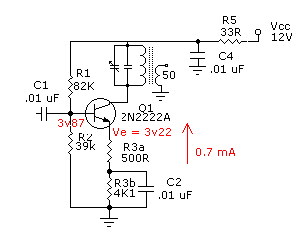
What the value of Zout???

walid1

Jun 27, 2004
749
Joined
Jun 27, 2004
Messages
749
Hello guys
The attached photo is a crystal oscillator
it is a voltage divider config. but replacing the RC with LC tuning tank
I need to know the out put impedance Zout??
Is it XC// XL at the operation freq 27MHz???
please help me
thank you in advance

http://NOTE: sorry L= 3.48 uH not 1.2 uH as in the circuit

View attachment 40569

 
Last edited by a moderator:

audioguru2

Apr 6, 2004
12,026
Joined
Apr 6, 2004
Messages
12,026
I didn't calculate the resonant frequency of the tank but if it is 27mHz then it is an extremely high impedance. Then the circuit will not start oscillating or it will stop oscillating if it has a load.


walid1

Jun 27, 2004
749
Joined
Jun 27, 2004
Messages
749
thank you guru

but if it is 27mHz then it is an extremely high impedance
Be sure that the resonance freq is 27MHz
is the Zout = XC//XL; the parallel equivalent of the two reactancess (coil and ca)???
regards
 

Hero999

Oct 28, 2007
2,433
Joined
Oct 28, 2007
Messages
2,433
Yes, the output impedance will be equal to the impedance of the inductor and capacitor in parallel.

The impedance of an ideal inductor and capacitor in parallel is infinite, in reality is won't be infinite but it'll be very high and depend on the Q of the tank. Any load connected to the output will reduce the amplitude and stability of the oscillator because it will affect the Q of the resonant circuit.


walid1

Jun 27, 2004
749
Joined
Jun 27, 2004
Messages
749
Any load connected to the output will reduce the amplitude and stability of the oscillator because it will affect the Q of the resonant circuit
What the solution then??
Do I have to replace the coil with a stepdown RF transfrmer??
What is the turn ratio then if i want to match with 100K ohm load?
thank you in advance.
 

audioguru2

Apr 6, 2004
12,026
Joined
Apr 6, 2004
Messages
12,026
A 100k load is a high impedance to the LC parallel tuned circuit and will be fine. A 1k load would be much too low.


walid1

Jun 27, 2004
749
Joined
Jun 27, 2004
Messages
749
A 1k load would be much too low.
what to do if the load is 1k only??
Do I have to replace the coil with a stepdown RF transfrmer??
 

audioguru2

Apr 6, 2004
12,026
Joined
Apr 6, 2004
Messages
12,026
If you use an output transformer to increase the load impedance then it steps down the signal voltage.
An emitter-follower transistor will increase the load impedance without the signal voltage loss.


walid1

Jun 27, 2004
749
Joined
Jun 27, 2004
Messages
749
Hi Guru
Thank you for attention
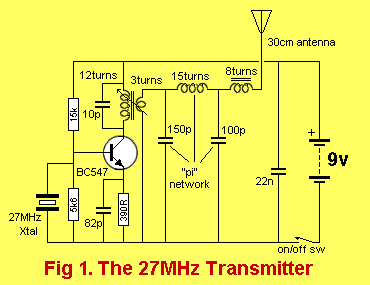
What do you think of this circuit
Fig1.gif

from: http://www.talkingelectronics.com/projects/27MHz%20Transmitters/27MHzLinks-1.html
The author use a transformer then PI network filter for impedance matching the low Z antenna (50 ohm) to the very high (near infinity) Z tank circuit.
I am a week ago, trying to understand, and I hope that you help me to understand
Thanks


Hero999

Oct 28, 2007
2,433
Joined
Oct 28, 2007
Messages
2,433
An alternative to building a transformer is to simply put a tap in the middle of the inductor, the apparent impedance of the load will be increased by a factor of four and the voltage across it will be halved so the power will be down by a factor of four.


walid1

Jun 27, 2004
749
Joined
Jun 27, 2004
Messages
749
Hello guys
In the following link,
http://www.electronics-tutorials.com/amplifiers/negative-feedback.htm
the author speaks about how to made the necessary calculations to determine the transformer's turns ratio and also the LC needed for impedance matching a 50-ohm antenna to the preceding stage
Regardless of some of the details that the writer is talking about, espicially his talking about the dc biasing and the o/p voltage swing, I will focus in the discussion with you on the method of calculating the turns ratio.
Look at the fig:
neg-feed-fig2.gif

the author said:
297380689.jpg


Here we are only mainly concerned here with the principle of a tuned circuit as a load. In this example we have a final load of 50 ohms connected to the output link coupling of our tuned circuit. Assume, just for discussion purposes, that in this example we needed a power output of 100 milliwatt from the amplifier and that we have available a power supply of 12V. Further,

Now:

2 * Po = [Vcc - Ve]^2 / R

or [2* 0.1] = [12 - 3.22]^2 / R

or [2* 0.1] = [ 8.78 ]^2 / R

and R = 77 / 0.2

= 385 ohms

Therefore the load presented to the output of our amplifier needs to be 385 ohms. The impedance ratio is 385 / 50 or 7.7:1 and the turns ratio on the transformer (inductor) is the square root of that number or 2.775:1.
My questions are:
1)Are these calculations are true in general?
2) Why '2' in 2.Po = [Vcc-Ve]^2/R, i learn that P = V^2/R
3)Why [Vcc-Ve]^2, I think it must be [Vcc-Vc]^2

Eagerly awaiting your reply
Thanks


Last edited by a moderator:

walid1

Jun 27, 2004
749
Joined
Jun 27, 2004
Messages
749
My questions are:
1)Are these calculations are true in general?
2) Why '2' in 2.Po = [Vcc-Ve]^2/R, i learn that P = V^2/R
3)Why [Vcc-Ve]^2, I think it must be [Vcc-Vc]^2

Eagerly awaiting your reply
Thanks
I discover the answer of the second question: the RMS value of the peak voltage = Vpeak/squre root of 2
and when we squre that root we get 2 which appear in the equation.

i need answer to question 3
thank you very much
 

walid1

Jun 27, 2004
749
Joined
Jun 27, 2004
Messages
749
I appeal to my friend  audioguru to respond to the subject
I waited for his reply for more than a week
Thanks


audioguru2

Apr 6, 2004
12,026
Joined
Apr 6, 2004
Messages
12,026
Hi walid,
I have not done RF work in my career and I haven't done school-work for about 42 years.

The transistor is a linear amplifier so its collector swings down to about 4.5V and swings up to the same amount above the supply voltage because of the tuned circuit. So the voltage swing is doubled.

Read further in the article where the author explains that the transistor is clipping and that its current should be higher. Then re-calculate the impedance of the transformer's primary.

 
Top