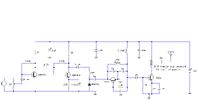
wireless transmitter

tazmania_kid

Dec 28, 2004
19
Joined
Dec 28, 2004
Messages
19
hi, am currently constructing a wireless transmitter operating at 88-108MHZ. I have few doubts here,
1) Can I use a normal wire as my antenna?

2) How am I going to determine the length of the antenna for my transmitter to operate?

3) Is it possible to construct a Tx operating at 475-500MHz?

4) How to improve the tx efficiency?

Thank you in advance.

 
A

Alun

Jan 1, 1970
0
Hi tazmania_kid welcome to the forum, transmitters are fairly easy to build, i will start of by answering your questions.

1) Can I use a normal wire as my antenna?

Yes, just any copper wire will work.

2) How am I going to determine the length of the antenna for my transmitter to operate?

To achieve maximum efficiency a with simple antenna it must be 1/4 of the wavelength of the radio waves you wish to transmit.

The speed of light or c = 299,792,458m/second

Wavelength = c / Frequency

Thus:
Length of Antenna = 1/4 Speed of light / Frequency
1/4 speed of light = 749,481,14.5m/second

So @ 100MHz:

Length = 749,481,14.5/100,000,000 = 0.749481145m

So a 749mm piece of wire will do the job fine.

3)Is it possible to construct a Tx operating at 475-500MHz?

Yes.

4)How to improve the tx efficiency?

The efficiency will depend of the frequency and power and the and the circuit design. It's hard to build efficient transmitters at low frequencies because the antenna needs to be very long and it's difficult at high frequencies because the electronics are harder. It will also depend on the modulation you wish to use, FM is more efficient than AM.

What do you need the transmitter for?

What frequency to you want to transmit?

And at what power level?

Also watch out as it is illegal in most countries to operate radio transmitters with out a licence. Some frequencies may by legal at low powers for example in the UK it's ok to operate a low power transmitter at 27MHz.

By the way does anyone know what other frequencies and at what power level are legal in the uk?


tazmania_kid

Dec 28, 2004
19
Joined
Dec 28, 2004
Messages
19
In regards to Alun's questions:
1) this is actually my final year project and I need to find the ways to improve the tx efficiency theoretically and if possible, practically.

2) my supervisor requested for a 475-500MHz transmitter.

3) the tx power is around 200mW theoretically.

by the way, if i were to change the tx frequency to 475-500MHz, is it true that i will only need to change the capacitor and inductor value in the LC tank circuit?

does anyone know what frequencies are legal in Malaysia?

 
A

Alun

Jan 1, 1970
0
1) this is actually my final year project and I need to find the ways to improve the tx efficiency theoretically and if possible, practically.

Is this for an electronics course?

I don't mind helping you but I'm not going to do all the work for you! :)

2) my supervisor requested for a 475-500MHz transmitter.

Should be no problem, but you will have to pay attention to the construction, vero-board or bred-board will not do at this frequency, at PCB is the only thing adequate.

3) the tx power is around 200mW theoretically.

200mW is fairly low powered, so don't expect a great range.

by the way, if i were to change the tx frequency to 475-500MHz, is it true that i will only need to change the capacitor and inductor value in the LC tank circuit?

Yes.

does anyone know what frequencies are legal in Malaysia?

I don't know, does anyone know a place on the Internet where you can find out what frequencies are free in which countries?

Any tazmania_kid you haven't answered on of my questions:

What do you need the transmitter for?
Data, Audio, Television.

Also if this transmitter is only part of a project you might be better of buying a ready built transmitter module. Building a transmitter can be quite time consuming as getting it to work will require some experimentation. Also you might need specialist equipment such as a frequency counter, oscilloscope, radio scanner, field strength meter etc.


trigger

Aug 7, 2004
236
Joined
Aug 7, 2004
Messages
236
The LC oscillation transmitter will not be stable as it will easily affected when your hand approach it. (frequency drifted)

And also, what will be the modulation is? AM? FM?

 
Last edited by a moderator:
A

Alun

Jan 1, 1970
0
trigger, although LC oscillators are not as stable as crystal oscillators, but they aren't as bad as you think, in fact an LC oscillator can be quite stable. The problem you had was probably because you built one of those simple two transistor transistor transmitters, where the RF output to drive the antenna is taken directly from the LC tank circuit.

When an object is placed near the antenna the reflected waves alter the loading on the LC resonator thus changing it's Q and maybe even affecting L & C slightly thus altering the resonant frequency.

2bjttx.gif


The four transistor FM transmitter is much better, the first two transistors from a better audio amplifier, the 3rd is a colpits oscillator not too dissimilar from the one used in the two transistor circuit. The 4th forms a RF amplifier, this not only provides more power but it isolates the load from the oscillator, thus any change in load (like placing your hand near the antenna) will have no affect the oscillator.

4trtx.gif


Edit: If this image is too small right click on it and click "View" or "Save image" and view it in an image editing program. You really should be able to click on an image to open it in a new window like on other forums I've used.

Another factor is the case, if you leave the circuit unenclosed any RF produced by the circuit can be reflected back on to the circuit by an object placed near the transmitter, this can also affect the oscillator. To solve this problem you should enclose the oscillator section in a separate screened section of the enclosure. This might be as simple as lining the box with aluminium foil, be careful though not to put the circuit too near the screening as the parasitic capacitances formed can mess up the oscillator. You should also build the circuit as small as possible and use a PCB rather than vero board.

 
Last edited:

audioguru2

Apr 6, 2004
12,026
Joined
Apr 6, 2004
Messages
12,026
Hi Tazmania Kid,
If you change the frequency of a simple FM broadcast band transmitter to 475-500MHz, its "general purpose" transistors must be changed to high-frequency types.

Hi Alun,
Thanks for posting and describing your 4 transistor FM transmitter. It would probably need only 3 transistors if the 1st transistor and magnetic mic was replaced by a biased electret mic.


trigger

Aug 7, 2004
236
Joined
Aug 7, 2004
Messages
236
I built a single transistor AM transmitter which worked from 300MHz to 600MHz (adjust the capacitor across the L) which is used for digital data transmission.

I am so lazy that I use the L in the LC tank to act like the antenna and make it as a track loop on the PCB. Actually, I have no choice as I have to use simplest components in that part of the circuit. (I can use saw resonator as RF oscillator but the required transmit frequency does not have a standard one)

The frequency drifted is approx. 5 to 10MHz and I have to use a wide band receiver to cover the drifted frequency.

 
A

Alun

Jan 1, 1970
0
Hi Tazmania Kid,
If you change the frequency of a simple FM broadcast band transmitter to 475-500MHz, its "general purpose" transistors must be changed to high-frequency types.
Yes, a MPSH10 will do instead of the BC548s.

Hi Alun,
Thanks for posting and describing your 4 transistor FM transmitter. It would probably need only 3 transistors if the 1st transistor and magnetic mic was replaced by a biased electret mic.
No doubt you could, in fact the 2-transistor transmitter here uses one of those electret microphones. Oh and another thing, these are not my circuits, I have to thank
http://www.zen22142.zen.co.uk/

I built a single transistor AM transmitter which worked from 300MHz to 600MHz (adjust the capacitor across the L) which is used for digital data transmission.

I am so lazy that I use the L in the LC tank to act like the antenna and make it as a track loop on the PCB. Actually, I have no choice as I have to use simplest components in that part of the circuit. (I can use saw resonator as RF oscillator but the required transmit frequency does not have a standard one)
The use of PCB traces for inductors is common practice in UHF oscillators, also if your just doing simple digital transmission you only really need 2 transistors, one for the oscillator and one for the power stage.
 
Last edited:

hakyman

Dec 30, 2004
49
Joined
Dec 30, 2004
Messages
49
hi all
what about low frequencies is there any solution without taking the antennas lenght bigger?or is there any type antennas has small dimensions?


audioguru2

Apr 6, 2004
12,026
Joined
Apr 6, 2004
Messages
12,026
Hi Hakyman,
AM radios use a ferrite bar antenna that works pretty well at their low frequency. I don't see why it won't also work for transmitting.


tazmania_kid

Dec 28, 2004
19
Joined
Dec 28, 2004
Messages
19
alun, am currently doing electronics courseand i need this tx for audio transmission and at the receiver side, what i need to do is to measure the received power and calculate the indoor path loss. then from the result, i need to study the tx to imrpove its efficiency and reduce interference.
thank you very much for your information ;)


tazmania_kid

Dec 28, 2004
19
Joined
Dec 28, 2004
Messages
19
hi, i wonder whether i can reduce the antenna size by a fraction of the lambda? say (lambda / 8 ), (lambda/16)? what are the pros and cons of this length?

cause if i were to use lambda/4, it will be a very big antenna in which it is not practical.

other than a normal wire, what type of material will improve the antenna efficiency? (my circuit is very unstable and is it due to the antenna or anything else?)


trigger

Aug 7, 2004
236
Joined
Aug 7, 2004
Messages
236
can you give more details about your circuit and the frequency it operated at?

 
A

Alun

Jan 1, 1970
0
alun, am currently doing electronics courseand i need this tx for audio transmission and at the receiver side, what i need to do is to measure the received power and calculate the indoor path loss. then from the result, i need to study the tx to imrpove its efficiency and reduce interference.
thank you very much for your information ;)
I'm sorry but I don't know any easy way of accurately measuring the output of a transmitter.

hi, i wonder whether i can reduce the antenna size by a fraction of the lambda? say (lambda / 8 ), (lambda/16)? what are the pros and cons of this length?

cause if i were to use lambda/4, it will be a very big antenna in which it is not practical.

I thought you were working on a 475 to 500MHz transmitter when a 1/4 wave antenna would only be 16mm, or did you change you're mind?

Hi Hakyman,
AM radios use a ferrite bar antenna that works pretty well at their low frequency. I don't see why it won't also work for transmitting.
I have used an AM radio aerial for a transmitter before, the trick is to connect a capacitor in parallel with it to resonate at the transmitting frequency, its not very efficient though and I wouldn't recommend it above 3MHz. You're best bet is to wind a coil round a large non-metallic frame and connect a capacitor in parallel to form a resonator this will work well from about 100kHz to 20MHz depending on the configuration. At higher frequencies (10 to 100MHz) you could also just use a regular wire antenna and connect an inductor (few turns of wire) in series with it.

other than a normal wire, what type of material will improve the antenna efficiency? (my circuit is very unstable and is it due to the antenna or anything else?)
As far as I'm aware coper wire is best. The reason for this instability is probably because you connected the antenna directly to the LC resonator and or poor constructi0on technique. I have covered this before, read my 3rd reply to this tread.

Anyway tazmania_kid,

What frequency are you using?

And could you please post a the schematic, and I'll do my best to see how it can be improved.
 

tazmania_kid

Dec 28, 2004
19
Joined
Dec 28, 2004
Messages
19
i stick to 88-108MHz as higher frequency will create more problems n more complicated circuit. as am new to circuit construction, i would rather choose a simpler one to begin with.

so with this frequency, 1/4 wave is 0.69m.

View attachment 36493

 
A

Alun

Jan 1, 1970
0
Hi tazmania_kid sorry for the late reply.

The circuit you've posted is on of those 2 transistor circuits I was talking about earlier. I don't normally re-post trhings but I will on this ocasion.

The problem with you're circuit is the RF output to drive the antenna is taken directly from the LC tank circuit. When an object is placed near the antenna the reflected waves alter the loading on the LC resonator thus changing it's Q and maybe even affecting L & C slightly thus altering the resonant frequency.

The four transistor FM transmitter is much better, the first two transistors from a better audio amplifier, the 3rd is a colpits oscillator not too dissimilar from the one used in the two transistor circuit. The 4th forms a RF amplifier, this not only provides more power but it isolates the load from the oscillator, thus any change in load (like placing your hand near the antenna) will have no affect the oscillator.


Another factor is the case, if you leave the circuit unenclosed any RF produced by the circuit can be reflected back on to the circuit by an object placed near the transmitter, this can also affect the oscillator. To solve this problem you should enclose the oscillator section in a separate screened section of the enclosure. This might be as simple as lining the box with aluminium foil, be careful though not to put the circuit too near the screening as the parasitic capacitances formed can mess up the oscillator. You should also build the circuit as small as possible and use a PCB rather than vero board.


MODERATOR EDIT: I have fixed the image so that it can be resized as normal on this site. MP

4trtx.gif

 
Last edited:

tazmania_kid

Dec 28, 2004
19
Joined
Dec 28, 2004
Messages
19
hi alun, thank you very much for your ideas. i will try to assembly it on a PCB as soon as possible and feedback to you ;)

 
Top