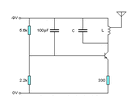
wireless transmitter

A

Alun

Jan 1, 1970
0
You could also try this circuit:
http://web.telia.com/~u85920178/tx/bug5.htm


tazmania_kid

Dec 28, 2004
19
Joined
Dec 28, 2004
Messages
19
Hi all, my transmitter can finally work!
I tried to talk to the mic and use the radio as the receiver, as a result, I can hear my own voice from the radio!
By the way, I tried to use a 1/4 wave antenna and also a very short length antenna, the result is that the radio can receive both signal, why is this so? (as I thought the transmitter can only work at a particular length depending on the frequency we transmit?)

 
A

Alun

Jan 1, 1970
0
Your transmiter will work when the antenna is shorter than 1/4 wave but it won't be as efficent and you won't be able to achieve such a long distance. You will get the best results when both the antennas on the transmiter and reciever are 1/4 wave.

So which circuit did you build then?

And what method of construction did you use?

 
Last edited:

tazmania_kid

Dec 28, 2004
19
Joined
Dec 28, 2004
Messages
19
I use back the original circuit.
Before this, I used a function generator to replace the mic as the input but i am not sure whether this is correct? And at the output, I used an oscilloscope, the result is that the waveform looked weird.
Until last night, I tried to use a mic and also the antenna, and it works! ;D
Next step, I should use a receiver to measure indoor path loss, hopefully it can receive my signal.
By the way, how am I going to determine the max range of the transmitter? (I tried few meters range last night, it still works...)


trigger

Aug 7, 2004
236
Joined
Aug 7, 2004
Messages
236
hmm.......... how do you measure the path loss with the receiver??

just wonder what method you are using........


tazmania_kid

Dec 28, 2004
19
Joined
Dec 28, 2004
Messages
19
By using the indoor path loss formula, I plug in the values like transmitted power, received power (measured by the rx), distance between tx and rx, I can compute the path loss.

Path Loss=PL(d0) + 10nlog(d/d0)
where PL(d0)=10log(Pt/Pr)

*I take d0, the reference distance, as 1m.

 
A

Alun

Jan 1, 1970
0
How did you measure the power?

What is the power output?

Are you measureing the frequency, if so what is the range?

How stable is it?

Does the frequency change when you alter the supply voltage or put something near the antenna?

I've buit one of these circuits today as an experiment, I designed for around 1GHz and it worked too.

At 9V the frequency was 1034.5MHz when I went near the antenna it changed to 1036MHz, and whenI held the antenna it dropped to 933MHz.

The frequency continiously fluctuates by 1MHz or so.

The frequency changes with the power supply, from 1024MHz @ 5V to 1060Mhz @ 20V. Failing that you could connect it to a phase locked loop.

The only way to get round these problems is to use a regulated power supply for the oscillator, build it in a screened box and use a separate RF amplifier to drive the antenna.

I didn't attempt frequency modulation with this circuit - how can you use the frequency to carry information if it continuously varies?

Your circuit will probably be more stable as it only runs at around 100MHz, but these issues will exist to a certain extend.


trigger

Aug 7, 2004
236
Joined
Aug 7, 2004
Messages
236
What I mean is, how to measure the power received by the receiver?

A standard receiver?? A spectrum analyzer? The RSSI output of the receiver (if it does have)? Receiver audio output (it won't work I thnk)???

Also... is the receiver got a reference antenna?

More is, how to measure the transmitter power??


trigger

Aug 7, 2004
236
Joined
Aug 7, 2004
Messages
236
Alun,

I don't have much frequency drift for my 453MHz LC transmitter with voltage variation......

I found that if I use normal variable capacitor to the LC tank, it will drift about 2 to 4 MHz..... but when I use a trim capacitor (I think with better accuracy and temperature variation ) the transmitter frequency is just fine with just 500KHz drift.... even my hands get close to it... it still works within my expected frequency range.


tazmania_kid

Dec 28, 2004
19
Joined
Dec 28, 2004
Messages
19
I have a Communication Service Monitor in my U and am planning to use this equipment as my receiver. In fact, it can also be a spectrum analyser, frequency counter... and so on.

Regarding the tx power, again, am using another formula to manually calculate it. But frankly speaking, I am not sure whether this works... :-\

And how you guys measure the frequency accurately? What are you using?


audioguru2

Apr 6, 2004
12,026
Joined
Apr 6, 2004
Messages
12,026
Hi Tasmania Kid,
You saw it on your 'scope. That crude and simple transmitter transmits AM as well as FM. It also transmits the 2nd harmonic of 100MHz (200MHz) and 3rd harmonic (300MHz), etc. Maybe the majority of its power is in its harmonics. So you can't simply determine its output power at 100MHz from its supply power.

 
A

Alun

Jan 1, 1970
0
I'm using a frequency counter, it works up to 1.1GHz with a tresshold of 10mV and has an impedance 50ohm. I just stick a 75mm piece of tinned coper wire in the co-aill socket and place the transmitter within a couple meters of it. The frequency counter will tick over quite happily as long as the transmitter is within 4 meters of it.

Here's the schematic, I can't remember what transistor I used but it had a max Ic of 20mA and fT of 6GHz. L was an air core inductor with 5 turns of #32 magnet wire wound round a 1mm former with the tap after the first turn, to make the capacitor I just twisted the ends of the wire from the inductor together a few times.

Xmitter.GIF


tazmania_kid

Dec 28, 2004
19
Joined
Dec 28, 2004
Messages
19
Hi Alun, am now trying on the 4 transistor circuit you've posted last time. But what is 7001? An NPN transistor of what series? Simply 7001?

 
A

Alun

Jan 1, 1970
0
The 7001 transistors look like they need to disipate a reasonable amount of power, you could try a 2N5109. Also the effency might be improved by putting a 22pf (experiment with differant vlaues) capacitor across the inductor conected to the antenna, this will form a resonant circuit.

Or you could just connect a power amplifier to the antenna output of your simple 2 transistor circuit.

Here's a scematic:http://www.wenzel.com/pdffiles/class_c.pdf

And I am currently doing some research into class C power amplifiers, here's a very usefull link:
http://hem.passagen.se/communication/clc.html


ECET0purdue

Jan 29, 2005
314
Joined
Jan 29, 2005
Messages
314
just a suggestion but i thought if yoou use 1/2 instead of 1/4 it would be better
cheers,
glen

 
A

Alun

Jan 1, 1970
0
Yes a 1/2 wave dipole would be a good idea and it would be less directional too, but it would need to be 1.5m long.


tazmania_kid

Dec 28, 2004
19
Joined
Dec 28, 2004
Messages
19
Can I use other transistor instead of 2N5109?
In fact, what is the criteria that will affect your choice of transistor used?


shekhar_dandya

Jun 18, 2004
136
Joined
Jun 18, 2004
Messages
136
Hi All,
I was planning to build such an F.M transmitter and got a lot of important information through the threads.thanx EL :).

Actually I was planning to connect such a transmitter to speaker output of my computer so that I can hear MP3 and other music from my computer on my radio FM band.
I think it would require an impedence matching stage at the i/p.but what x'tor configuration to use that has a low i/p impedence(8 ohms) and a high o/p impedence(in kohms)?


The second thing is how do you decide the range of x'mission?
Thanks
-Shekhar


audioguru2

Apr 6, 2004
12,026
Joined
Apr 6, 2004
Messages
12,026
Hi Shekhar,
Which FM transmitter are you going to make?

To drive it from the speaker output of your computer you don't have to match the impedance and you also don't even have to terminate the amplifier with 8 ohms, unless it's a vacuum tube amplifier with an output transformer. Just use a 10K audio-taper volume control to reduce the speaker output to microphone level. Also remove the resistor at the input of the transmitter that supplies power to its electret mic.

The transmitters discussed here are really just toys and are not suitable for transmitting music:
1) Their radio frequency drifts with temperature change, supply voltage change (don't use a battery) and if you move near its antenna.
2) They don't have pre-emphasis, which is treble boost that all FM radio stations have and all FM radios have the opposite (treble cut) to reduce noise. The result will be that your radio will play the transmitter's music without any treble. It will sound like the treble tone control on your radio is turned all the way down.
3) They transmit in mono, not stereo.

There is an FM stereo transmitter IC that is used in many car MP3 to FM adapters. It costs only $2.90US. It uses a crystal and has a Phase-Locked-Loop for rock-solid frequency stability. It must have a powerful radio output because in most circuits it uses an output attenuator. However, it is suface mount only, it is reported to have a fairly high distortion and its audio frequencies above about 10KHz are reduced. I have attached a magazine's circuit that uses it.

View attachment 36536

 
A

Alun

Jan 1, 1970
0
Audioguru,
I agree these transmitters are not good enough for music but they're more than sufficient for voice communication.

Frequency stability isn't too bad if you isolate the oscillator from the antenna with an RF amplifier (see the 4 transistor transmiter) and run the oscillator from a voltage regulator. Temperature is not too much of a problem if you use a decent quality capacitor in the LC tank circuit.

The circuit you posted is the best option for a good quality transmitter but for where the quality is unimportant this level of complexity isn't required.

Another thing, is the attenuator network required or can you omit it to get more power?

You could always connect it to an RF amplifier to get more power too.

tamania_kid,
I don't know exactly, but by looking at the components used to looks like you need something with a high ft ( >500MHz) a resonable power disipation (>1W) and an Ic > 300mA.

Try a 2SC1324.

 
Top