BT150 Thyristor equivalent(BT151) has just exploded !!!

CDRIVE

Hauling 10' pipe on a Trek Shift3
May 8, 2012
4,960
Joined
May 8, 2012
Messages
4,960
You're quite welcome. That circuit (top one) is suitable for SCR's too.

Chris
 

CDRIVE

Hauling 10' pipe on a Trek Shift3
May 8, 2012
4,960
Joined
May 8, 2012
Messages
4,960
Elecbegginner, sorry to tell you this but the DMM method I posted will only work for very small T092 case type thyristors and they're not very common. I'm really beat right now but I hope I have the energy to explain tomorrow. The first circuit I gave you should work though.

Chris

9180d1375931611-bt150-thyristor-equivalent-bt151-has-just-exploded-scrtester.jpg
 

CDRIVE

Hauling 10' pipe on a Trek Shift3
May 8, 2012
4,960
Joined
May 8, 2012
Messages
4,960
This is to EB and anyone else reading this thread:

All my posts regarding DMM thyristor testing is all wet! I'm quite embarrassed by it too! :eek: Normally I sim everything I post unless it's so basic it doesn't warrant it. The fact is, most thyristors require far more gate current (Igt) to trigger and anode current to maintain latch than DMM diode function will provide. Many thyristors will require far more gate trigger voltage (Vgt) too! There are small signal thyristors manufactured in a TO92 case that will work with the DMM setup but are not that common. They require very low Vgt, Igt and Il but they are not what this thread is about.

Lastly, I would love to edit those posts but the time allotted for that has expired, So I guess they're there forever.

EB, the last print I posted should work for SCR's that require no more than ~20mA to trigger, maintain latch and minimum gate trigger voltages under <=9V. This is sufficient for many but the data sheet should always be consulted to verify the specs.


My apologies.
Chris
 

CDRIVE

Hauling 10' pipe on a Trek Shift3
May 8, 2012
4,960
Joined
May 8, 2012
Messages
4,960
Well, my laptop just shut down again so I'm on a backup PC. I just had a thought but I can't test it without my laptop. It will have cooled down and might reboot when I return from the watering hole. Anyway, here it is...

You could probably get the DMM method to work on many thyristors if you hung a big honking cap accross the open terminals of the DMM. Since most DMMs Diode Test employ a constant current source (1mA) with an open circuit voltage of 3V it will take quite some time to charge it before the test switch can be closed. The circuit would also require a series gate and anode resistor though. This makes the 9V battery circuit I posted far more practical anyway.

By the way, I edited the posts that I could.

Chris
 

Elecbegginner

Mar 24, 2013
103
Joined
Mar 24, 2013
Messages
103
I checked with DMM the BT151 with the jumper method , and i can see resistance drop from anode to cathode , i guess this one is a logic level one :D , and also checked all the parts of the card "with the thyristor" and every component looks fine and works very well , i think that this card will only work with its original thyristor " BT150" , the one am placing right now is BT151 , do you think this difference may be a factor ?
 
Last edited:

Elecbegginner

Mar 24, 2013
103
Joined
Mar 24, 2013
Messages
103
This is to EB and anyone else reading this thread:

All my posts regarding DMM thyristor testing is all wet! I'm quite embarrassed by it too! :eek: Normally I sim everything I post unless it's so basic it doesn't warrant it. The fact is, most thyristors require far more gate current (Igt) to trigger and anode current to maintain latch than DMM diode function will provide. Many thyristors will require far more gate trigger voltage (Vgt) too! There are small signal thyristors manufactured in a TO92 case that will work with the DMM setup but are not that common. They require very low Vgt, Igt and Il but they are not what this thread is about.
Lastly, I would love to edit those posts but the time allotted for that has expired, So I guess they're there forever.

EB, the last print I posted should work for SCR's that require no more than ~20mA to trigger, maintain latch and minimum gate trigger voltages under <=9V. This is sufficient for many but the data sheet should always be consulted to verify the specs.


My apologies.
Chris
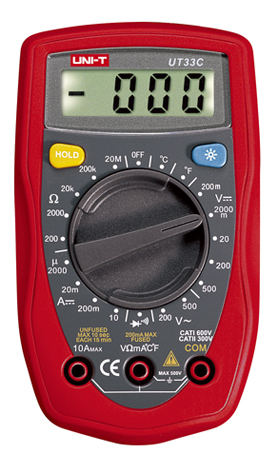
No problem but i guess the DMM am using has done the job , its a :
Uni-t_UT33C.jpg
 

CDRIVE

Hauling 10' pipe on a Trek Shift3
May 8, 2012
4,960
Joined
May 8, 2012
Messages
4,960
Are you saying that the DMM's Diode function worked on the BT151 as I originally thought it would??

I'll compare the specs between the 150 and 151 and get back to you. This PC is up again but don't know for how long.

Chris
 

Elecbegginner

Mar 24, 2013
103
Joined
Mar 24, 2013
Messages
103
Are you saying that the DMM's Diode function worked on the BT151 as I originally thought it would??

I'll compare the specs between the 150 and 151 and get back to you. This PC is up again but don't know for how long.

Chris

Yes , i have followed the steps and it worked , I guess the BT151 belongs to the sensitive gate SCRs type
 
Last edited:

CDRIVE

Hauling 10' pipe on a Trek Shift3
May 8, 2012
4,960
Joined
May 8, 2012
Messages
4,960
Yes , i have followed the steps and it worked , I guess the BT151 belongs to the sensitive gate SCRs type

Yes, but I compared the specs between the 150 and 151 and the gate specs for the 150 are a good deal more sensitive then the 151. The 150 will trigger on a gate current of a mere 15uA and that's in the "Typical" column not the "Minimum"! Google the data sheets to read for yourself.

Oh, I'm quite pleased that my test instructions worked! ;)

Chris
 
Last edited:

Elecbegginner

Mar 24, 2013
103
Joined
Mar 24, 2013
Messages
103
Yes but does it mean the BT151 is not appropriate ?
As for the Datasheets i see an interesting difference in the static characteristics
 
Last edited:

CDRIVE

Hauling 10' pipe on a Trek Shift3
May 8, 2012
4,960
Joined
May 8, 2012
Messages
4,960
Yes but does it mean the BT151 is not appropriate ?

That's difficult to answer without seeing the schematic of the gate driver. Can you reverse engineer it?

Chris
 

Elecbegginner

Mar 24, 2013
103
Joined
Mar 24, 2013
Messages
103
That's difficult to answer without seeing the schematic of the gate driver. Can you reverse engineer it?

Chris

How will i reverse engineer it ? its hard to find a schematic for that specific one
 
Last edited:

CDRIVE

Hauling 10' pipe on a Trek Shift3
May 8, 2012
4,960
Joined
May 8, 2012
Messages
4,960
We've asked this before but have not seen any...Photos! We need good pix of both sides of the PCB. Post the manufacturer and model number.Reverse engineering means drawing the circuit in reverse. IE, what you physically see on the board is drawn to print.

What does the motor control?
Chris
 
Last edited:

CDRIVE

Hauling 10' pipe on a Trek Shift3
May 8, 2012
4,960
Joined
May 8, 2012
Messages
4,960
we'll be waiting but why no pix???

Chris
 

Elecbegginner

Mar 24, 2013
103
Joined
Mar 24, 2013
Messages
103
My phone camera has low resolution , i need at least 5 Mpx to make clear photos .


Once again thanks for the assistance .
 

CDRIVE

Hauling 10' pipe on a Trek Shift3
May 8, 2012
4,960
Joined
May 8, 2012
Messages
4,960
They're not identical.

BTW, you never did determine what caused it to pop in the first place.

Chris
 

Elecbegginner

Mar 24, 2013
103
Joined
Mar 24, 2013
Messages
103
They're not identical.

BTW, you never did determine what caused it to pop in the first place.

Chris

I did , it was a bad motor that caused that (lack of brush carbon caused shorts in the coils ) , but the the variation of speeds problem was existing before that .

So the question is , could the thyristor be responsible for the inability to vary the motor's speed ? or its only acting like a on/off switch ?
 
Last edited:
Top