You are using an out of date browser. It may not display this or other websites correctly.
You should upgrade or use an alternative browser.
You should upgrade or use an alternative browser.
Koford (Slot Car) Bench Power Supply Project
- Thread starter TheChad
- Start date
Scroll to continue with content

Yeah.. wasting power will do that.. This was the idea behind using a relayOkay..
Resistors came in... It's works great, but having the resistor on all the time, it gets HOT! I tried connecting 2 to see if I could share the load, but them they both just got HOT!
So then I thought I would check to see what voltage the center tap on the transformer was... It is 7.2v... But does the center tap still give 8A? Or only 1/2 (4A)?
-TheChad

You can use them in parallel, or in series, but here's how the power will work out:
-Resistor A and Resistor B in parallel will each dissipate the same amount of power. Power wasted in each resistor will not decrease with the addition of A or B. The result is wasting twice as much power as a single resistor.
-Resistor A and Resistor B in series will each dissipate the same amount of power. Power wasted in each resistor will be a quarter of what was wasted when running in parallel. Because there are two of them, the total power wasted will be half of a single resistor.
-To keep the power wasted the same, you can do the following:
--Double the value of the resistors if you want to use them in Parallel.
--Half the value of the resistors if you want to use them in Series.
Regardless though... the trade-off to have permanently mounted resistors to drain the capacitor is wasted power which will be heat. It can be split between 1 or 8 resistors, but the inside of that case will still get warm because of it.
Voltage = Current * Resistance
Power = Voltage * Current
Power = Voltage ^2 / Resistance
My understanding of how transformers work would result in the center tap being able to provide twice the current capability at half the voltage of the outer-most leads.
If you were thinking of using that center-tap for a voltage source for your meter, you would require at least 1 diode and a capacitor to make a rough 'half-wave' rectifier to provide DC to the meter.

My understanding of how transformers work would result in the center tap being able to provide twice the current capability at half the voltage of the outer-most leads.
If you were thinking of using that center-tap for a voltage source for your meter, you would require at least 1 diode and a capacitor to make a rough 'half-wave' rectifier to provide DC to the meter.
No, I was thinking, if I used the center tap instead, the voltage output would be much lower, Since I only need 12v. If I used the center tap that measures 7.2v before rectification, after rectification should be roughly 12v? which would be all I need anyway and possibly be able to not use a resistor at all on the capacitor, or use less resistance...
-TheChad

- Joined
- Jan 21, 2010
- Messages
- 25,510
OK, now you have me really confused.
I thought you were using a switchmode regulator to set the output voltage? Why are you planning to change the taps on the transformer?
The resistors won't change the voltage, they'll just allow it to leak away after the power is switched off.
I think your original issue was that your front panel meter didn't turn off immediately after you removed the power. That's not a big deal, and it's not going to be fixed by changing the taps on the transformer.
You probably know exactly what you're trying to achieve, but I don't. Perhaps you can list all the problems you perceive the supply now having and we can discuss how to fix them (and indeed IF they need to be fixed).
I thought you were using a switchmode regulator to set the output voltage? Why are you planning to change the taps on the transformer?
The resistors won't change the voltage, they'll just allow it to leak away after the power is switched off.
I think your original issue was that your front panel meter didn't turn off immediately after you removed the power. That's not a big deal, and it's not going to be fixed by changing the taps on the transformer.
You probably know exactly what you're trying to achieve, but I don't. Perhaps you can list all the problems you perceive the supply now having and we can discuss how to fix them (and indeed IF they need to be fixed).
It may be worth a try.. I'm thinking you may get closer to 10V though..
Edit: As Steve listed above, he pretty much nailed it.
Using the center tap instead to power the input of your switch mode voltage converter will result in a lower voltage, which could result in the meter powering off sooner, but I would call it a far from ideal solution.
Edit: As Steve listed above, he pretty much nailed it.
Using the center tap instead to power the input of your switch mode voltage converter will result in a lower voltage, which could result in the meter powering off sooner, but I would call it a far from ideal solution.
OK, now you have me really confused.
I thought you were using a switchmode regulator to set the output voltage? Why are you planning to change the taps on the transformer?
The resistors won't change the voltage, they'll just allow it to leak away after the power is switched off.
I think your original issue was that your front panel meter didn't turn off immediately after you removed the power. That's not a big deal, and it's not going to be fixed by changing the taps on the transformer.
You probably know exactly what you're trying to achieve, but I don't. Perhaps you can list all the problems you perceive the supply now having and we can discuss how to fix them (and indeed IF they need to be fixed).
What I was saying is that if I used the center tap on the transformer, the initial voltage will be quite a bit lower, thus the capacitor would bleed off faster, because instead of bleeding off 19v it would only bleed off 12v..
The problem now is that the resistor I have to drain off the capacitor gets really hot... I knew it was going to get warm, but I was hoping it would stay worm and not go hot.
I'm not soo concerned with the meter power staying on after I switch the power off, but I don't want it staying on as long as it does.. I would like it to power off with in about 3-5 seconds of cutting the main power.
It may be worth a try.. I'm thinking you may get closer to 10V though..
Edit: As Steve listed above, he pretty much nailed it.
Using the center tap instead to power the input of your switch mode voltage converter will result in a lower voltage, which could result in the meter powering off sooner, but I would call it a far from ideal solution.
My thought was, that I don't need it putting out 19v.... so I was thinking if using the center tap would result in like 12-13v then I could eliminate having all that extra voltage. Just thought it might be an easy solution...
-TheChad
- Joined
- Jan 21, 2010
- Messages
- 25,510
The best (well, maybe not the best, but a good) solution is to use a relay to connect that 100 ohm resistor across the caps as power is switched off. Because it is only connected as the power is turned off, it will probably hardly even get warm. You could place several in parallel to make them act faster. Note that if the relay fails, the resistors might be always connected. They will get hot, but if they are appropriately rated and have sufficient airflow they won't burn up.
You have a regulator that requires some additional voltage to maintain regulation, if you use the centre tap you'll lose regulation. Because it's a switchmode regulator, the additional input voltage is not a nasty overhead that causes problems.
You have a regulator that requires some additional voltage to maintain regulation, if you use the centre tap you'll lose regulation. Because it's a switchmode regulator, the additional input voltage is not a nasty overhead that causes problems.
So a thought popped in my head... I hope it's decent...
Can't an active low 'low-voltage' detector be used to power the meter?
A zener diode and resistor form a voltage divider that will determine the threshold voltage at which the transistor begins to saturate.
It would use 3, maybe 4 small components max. Would not give off heat, and would fit in the case. It would not click like the relay.
It would operate for a time in the linear region as the device powers down and the voltage fades from the capacitor, but the threshold could be adjusted by carefully picking different resistor/zener values.
I have not built such a device, but the logic is there. Can someone confirm if I'm sleep deprived, or if I'm sleep deprived and found a decent solution?
Can't an active low 'low-voltage' detector be used to power the meter?
A zener diode and resistor form a voltage divider that will determine the threshold voltage at which the transistor begins to saturate.
It would use 3, maybe 4 small components max. Would not give off heat, and would fit in the case. It would not click like the relay.
It would operate for a time in the linear region as the device powers down and the voltage fades from the capacitor, but the threshold could be adjusted by carefully picking different resistor/zener values.
I have not built such a device, but the logic is there. Can someone confirm if I'm sleep deprived, or if I'm sleep deprived and found a decent solution?
Okay, so RadioShack had several Relay's on clearance, I picked up a couple, I don't know if either will work or not, but I figured for a couple of $'s, I can always take them back if I don't use them...
Anyway I believe this is the proper datasheet for the Tyco Electronics SRUDH-SS-109L
and the Tyco Electronics PCLH-206A1S
Will either of these work? Preferably the Tyco SRUDH-SS-109L because it's a lot smaller! If so, I will need assistance on how to connect everything as there are multiple terminals...
Thanks,
-TheChad
Anyway I believe this is the proper datasheet for the Tyco Electronics SRUDH-SS-109L
and the Tyco Electronics PCLH-206A1S
Will either of these work? Preferably the Tyco SRUDH-SS-109L because it's a lot smaller! If so, I will need assistance on how to connect everything as there are multiple terminals...
Thanks,
-TheChad
- Joined
- Jan 21, 2010
- Messages
- 25,510
OK, the first one is 9V DC relay capable of switching 12A. And it indicates that even switching at the full 12A it will have a life of 7000 or more cycles and that's heaps.
I would recommend you rectify the AC from the centre tap of the transformer (a single diode would be OK) with a small capacitor across the coil (10uF should be sufficient).
The common pin should be connected to the positive end of the main filter capacitors.
The NC pin should be connected to your capacitor discharge resistor so that the caps are discharged when the power is removed.
The NO pin can be used to connect to the regulator. This will remove power from the regulator (and the load, and the meters) immediately the power is removed.
The wiring diagram in the datasheet shows the NC connection as the one "connected" to the common pin by the diagonal line. This is what is connected when there is no power to the relay coil.
I would recommend you rectify the AC from the centre tap of the transformer (a single diode would be OK) with a small capacitor across the coil (10uF should be sufficient).
The common pin should be connected to the positive end of the main filter capacitors.
The NC pin should be connected to your capacitor discharge resistor so that the caps are discharged when the power is removed.
The NO pin can be used to connect to the regulator. This will remove power from the regulator (and the load, and the meters) immediately the power is removed.
The wiring diagram in the datasheet shows the NC connection as the one "connected" to the common pin by the diagonal line. This is what is connected when there is no power to the relay coil.
I just connected to 100Ω 5w resistors end to end (Series?) and they both only get barely above warm. I held them in my hand with no need to let go of them from the heat.
They drain off the capacitor in ~5 seconds which is perfectly acceptable.
I think this will work.
-TheChad
They drain off the capacitor in ~5 seconds which is perfectly acceptable.
I think this will work.
-TheChad
So, connecting two 100Ω resistors end to end (series?) gives me ~200Ω.... Connecting two 100Ω resistors + to + and - to - (parallel?) gives me ~50Ω? Is that right? That's what I measured with the ohm meter...
I am thinking in terms of batteries, If you connect batteries in Series they multiply, IE: 1.5v + 1.5v = 3.0v, however if you connect them in parallel, they maintain the same voltage 1.5v, but double capacity. So is that why a resistor measures 50Ω? because it doubled capacity of 100Ω = 50Ω? (Just trying to make sure I understand)..
So if I were to order a 200Ω resistor, would it be as warm as the two 100Ω resistors in series? or will it be hotter because it's a single resistor instead of sharing the load over 2 resistors?
For example would it be as hot as both resistors added together? if resistor A = 70-degrees and resistor B = 70-degrees, a single 200Ω resistor would = 140-degrees? or would the 200Ω resistor still only = 70-degrees?
Thanks again! It's almost done!!
-TheChad
I am thinking in terms of batteries, If you connect batteries in Series they multiply, IE: 1.5v + 1.5v = 3.0v, however if you connect them in parallel, they maintain the same voltage 1.5v, but double capacity. So is that why a resistor measures 50Ω? because it doubled capacity of 100Ω = 50Ω? (Just trying to make sure I understand)..
So if I were to order a 200Ω resistor, would it be as warm as the two 100Ω resistors in series? or will it be hotter because it's a single resistor instead of sharing the load over 2 resistors?
For example would it be as hot as both resistors added together? if resistor A = 70-degrees and resistor B = 70-degrees, a single 200Ω resistor would = 140-degrees? or would the 200Ω resistor still only = 70-degrees?
Thanks again! It's almost done!!
-TheChad
Yes, that's right.So, connecting two 100Ω resistors end to end (series?) gives me ~200Ω.... Connecting two 100Ω resistors + to + and - to - (parallel?) gives me ~50Ω? Is that right? That's what I measured with the ohm meter...
In a sense... there is a formula for determining this.I am thinking in terms of batteries, If you connect batteries in Series they multiply, IE: 1.5v + 1.5v = 3.0v, however if you connect them in parallel, they maintain the same voltage 1.5v, but double capacity. So is that why a resistor measures 50Ω? because it doubled capacity of 100Ω = 50Ω? (Just trying to make sure I understand)..
Series connections have a constant current, and the voltage is additive.
Parallel connections have a constant voltage, and the current is additive.
Resistance in parallel = 1/( 1/R1 + 1/R2 + 1/R3 + ... + 1/Rn )
Resistance in series = R1 + R2 + R3 + ... + Rn
The wasted power would be the same... but combined, two resistors are physically bigger and can dissipate the power into the air easier so two will feel cooler. A single resistor would concentrate the same wasted power in a smaller area and would be hotter. (Note that the temperature inside the case would be the same... it's just the individual resistors would vary)So if I were to order a 200Ω resistor, would it be as warm as the two 100Ω resistors in series? or will it be hotter because it's a single resistor instead of sharing the load over 2 resistors?
This would not quite be true... there is some more math required here that I don't know yet.For example would it be as hot as both resistors added together? if resistor A = 70-degrees and resistor B = 70-degrees, a single 200Ω resistor would = 140-degrees? or would the 200Ω resistor still only = 70-degrees?
Instead of thinking of a resistor at a specific temperature, think of it in Watts.
If resistors A and B each dissipate 1.5W, they will collectively warm the air the same as resistor C dissipating 3W. The temperature at the surface of the resistor would not simply be double. Things to consider is at what rate can the resistor 'loose' heat into the air. If this rate is low, the resistor will be hotter, if this rate is high it will be cooler. (Heatsinks help to increase the rate at which heat can be 'lost' into the surrounding air.) The power the resistor is dissipating will cause the resistor to heat up, while the surface of the resistor is allowing it to cool...
That's about all I can tell you with my current understanding.
You're welcome! (I think it's amusing how something so simple has exploded... you tend to get sidetracked like I do)Thanks again! It's almost done!!
-Gryd3-TheChad
You're welcome! (I think it's amusing how something so simple has exploded... you tend to get sidetracked like I do)
-Gryd3
Yeah, I'm very analytical, I often over analyze things, I will do something, it will work, but I'll wonder if I could have or should have done it differently, even if the same result is achieved.
But I always try to do things the correct way, never 1/2-ass it or do something wrong just because it works...
Anyway, on that note, LOL...
I was browsing Mouser and found this: http://www.mouser.com/ProductDetail...=sGAEpiMZZMtlubZbdhIBIDTODbDtFnrROxdF6lOjpss=
So I was thinking, maybe that is the ultimate solution, I can get 2 of them, wire them in series and glue them down to the power supply case, with the heatsink on the resistor and it being glued to the case, the heat will hopefully end up in the case instead of inside the power supply and keep the insides cooler.
-TheChad
Before you do that.Yeah, I'm very analytical, I often over analyze things, I will do something, it will work, but I'll wonder if I could have or should have done it differently, even if the same result is achieved.
But I always try to do things the correct way, never 1/2-ass it or do something wrong just because it works...
Anyway, on that note, LOL...
I was browsing Mouser and found this: http://www.mouser.com/ProductDetail/Vishay-Dale/RE60G1000C02/?qs=sGAEpiMZZMtlubZbdhIBIDTODbDtFnrROxdF6lOjpss=
So I was thinking, maybe that is the ultimate solution, I can get 2 of them, wire them in series and glue them down to the power supply case, with the heatsink on the resistor and it being glued to the case, the heat will hopefully end up in the case instead of inside the power supply and keep the insides cooler.
-TheChad
What kind of spare parts do you have handy?
I'm interested in knowing the capacitor values, and if you have diodes kickin around...
The thought is powering your meter from the center-tap of the transformer, and building a very basic half-wave rectifier with a small capacitor and diode to 'regulate' the voltage to the meter.
Cheaper parts, and would waste less power.
HTML:
http://datasheet.octopart.com/PCLH-206A1S-Tyco-Electronics-datasheet-15179.pdfBefore you do that.
What kind of spare parts do you have handy?
I'm interested in knowing the capacitor values, and if you have diodes kickin around...
The thought is powering your meter from the center-tap of the transformer, and building a very basic half-wave rectifier with a small capacitor and diode to 'regulate' the voltage to the meter.
Cheaper parts, and would waste less power.
I don't have many parts laying around...
My Inventory consists of:
1. 100x - 0.25w 20k ohm Resistors
2. 4x - 0.5w 1-Mag ohm Resistors
3. 4x - 1w 100 Ohm Resistor
4. 1x - 100uF 35VDC Capacitor
5. 1x - 4700uF 35VDC Capacitor
6. 1x - 33000uF 10VDC Capacitor
7. 1x - Tyco Electronics SRUDH-SS-109L
8. 1x - Tyco Electronics PCLH-206A1S
Remember I don't have a lot of extra space..
Thanks!
-TheChad
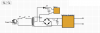
This is what I was thinking for the meter.
Use the center tap. One diode, and a capacitor for the positive side to the meter. The negative goes to one of the other wires on the transformer.
All you need is a diode, you could try it with the 100uF capacitor. (Although, it may be too small depending on the draw of the meter.)
Use the center tap. One diode, and a capacitor for the positive side to the meter. The negative goes to one of the other wires on the transformer.
All you need is a diode, you could try it with the 100uF capacitor. (Although, it may be too small depending on the draw of the meter.)
Attachments
This is what I was thinking for the meter.
Use the center tap. One diode, and a capacitor for the positive side to the meter. The negative goes to one of the other wires on the transformer.
All you need is a diode, you could try it with the 100uF capacitor. (Although, it may be too small depending on the draw of the meter.)
The operating current for the meter is <20mA according to the spec sheet.
The meter has an operating voltage range from 4.5v - 30v. Would it even need the capacitor?
http://www.radioshack.com/1n4004-mi...&sz=12&srule=Price-low-high&prefv1=RadioShack
OR
http://www.radioshack.com/3a-barrel...e-low-high&prefv1=RadioShack&start=6&tab=tab2
Would either of these be what I should get? Or something different?
Thanks!
-TheChad
Last edited:
I'd go with the first one, but I don't like the priceThe operating current for the meter is <20mA according to the spec sheet.
The meter has an operating voltage range from 4.5v - 30v. Would it even need the capacitor?
http://www.radioshack.com/1n4004-mi...&sz=12&srule=Price-low-high&prefv1=RadioShack
OR
http://www.radioshack.com/3a-barrel...e-low-high&prefv1=RadioShack&start=6&tab=tab2
Would either of these be what I should get? Or something different?
Thanks!
-TheChad
As far as the capacitor is concerned, I would say it is required.
The simple rectifier we are making to power the meter is called a half-wave rectifier. Voltage will be 0 half the time, and without a capacitor to average this out, the meter may end up just flicking on/off 60 times a second or getting damaged.

This is a sample picture from online. The black line is the voltage level with a capacitor, the line behind it is the top half of the sine-wave that makes it through the diode. You'll notice the black line slopes downward after each pulse. Smaller capacitor or a bigger load will make the voltage drop faster inbetween pulses. You know what the load is though, and we only need to keep the line above the 4.5V range though...
Similar threads
- Replies
- 6
- Views
- 595


- Replies
- 1
- Views
- 4K
- Replies
- 4
- Views
- 4K

- Replies
- 3
- Views
- 2K

- Replies
- 1
- Views
- 3K