Designing a Time Delayed Relay

KrisBlueNZ

Sadly passed away in 2015
Nov 28, 2011
8,393
Joined
Nov 28, 2011
Messages
8,393
Out of curiosity, would it have been safer to isolate the bridge rectifier output to the converter with a transformer?
You mean use a transformer to supply the micro, etc? Well, considering how big the circuit has become, that would probably be a reasonable option. Back in the beginning, the whole design was going to be quite small and simple, and I thought it would be worthwhile to use a capacitor-fed power supply, to save weight, some space, and some cost, because isolation is already required between the micro and each current input, and between the micro and the relay output. So strictly speaking, isolation between the micro and the incoming power supply is not needed.

But you could certainly argue that it would have been better to use a power transformer and a simple linear regulator to produce a single 5V rail, to power the micro, the Allegro chips, and a relay with a 5V coil. This might avoid the requirement for a heatsink, and the tiny SMT power supply IC.

This is a problem I've had before. When requirements change, I fail to re-evaluate the overall scheme of the design and reconsider the basic assumptions I made when starting out.
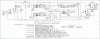
268425.010.GIF

Here's the circuit using a mains-frequency transformer for the input supply. There is no +48V rail and the relay coil runs at 5V along with the rest of the circuitry.

There is no active zener. Only U1, the linear regulator, will dissipate significant power; this should be less than 1W so a heatsink may not be needed. The tab will be at the 0V rail potential so you don't need isolated copper areas. There are a lot fewer components, though C1 is physically larger than the smoothing capacitor in the other design. But you could get away with a 470 µF cap there I'm sure.

Sorry to do this to you! If you decide to switch to this circuit, you can console yourself that the time you spent tightening the previous layout was still a useful learning experience :-/
 

chopnhack

Apr 28, 2014
1,576
Joined
Apr 28, 2014
Messages
1,576
Sorry to do this to you! If you decide to switch to this circuit, you can console yourself that the time you spent tightening the previous layout was still a useful learning experience :-/

LOL, no worries - that is part of the design process. I had a look at various transformers, are there any you could recommend that would be of the smallest form factor? I wanted to build a bom and see what I was looking at. With regards to the smoothing cap, from my previous experience seeing how large a capacitance is needed, I would not try to skimp - if you think 1k is needed, I believe it! I was thinking of using two 470u in parallel to save space. Is that ok? I will look for some low ESR caps.
 

KrisBlueNZ

Sadly passed away in 2015
Nov 28, 2011
8,393
Joined
Nov 28, 2011
Messages
8,393
I think Digi-Key's best option is http://www.digikey.com/product-detail/en/F20-120-C2-B/237-1491-ND/3986400 which is 35 × 29 mm and 30 mm high. Mouser have a similar range. That one has a secondary voltage of 10V AC.

Maximum load current will be about 120 mA (80 mA for the relay coil, 30 mA for the two Allegro chips, and 10 mA for anything else), or about 1.2 VA for a 10V seconday. That transformer's secondary is rated for 240 mA, i.e. 2.4 VA, twice what's needed, and Digi-Key have 2.0 VA and 1.6 VA transformers, but they're no smaller, and more expensive, so that one seems like a good choice.

Re the smoothing cap, I hadn't done the calculations. 470 µF at 120 Hz ripple frequency and 120 mA load will have a ripple depth of roughly

dV = I dT / C
= 0.12 × 0.008333 / 0.00047
= 2.1V p-p

That seems a bit high to me; I'd go for 1000 µF. Yes, two 470 µF in parallel is a good idea. If you can find 20V rated parts, use them and save a bit more space. ESR isn't important at all - this is just 120 Hz smoothing - but don't skimp on quality. I'd use http://www.digikey.com/product-detail/en/EKY-250ELL471MH20D/565-1550-ND/756066

Edit: A fuse in the primary side would be appropriate. 100~200 mA time delay or slow-blow 20 mm glass fuse with two fuse clips.
 

chopnhack

Apr 28, 2014
1,576
Joined
Apr 28, 2014
Messages
1,576
I think Digi-Key's best option is http://www.digikey.com/product-detail/en/F20-120-C2-B/237-1491-ND/3986400 which is 35 × 29 mm and 30 mm high. Mouser have a similar range. That one has a secondary voltage of 10V AC.

Maximum load current will be about 120 mA (80 mA for the relay coil, 30 mA for the two Allegro chips, and 10 mA for anything else), or about 1.2 VA for a 10V seconday. That transformer's secondary is rated for 240 mA, i.e. 2.4 VA, twice what's needed, and Digi-Key have 2.0 VA and 1.6 VA transformers, but they're no smaller, and more expensive, so that one seems like a good choice.

Re the smoothing cap, I hadn't done the calculations. 470 µF at 120 Hz ripple frequency and 120 mA load will have a ripple depth of roughly

dV = I dT / C
= 0.12 × 0.008333 / 0.00047
= 2.1V p-p

That seems a bit high to me; I'd go for 1000 µF. Yes, two 470 µF in parallel is a good idea. If you can find 20V rated parts, use them and save a bit more space. ESR isn't important at all - this is just 120 Hz smoothing - but don't skimp on quality. I'd use http://www.digikey.com/product-detail/en/EKY-250ELL471MH20D/565-1550-ND/756066

Edit: A fuse in the primary side would be appropriate. 100~200 mA time delay or slow-blow 20 mm glass fuse with two fuse clips.

Thanks Kris! I will start to work on this later in the week. No 20v caps, 16v and 25v seem to be pretty common. I will see what room we have on the board before worrying about this. As for the slow blow fuse, 160mA are available - that should exceed the max needed by the circuit. Thanks again :)
 

chopnhack

Apr 28, 2014
1,576
Joined
Apr 28, 2014
Messages
1,576
I think Digi-Key's best option is http://www.digikey.com/product-detail/en/F20-120-C2-B/237-1491-ND/3986400 which is 35 × 29 mm and 30 mm high. Mouser have a similar range. That one has a secondary voltage of 10V AC.

Maximum load current will be about 120 mA (80 mA for the relay coil, 30 mA for the two Allegro chips, and 10 mA for anything else), or about 1.2 VA for a 10V seconday. That transformer's secondary is rated for 240 mA, i.e. 2.4 VA, twice what's needed, and Digi-Key have 2.0 VA and 1.6 VA transformers, but they're no smaller, and more expensive, so that one seems like a good choice.


Edit: A fuse in the primary side would be appropriate. 100~200 mA time delay or slow-blow 20 mm glass fuse with two fuse clips.

Kris, I was reading the spec sheet for the transformer and it claims: 8. Inherently Limited. No fusing required.
Does that mean the transformer itself blows open when shorted? I am guessing because of the low amperage through it, the small wires act as fuses. Does this mean that the fuse is a waste? Or should I select a lower/faster fuse?
 

KrisBlueNZ

Sadly passed away in 2015
Nov 28, 2011
8,393
Joined
Nov 28, 2011
Messages
8,393
I see what you mean.

no fusing required.png
I don't know what's the best way to approach this. I think there should be a fuse somewhere. I'll ask Steve for his opinion.
 

(*steve*)

¡sǝpodᴉʇuɐ ǝɥʇ ɹɐǝɥd
Moderator
Jan 21, 2010
25,510
Joined
Jan 21, 2010
Messages
25,510
Hi, I've been asked to make some comments. I'll add what little I can.

"Inherently Limited" (for a transformer) means that the primary current and therefore potential dissipation is limited by the primary's impedance or a thermal fuse, etc. Even given this, I would add a fuse because it's cheap and extra protection won't hurt. I'd possibly go for a non-removeable fuse because the chance of it blowing is low.

Here is a link I found.
 

KrisBlueNZ

Sadly passed away in 2015
Nov 28, 2011
8,393
Joined
Nov 28, 2011
Messages
8,393
Thanks Steve!

I should have looked for applications info from Tamura :-(

That document you linked to says "An Inherently Limited transformer has designed into it an impedance that limits the current output to a maximum value. This coupled with the correctly sized transformer limits the temperature under a full line voltage and shorted secondary to a safe level."

So it doesn't need a fuse at all - in the primary or the secondary.

I can't add to Steve's opinion on including a fuse anyway, except to say that you should if you're going to provide footprints for more than one type of transformer (to make the layout more flexible for later reuse or future part replacement), so you could use a different transformer that doesn't have this "inherently limited" feature.
 

chopnhack

Apr 28, 2014
1,576
Joined
Apr 28, 2014
Messages
1,576
Thanks guys! Another interesting appearance of reactance. :) No fuse it is. If the transformer needs to be replaced in the future, I can pig tail one in. Shame I spent 30 minutes modeling the fuse in Eagle :eek: - getting easier though!
 

chopnhack

Apr 28, 2014
1,576
Joined
Apr 28, 2014
Messages
1,576
The transformer takes up some serious real estate! I am really tempted to use the reverse side of the board for components. I know you said to not do this because it can lead to assembly errors and a generally untidy appearance, but I was thinking of putting the bridge and some discretes on the reverse side. Also, having looked at these drawings a few times, I think my through hole components that have obscured pads should be blue traces to be solder from below. What are your thoughts?


upload_2014-11-23_15-25-4.png
 

KrisBlueNZ

Sadly passed away in 2015
Nov 28, 2011
8,393
Joined
Nov 28, 2011
Messages
8,393
Yes, I see your point. You might like to put the large THT components on the underside - the transformer and the relay, and perhaps the connectors. Assuming the transformer sits well above the board, you can even put THT components on the opposite side of the board - the electrolytics, for example; you could actually use most of the area "under" (on the other side of) the transformer. Fit the underneath components last. You could even use SMT electrolytics: http://www.digikey.com/product-detail/en/UCW1E471MNL1GS/493-9424-1-ND/3962772 and switch all your resistors, capacitors and the transistor to SMT, so there are no leads poking through on the side with the transformer, relay and connectors. Just a thought.

I agree that it's good to avoid tracks on the same side as large components when they will be covered by the component. Except that high-current paths should have copper on both sides, and vias between.

You should connect both secondaries of the transformer in parallel.

You can also get fully integrated power modules with regulated 5V outputs that are smaller than that transformer: http://www.digikey.com/product-detail/en/VSK-S2-5U/102-2589-ND/3316493 (but more expensive, even if you subtract the bridge, the two 470 µF capacitors and the 7805).
 

chopnhack

Apr 28, 2014
1,576
Joined
Apr 28, 2014
Messages
1,576
Thanks Kris :) I will look at some more layout options. Only the tiniest heights can go on the backside - say no more than 3mm high. I have 5mm offsets that I intend to use.
 

KrisBlueNZ

Sadly passed away in 2015
Nov 28, 2011
8,393
Joined
Nov 28, 2011
Messages
8,393
Only the tiniest heights can go on the backside - say no more than 3mm high. I have 5mm offsets that I intend to use.
Unless you put ALL of the tall items on the underside, right?
 

chopnhack

Apr 28, 2014
1,576
Joined
Apr 28, 2014
Messages
1,576
Unless you put ALL of the tall items on the underside, right?
eh?

Perhaps a matter of symantics. I was referring to the back side or under side as the side that will face down into the box and have the least clearance.

You pulling my leg? :D:p
 

KrisBlueNZ

Sadly passed away in 2015
Nov 28, 2011
8,393
Joined
Nov 28, 2011
Messages
8,393
No. Which side you call the top and which side you call the bottom depends on your point of view, but in designs where space is tight, it's common to put the THT and tall parts on one side of the the board, and all or most of the SMT parts (low profile) on the other, in the gaps under the large THT components. It also fits well with wave soldering, which is irrelevant nowadays. So whether you put the tall and THT components on the underside and the SMT stuff on the top side, and mount the board "upside down", or the reverse, the result is the same.
 

chopnhack

Apr 28, 2014
1,576
Joined
Apr 28, 2014
Messages
1,576
Thank you for clearing that up! It makes sense from a manufacturing standpoint.
Cool thing is I get to break with convention there since its a hand soldered one of :cool:
 

chopnhack

Apr 28, 2014
1,576
Joined
Apr 28, 2014
Messages
1,576
Oh F.F.S......... :mad:

Eagle crashed taking my last revision with it! This has not been my "electrical" week! :(
 

KrisBlueNZ

Sadly passed away in 2015
Nov 28, 2011
8,393
Joined
Nov 28, 2011
Messages
8,393
Code:
https://www.youtube.com/watch?v=o7B6IHgV4Qk
Yes, well, that's quite enough of that thank you very much!
 

chopnhack

Apr 28, 2014
1,576
Joined
Apr 28, 2014
Messages
1,576
Code:
https://www.youtube.com/watch?v=o7B6IHgV4Qk
Yes, well, that's quite enough of that thank you very much!
LOL, I am better today... Only lost about 30 minutes worth of work, just one of those things - If it was going to happen, it did type of thing, ya know?
 
Top