- Joined
- Nov 28, 2011
- Messages
- 8,393
You mean use a transformer to supply the micro, etc? Well, considering how big the circuit has become, that would probably be a reasonable option. Back in the beginning, the whole design was going to be quite small and simple, and I thought it would be worthwhile to use a capacitor-fed power supply, to save weight, some space, and some cost, because isolation is already required between the micro and each current input, and between the micro and the relay output. So strictly speaking, isolation between the micro and the incoming power supply is not needed.Out of curiosity, would it have been safer to isolate the bridge rectifier output to the converter with a transformer?
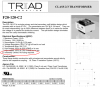
But you could certainly argue that it would have been better to use a power transformer and a simple linear regulator to produce a single 5V rail, to power the micro, the Allegro chips, and a relay with a 5V coil. This might avoid the requirement for a heatsink, and the tiny SMT power supply IC.
This is a problem I've had before. When requirements change, I fail to re-evaluate the overall scheme of the design and reconsider the basic assumptions I made when starting out.
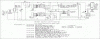
Here's the circuit using a mains-frequency transformer for the input supply. There is no +48V rail and the relay coil runs at 5V along with the rest of the circuitry.
There is no active zener. Only U1, the linear regulator, will dissipate significant power; this should be less than 1W so a heatsink may not be needed. The tab will be at the 0V rail potential so you don't need isolated copper areas. There are a lot fewer components, though C1 is physically larger than the smoothing capacitor in the other design. But you could get away with a 470 µF cap there I'm sure.
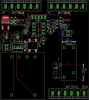
Sorry to do this to you! If you decide to switch to this circuit, you can console yourself that the time you spent tightening the previous layout was still a useful learning experience :-/