Assistance with Transistor Theory

Status
Not open for further replies.

Laplace

Apr 4, 2010
1,252
Joined
Apr 4, 2010
Messages
1,252
The FET works as a transconductance device. That is why the manufacturer's datasheet specifies the forward transconductance or transadmittance of the device.

The BJT works as a current amplifier. That is why the manufacturer's datasheet specifies the current gain of the device.

To the extent that the BJT behaves as a transconductance device, the job of the circuit designer is to overcome the bad behavior of the device.
 

Ratch

Mar 10, 2013
1,102
Joined
Mar 10, 2013
Messages
1,102
Laplace,

"The FET works as a transconductance device. That is why the manufacturer's datasheet specifies the forward transconductance or transadmittance of the device."

Yes, BJT's, FET's, and tubes are all transconductance devices. The transconductance of FET's and tubes are linear, so their transconductance is given by the manufacturer. The transconductance of BJT's are exponential and highly variable due to their diffusion mechanism, so it is not published.

" The BJT works as a current amplifier. That is why the manufacturer's datasheet specifies the current gain of the device."

The manufacturer publishes the gain of a test circuit which contains the BJT.

"To the extent that the BJT behaves as a transconductance device, the job of the circuit designer is to overcome the bad behavior of the device."

True, a BJT has a exponential relationship with its Vbe and Ic. Different schemes are used to overcome this nonlinearity.

Ratch
 

Laplace

Apr 4, 2010
1,252
Joined
Apr 4, 2010
Messages
1,252
The manufacturer publishes the gain of a test circuit which contains the BJT.
It should not be suprizing that a BJT must be properly biased in a circuit before it will exhibit its behavior as a current amplifier.
 

Ratch

Mar 10, 2013
1,102
Joined
Mar 10, 2013
Messages
1,102
It should not be suprizing that a BJT must be properly biased in a circuit before it will exhibit its behavior as a current amplifier.

As long as the BJT is biased to be in its active region, it will be a transconductance amplifer. The components added to the BJT determine whether the circuit is a current, voltage, or whatever amplifier. Did you not read the link given in post #38 of this thread, which quotes the knowledgeable guy who wrote a book of transistor design?

Ratch
 

Laywah

Dec 19, 2014
9
Joined
Dec 19, 2014
Messages
9
Sorry, I didn't intend to start a flame-war.
I value everyone's input and understanding of what they believe a transistor is and what its functions are.

Ratch,
Thanks for trying to provide some detail into the specific questions.

Reading everyone's posts, i am getting a more general understanding and that is quite a good thing, especially to see some of the different ideas that have been used and how people are using them.

Luke V,
I completely agree with trial and error and I apply that principle all the time. I was simply just trying to clarify some theory that I never had/understood. I never did electronics in High school or tertiary education and I was never someone who studied physics so all this is completely new to me.

Thanks again everyone for your insight on this topic :)
 

LvW

Apr 12, 2014
604
Joined
Apr 12, 2014
Messages
604
The BJT works as a current amplifier. That is why the manufacturer's datasheet specifies the current gain of the device.
Laplace - are you aware that you are repeating a claim - nothing else?
Can you present one single justification for your claim (we speak about the BJT alone - not about a test circuit)?
Of course, in a test circuit even an opamp (undoubtly, voltage-controlled?) can act as a current-to-voltage converter.
Why don`t you give some comments to my technical examples (post#17 and post#33)?
Do you need more examples?
If you try to understand the characteristic curves given in the data sheets [Ic=f(Vce) and Ic=f(Vbe)] you will see that they proof the voltage-control properties of the BJT.

And - do you really ask why the "manufacturer's datasheet specifies the current gain of the device".?
Answer: Because the current Ib, of course, must be taken into account during the design of BJT circuits. But this has nothing to do with any controlling function. (Unfortunately, in the past the term "current gain" was invented). Do you know that in some FET data sheets also the term "current gain" is used? I couldn`t believe, but it`s true.
 
Last edited:

LvW

Apr 12, 2014
604
Joined
Apr 12, 2014
Messages
604
I knew I should not have stepped into this thread.
Bob
Why? It is my experience that such a discussion - if it is a fair and technically oriented sequence of questions and answers - is the best method to improve the knowledge.
It always widens the horizon.
 

Arouse1973

Adam
Dec 18, 2013
5,178
Joined
Dec 18, 2013
Messages
5,178
Why? It is my experience that such a discussion - if it is a fair and technically oriented sequence of questions and answers - is the best method to improve the knowledge.
It always widens the horizon.

I agree, this type of discussion is priceless. With so many great minds coming together in such a debate. It may irritate some people but then they don't have to get involved do they. But I bet they keep an eye on this thread though.
 

Arouse1973

Adam
Dec 18, 2013
5,178
Joined
Dec 18, 2013
Messages
5,178
Adam - thank you providing this numeric example.
What I do not understand is the following: Why you don`t consider this as the "voltage-control" method?
This the main question: At which design step did you implement any idea of current-control?
In contrary, you follow exactly the list of steps I have mentioned in reply#33:

You fix the voltage across RE and you design a voltage divider which - as good as possible - produces a "stiff" voltage at the base node (therefore, the factor "10").
As a result you have a fixed voltage VBE which determines the current Ic (which is stabilized against temperature using RE feedback).

I repeat again: That is the "surprising and funny" situation I spoke about earlier:
All persons who claim to believe in current-control make - in reality - use of voltage-control because there is no other way because of semiconductor physics.

Finally, here is an answer from one of the leading developers in the world of electronics: Barrie Gilbert (Analogue Devices):

"The old current-in, current-out seems view simple at first, but that's about as far as it goes.
We clearly agree that the BJT should be seen in the same way as an MOS device, explaining that the DC base current of the BJT is actually due to a defect (of sorts) and only a nuisance.
At Analog Devices we have made BJTs (under special conditions) having a DC beta of over 25,000."


Hi Lvw
I think you hit the nail on the head with regard the word Control. People may interpret this differently to the word operation. I am not disagreeing with you in the fact that Vbe is the deciding factor in how much current will pass through the transistor. It's just sometimes easier to work with the current control method.
 

Ratch

Mar 10, 2013
1,102
Joined
Mar 10, 2013
Messages
1,102
Hi Lvw
I think you hit the nail on the head with regard the word Control. People may interpret this differently to the word operation. I am not disagreeing with you in the fact that Vbe is the deciding factor in how much current will pass through the transistor. It's just sometimes easier to work with the current control method.

I think that calling it the Current Control Method is a misnomer. I suggest calling it the Current Indication method instead. A lot of folks are fooled into thinking that because there is a linear relationship between the Ib and Ic over a large range of the active region, the Ib is controlling the Ic. Not really. Ib is a consequence of Ic, not a control of Ic. The physics of the BJT shows why that is so.

Ratch
 

LvW

Apr 12, 2014
604
Joined
Apr 12, 2014
Messages
604
Hi Lvw
I think you hit the nail on the head with regard the word Control. People may interpret this differently to the word operation. I am not disagreeing with you in the fact that Vbe is the deciding factor in how much current will pass through the transistor. It's just sometimes easier to work with the current control method.

Adam - there is one point which I agree with you upon (wording correct?): We have to define the term "control".
According to my understanding - as far as the BJT is concerned - this term defines the electrical quantity at the input port of the BJT (base-emitter path) which determines the current Ic.
However, again my question (just to understand your as well as other person`s way of thinking):
Can you give me one simple example demonstrating that " It's just sometimes easier to work with the current control method.".
I really don`t know what`s behind this sentence. I do not know any application where we make use of "current control".
 

Arouse1973

Adam
Dec 18, 2013
5,178
Joined
Dec 18, 2013
Messages
5,178
Hi Lvw

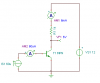
One example I can think of is this. I have a transistor which I don't have the data sheet for, all I have is a meter that measures HFE. I want to set the collector output to half supply. So I add a variable POT for the base resistor and connect an ammeter in series with the base resistor.

I trim the resistor until I have the required base current which I know is IC/HFE. And yes I here you say I could just trim the POT until I had half supply on the collector and not worry about the base current because I know it will work out the same.

But what if I have a problem with this circuit but I don't know what's wrong with it. The only thing I have to go on is I know what the base current should be. I don't actually know what the Vbe should be because I don't have a data sheet.

In this case how would you do this.

Another example which I had no way of choosing Vbe and didn't care about it as I knew it would sort itself out anyway. All I used for this was the gain and base current knowing I needed 6 mA IC for half supply.

CC_BJT.PNG

Thanks
Adam
 
Last edited:

LvW

Apr 12, 2014
604
Joined
Apr 12, 2014
Messages
604
Hi Lvw
One example I can think of is this. I have a transistor which I don't have the data sheet for, all I have is a meter that measures HFE. I want to set the collector output to half supply. So I add a variable POT for the base resistor and connect an ammeter in series with the base resistor.
I trim the resistor until I have the required base current which I know is IC/HFE. And yes I here you say I could just trim the POT until I had half supply on the collector and not worry about the base current because I know it will work out the same.
But what if I have a problem with this circuit but I don't know what's wrong with it. The only thing I have to go on is I know what the base current should be. I don't actually know what the Vbe should be because I don't have a data sheet.

OK Adam - thank you for the example. Some comments:
* The shown circuit does not contain any voltage source with base resistor (POT) but an ideal current source that does not exist in practice. Thus, it is not a real-world application.
And - as far as I understood you - it was your goal to demonstrate that the current-control method is best for practical circuits, right?
* I agree with you that you can measure hfe (app. identrical to B) in order to find the required Ib=Ic/B. Now, if you vary the POT and MEASURE Ib you can - of course realize the desired Ic
(withouit knowing Vbe) .
* But is this a practical way for designing a BJT stage? (By the way, this procedure is, of course, not a proof that Ic would be controlled bx Ib).
Instead of measuring B you also could measure Vbe (without knowing the corresponding value for Ib).

* Conclusion: I think - up to now - you didn`t show that it is "sometimes easier to work with the current control method"
 

Ratch

Mar 10, 2013
1,102
Joined
Mar 10, 2013
Messages
1,102
Arouse1973,

Your question is about how to set up a current amplifier circuit. Since the BETA (short circuit current gain of the transistor) varies all over the map, any transistor replacement or component drift due to aging will require more "fiddling" with the circuit to bring it back to specifications. The first thing to do is to put some resistance in the emitter circuit. Then a constant voltage across the base will lock in the emitter/collector current no matter how the transistor changes. Did you read how Winfield Hill, the author of "The Art of Electronics" does it?

http://cr4.globalspec.com/thread/68055/voltage-vs-current Look especially at post #2 and #10.

Ratch
 

Arouse1973

Adam
Dec 18, 2013
5,178
Joined
Dec 18, 2013
Messages
5,178
Hi Lvw.
I don't think I said that the current control method is the best for practical circuits. I said it's sometimes easier to work with the current control method.

The second example didn't have the POT because of the current source, it does not matter that it's an ideal current source. A practical real world current source (non-ideal) could be made to push 60 uA into the base and we still wouldn't need to worry about Vbe.

I agree this doesn't prove Ib controls Ic but a lot of people are comfortable with the notion that it does.

Just like we are all happy with the notion of conventional current flow, but it is wrong.

Thanks
Adam
 

Arouse1973

Adam
Dec 18, 2013
5,178
Joined
Dec 18, 2013
Messages
5,178
Arouse1973,

Your question is about how to set up a current amplifier circuit. Since the BETA (short circuit current gain of the transistor) varies all over the map, any transistor replacement or component drift due to aging will require more "fiddling" with the circuit to bring it back to specifications. The first thing to do is to put some resistance in the emitter circuit. Then a constant voltage across the base will lock in the emitter/collector current no matter how the transistor changes. Did you read how Winfield Hill, the author of "The Art of Electronics" does it?

http://cr4.globalspec.com/thread/68055/voltage-vs-current Look especially at post #2 and #10.

Ratch

Hi Ratch
Yes I did read this and very interesting it was. The example I gave was trying to portray how some people may design a circuit using a current source. If I change this a bit then and say fully switch the transistor on assuming a min HFE of some amount, say 10. Then I set the base current for this and forget about Vbe.
Adam
 

Ratch

Mar 10, 2013
1,102
Joined
Mar 10, 2013
Messages
1,102
Hi Lvw.
I don't think I said that the current control method is the best for practical circuits. I said it's sometimes easier to work with the current control method.

The second example didn't have the POT because of the current source, it does not matter that it's an ideal current source. A practical real world current source (non-ideal) could be made to push 60 uA into the base and we still wouldn't need to worry about Vbe.

I agree this doesn't prove Ib controls Ic but a lot of people are comfortable with the notion that it does.

Just like we are all happy with the notion of conventional current flow, but it is wrong.

Thanks
Adam

Although the BJT collector current is controlled by Vbe, you would not be wise to use Vbe to control collector current due to its exponential response. Better to apply a constant voltage across an emitter resistance in order to obtain a constant emitter/collector current regardless of the BJT characteristics. The Vbe will take care of itself.

Ratch
 

Arouse1973

Adam
Dec 18, 2013
5,178
Joined
Dec 18, 2013
Messages
5,178
Although the BJT collector current is controlled by Vbe, you would not be wise to use Vbe to control collector current due to its exponential response. Better to apply a constant voltage across an emitter resistance in order to obtain a constant emitter/collector current regardless of the BJT characteristics. The Vbe will take care of itself.

Ratch

Yes right Vbe will take care of itself. This is why I think people forget about Vbe and say let the base current do the work. So for them they are controlling the collector current using the base current. The fact that Vbe will change a small amount is irrelevant to them but a necessity for the operation of the circuit.
Adam
 

Ratch

Mar 10, 2013
1,102
Joined
Mar 10, 2013
Messages
1,102
Hi Ratch
Yes I did read this and very interesting it was. The example I gave was trying to portray how some people may design a circuit using a current source. If I change this a bit then and say fully switch the transistor on assuming a min HFE of some amount, say 10. Then I set the base current for this and forget about Vbe.
Adam

If a constant current source is desired, then the circuit of http://www.radio-electronics.com/info/circuits/transistor/active-constant-current-source.php would be more appropriate. A switch using a transistor is a study of making a transistor saturate or turn off.

Ratch
 
Status
Not open for further replies.
Top