Caustic Corrosion on Water Level Sensor

BHARGAV SHANKHALPARA

Nov 6, 2013
35
Joined
Nov 6, 2013
Messages
35
Hello All..!!

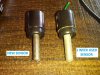
I am working on project water level controller. in that for water level detection i used three sensors shown in image. which is made up of stainless steel as well as mild steel.

i am using three sensors, one at bottom of tank which work as common. second at middle of tank, and third is at top of tank. in bottom sensor (work as common) i give DC 5V.

When i get 5 volt in both middle and top sensor we assume it as full tank, when not getting 5v at middle and top i assume tank is empty.

my problem is that when we install system at our farm its working perfectly, but after a week its start malfunction. when we see sensors which we have installed at top tank, there is Caustic Corrosion around common sensor in which we give DC 5V. thats why its not working properly. after that i cleaned common sensors and connect again its working fine.

is there any solution by which we avoid this type of Caustic Corrosion around sensor....??

Please suggest solution

thank you..!!
IMG_20150412_121925.jpg
 

KMoffett

Jan 21, 2009
723
Joined
Jan 21, 2009
Messages
723
Can you post your circuit? Continuous DC voltages applied to electrodes in water will cause electrolytic corrosion. A better choice would be a circuit that applies an AC voltage to the electrodes.

Ken
 

KTW

Feb 22, 2015
273
Joined
Feb 22, 2015
Messages
273
Can you use a plastic float sensor?

Float-Switch---9008.jpg
 

duke37

Jan 9, 2011
5,364
Joined
Jan 9, 2011
Messages
5,364
I have used Waxoyl which is a wax diluted with a petroleum spirit. This is sold for protecting the undersides of cars from corrosion. I have used it on electric fence energisers and outside nuts and bolts. It can be removed with white spirit or paraffin.
When fully dry it is a stiffish wax.

It needs to be warm to apply but this should not be a problem in India !
 

KMoffett

Jan 21, 2009
723
Joined
Jan 21, 2009
Messages
723
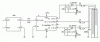
Here is the basic version of the AC-excited controller I made many years ago (and have used every year) to control the level of water in a Christmas tree stand bowl. It drives the bottom electrode with a 4KHz 5V square wave. The detected square waves are rectified with a voltage doubler and filtered. The lower electrode starts the pump. The upper electrode stops the pump. I used highly corrosion resistant stainless steel electrodes. I use it for about a month every year and have never seen any sign of corrosion. Nor have I had to clean the electrodes due to mineral deposits.


Ken
 

Attachments

  • WaterLevelPicaxe.gif
    WaterLevelPicaxe.gif
    47.8 KB · Views: 445

Vikas verma

Jun 29, 2017
2
Joined
Jun 29, 2017
Messages
2
Here is the basic version of the AC-excited controller I made many years ago (and have used every year) to control the level of water in a Christmas tree stand bowl. It drives the bottom electrode with a 4KHz 5V square wave. The detected square waves are rectified with a voltage doubler and filtered. The lower electrode starts the pump. The upper electrode stops the pump. I used highly corrosion resistant stainless steel electrodes. I use it for about a month every year and have never seen any sign of corrosion. Nor have I had to clean the electrodes due to mineral deposits.

Hello sir,

Will you send the diagram please
 

Alec_t

Jul 7, 2015
3,817
Joined
Jul 7, 2015
Messages
3,817
Vikas, you are posting in a 2-year old thread. KMoffett may not see this.
 

KMoffett

Jan 21, 2009
723
Joined
Jan 21, 2009
Messages
723
Hello sir,

Will you send the diagram please
I posted my micro-controller schematic in post #8.

If electrodes are submerged in water with a DC voltage applied to them, electrolytic action will cause them to corrode. The positive electrode will corrode, and negative will be plated. With AC, the electrodes are alternately positive and negative at a very rapid rate. This largely prevents either electrode from being corroded.

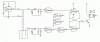
If you don't want to deal with micro-controller programming, here is a level controller using CD4093 logic chips.
Water Level.gif
No component values shown. If you want to use it, I'll go back and add them.
Ken
 

Tha fios agaibh

Aug 11, 2014
2,253
Joined
Aug 11, 2014
Messages
2,253
I like the AC idea but you won't totally eliminate corrosion.

Original post said stainless steel, but in the picture looks like brass electrodes.

I would cover the electrode with insulation except for the very end. That way all you have to do is clean the tip instead of the entire electrode.
You'll have less galvanic reaction if you use a polypropylene tank (non conductive) as opposed to steel.
You may also be able to use a external tube that shows the water column (in the tank) and mount photo or proximity sensors to it to detect the water level. This works well as long as the tube does not get dirty.
 

Cannonball

May 6, 2017
193
Joined
May 6, 2017
Messages
193
Hello everyone,
I like duke37's idea. You can water proof the magnet and the reed switch. Problem solved.
 

KMoffett

Jan 21, 2009
723
Joined
Jan 21, 2009
Messages
723
If you use a floating magmet and reed switch, make sure that the magnet cannot go above the upper reed or below the lower one. If they do you will get an invalid condition.

Ken
 

duke37

Jan 9, 2011
5,364
Joined
Jan 9, 2011
Messages
5,364
An alternative is to use an ultrasonic distance measuring device. I bought a couple of these some time ago but have not had the time to investigate if they work and how to decode the output.
 

abdul Wahhab

Dec 3, 2017
1
Joined
Dec 3, 2017
Messages
1
"No component values shown. If you want to use it, I'll go back and add them.
Ken[/QUOTE]"

Hi Ken,

very nice Idea of using AC sensing to prevent Corrosion. Can you please suggest the component values for the circuit you have proposed.

-thanks in advance.
 

davenn

Moderator
Sep 5, 2009
14,472
Joined
Sep 5, 2009
Messages
14,472
very nice Idea of using AC sensing to prevent Corrosion. Can you please suggest the component values for the circuit you have proposed.

-thanks in advance.

did you not look at the circuit ? ... it already has values
 
Top