Impedance of two stage amplifier

OrangeArav

Jul 14, 2015
38
Joined
Jul 14, 2015
Messages
38
Current source casceds,not much different than voltage source cascades:
when you drive an amp with a current source you need to use current dividers(parallel) instead of voltage dividers(series) and
multiply the chain like you did for voltage sources.

Rin,Rout are calculated the same the only difference:
an ideal current source has Rint=infinity.
an ideal voltage source has Rint=zero.
Ok, but if you need to do a KVL to find the current ib can you just assume the voltage on R1 is Vin, or do you have to do the transformation first making a V source of value Iin*R1 in series with R1. Only then do the KVL and find the ib? What happens is you end up with Iin*R1 in the numerator instead of Vtest.
P.S. in the solutions Rin = 60.7k
 

dorke

Jun 20, 2015
2,342
Joined
Jun 20, 2015
Messages
2,342
Ok, but if you need to do a KVL to find the current ib can you just assume the voltage on R1 is Vin, or do you have to do the transformation first making a V source of value Iin*R1 in series with R1. Only then do the KVL and find the ib? What happens is you end up with Iin*R1 in the numerator instead of Vtest.
P.S. in the solutions Rin = 60.7k

No you can not do that assumption !
Rin and Rout are independent of the way you drive the input (or output) same thing for current source or voltage source.

By definition we have:
Rin=Vin/Iin | Iout=0
Rout=Vout/Iout | Vin=0

example,Solving for Rin:

Iout=0 ===> R4 disconnected(no load).

VR3=(ib+b*ib)*R3 ;b=beta
As can be seen R1 is parallel to whatever resistance to it's right,
It will be simpler to calculate without it(disconnected) and
add that at the end.

KVL of input loop
Vin=VRpi+VR3=
=ib*Rpi + (ib+b*ib)*R3=ib*[Rpi+(b+1)R3]

Note that Iin'=ib !
Vin= Iin'*[Rpi+(b+1)R3]
Rin'=Rpi+(b+1)R3

Rin=Rin' || R1


IMG_0439.JPG
 

The Electrician

Jul 6, 2012
117
Joined
Jul 6, 2012
Messages
117
Finding the current gain, Ai, is not too hard if you can find the voltage gain, Av.

The voltage and current at the input are related by Vin = Zin*Iin. The output voltage is given by Vout=Vin*Av which gives Vout = Iin*Zin*Av. The output voltage and output current are related by Vout = Iout*Zload.

Do some algebra with all this and you can get the current gain: Ai = Av * (Zin/Zload).

You might need to include R1 as part of Zin.
 

OrangeArav

Jul 14, 2015
38
Joined
Jul 14, 2015
Messages
38
dorke, The Electrician,
Thank you for your posts, helped me a lot! Now, For the overall current gain, Ai, I came up with 33.8 ~ 34.


EPwbe6Fb


zlnBc3ps
 

The Electrician

Jul 6, 2012
117
Joined
Jul 6, 2012
Messages
117
dorke, The Electrician,
Thank you for your posts, helped me a lot! Now, For the overall current gain, Ai, I came up with 33.8 ~ 34.


EPwbe6Fb


zlnBc3ps

Your expression for Av is slightly in error. You have: -R2||RL*beta/((beta+1)R3+r Pi+R1)
The R1 in the denominator shouldn't be there. Also, you appear to have a numerical value for Av of 0.1355, but you must have used the correct value of .24 to calculate Ai
Otherwise, it all looks good.

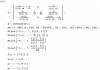
Here's my solution; it's possible to get everything from the admittance matrix. My value for Zout includes RL:

G4.png
 

OrangeArav

Jul 14, 2015
38
Joined
Jul 14, 2015
Messages
38
The Electrician,
Not sure why R1 shouldn't be there in the denominator? Since we're calculating Av, the overall voltage gain, we need to convert the current source to a voltage source by doing Vin=Iin*R1 in series with R1, or am I confusing something again? Then, I assumed Iin*R1=Vin and divided Vout by Vin to get Av, not Av0, (because I included the load resistor).


P.S. Also, I assumed Zin = R1 = 50k. Now, I realize it's the 27.4k input
 
Last edited:

The Electrician

Jul 6, 2012
117
Joined
Jul 6, 2012
Messages
117
The value of Vin doesn't matter when calculating Av, because its value cancels out when you divide Vout by Vin. So if Vin contains R1 as a factor, or any other factor that determines the value of Vin, that factor will not appear in Av.
 

Colin Mitchell

Aug 31, 2014
1,416
Joined
Aug 31, 2014
Messages
1,416
Coming up with an absurd value of 33.8 is like saying I am going to drive at 101.3 km per hour for the next 37 minutes.
 

The Electrician

Jul 6, 2012
117
Joined
Jul 6, 2012
Messages
117
Coming up with an absurd value of 33.8 is like saying I am going to drive at 101.3 km per hour for the next 37 minutes.
Or like saying that there are 39.37 inches in a meter, or that the speed of light is 299792458 meters per second. Where do these absurd values come from?
 

Colin Mitchell

Aug 31, 2014
1,416
Joined
Aug 31, 2014
Messages
1,416
"Or like saying that there are 39.37 inches in a meter, or that the speed of light is 299792458 meters per second. "

You have absolutely no idea what I am talking about.
Transistors have tolerances of +/- 50% and values change according to the temperature and even the supply voltage.
It is totally absurd to produce values to the first or second decimal point when the whole value cannot be guaranteed to within 20% to 50%.
It just shows a total lacking of physics.
That's the first thing I taught in Physics. An understanding of the accuracy of your result.
If all values are provided as whole units (or even one is provided as whole units), the answer cannot be delivered with decimal places.
 

(*steve*)

¡sǝpodᴉʇuɐ ǝɥʇ ɹɐǝɥd
Moderator
Jan 21, 2010
25,510
Joined
Jan 21, 2010
Messages
25,510
My rough calculation was 32k.

I assume for the purposes of calculation the gate is reverse biased.

I will also add that I've basically only read the first post in this thread.
 

The Electrician

Jul 6, 2012
117
Joined
Jul 6, 2012
Messages
117
My rough calculation was 32k.

I assume for the purposes of calculation the gate is reverse biased.

I will also add that I've basically only read the first post in this thread.

Rough calculation of what? Overall voltage gain?

Colin's comment was in reference to another problem the OP posed in post #9.
 

The Electrician

Jul 6, 2012
117
Joined
Jul 6, 2012
Messages
117
"Or like saying that there are 39.37 inches in a meter, or that the speed of light is 299792458 meters per second. "

You have absolutely no idea what I am talking about.
Transistors have tolerances of +/- 50% and values change according to the temperature and even the supply voltage.
It is totally absurd to produce values to the first or second decimal point when the whole value cannot be guaranteed to within 20% to 50%.
It just shows a total lacking of physics.
That's the first thing I taught in Physics. An understanding of the accuracy of your result.
If all values are provided as whole units (or even one is provided as whole units), the answer cannot be delivered with decimal places.

I know exactly what you're talking about, and the things you mention have no relevance to this homework problem. When the student's education has progressed to the point where he learns to consider component tolerances, temperature variations, etc., then they can be considered.

The purpose of this sort of homework problem is to learn to do the calculations of circuit analysis, and it's conventional to take integer values as having a precision of several decimal places.
 
Top