Push Button H2O - Reversing Polarity

mcasey

Jul 9, 2016
64
Joined
Jul 9, 2016
Messages
64
I'm trying to avoid using a momentary rocker switch in order to turn a magnetically latching 9 volt solenoid valve on and off. I like the idea of using a single soft rubber push button (making contact with some circuit beneath, I guess...) to turn the valve on and off. Any ideas?
 

mcasey

Jul 9, 2016
64
Joined
Jul 9, 2016
Messages
64
Thank you Bluejets... I have been searching online since your response for a "flip flop circuit switch". I find many schematics, but no hardware. Forgive me for sounding ignorant... I know what I want to accomplish, I just do not know much about electronics and/or electricity...
 

mcasey

Jul 9, 2016
64
Joined
Jul 9, 2016
Messages
64
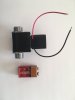
Basically, I have a 9 volt latching solenoid valve that i want to attach to "something" with a on off push button. I tested the valve by connecting the wires to the terminals of a 9 volt battery. It works fine, but I have to "flip flop" the connections in order to make the valve turn on and off.
 

Attachments

  • IMG_0072.JPG
    IMG_0072.JPG
    92 KB · Views: 92

Gryd3

Jun 25, 2014
4,098
Joined
Jun 25, 2014
Messages
4,098
Basically, I have a 9 volt latching solenoid valve that i want to attach to "something" with a on off push button. I tested the valve by connecting the wires to the terminals of a 9 volt battery. It works fine, but I have to "flip flop" the connections in order to make the valve turn on and off.
You could go buy a 'latching' relay...
The flip-flop is a circuit you can build with a number of different parts, or can be purchased as a component...
I'm not aware of a 'module' you can buy that will do this though.
 

mcasey

Jul 9, 2016
64
Joined
Jul 9, 2016
Messages
64
How is a latching solenoid valve typically wired in? They are all over the internet for sale, but no one offers instructions on how to wire them in...
 

(*steve*)

¡sǝpodᴉʇuɐ ǝɥʇ ɹɐǝɥd
Moderator
Jan 21, 2010
25,510
Joined
Jan 21, 2010
Messages
25,510
My presumption is that a latching solenoid is like a latching relay in that power is only required to change the state, but not to maintain it.

it could have 1 coil where the polarity is reversed, or 2 coils.

in either case a momentary double pole double throw switch with a centre off will do the trick. the disadvantages are that the final switch position will not indicate the solenoid state (which it sounds like you don't need) and you need a different action to turn it on vs. off (which may be an advantage or a disadvantage)

knowing how to wire it... well we need more details on the solenoid
 

mcasey

Jul 9, 2016
64
Joined
Jul 9, 2016
Messages
64
This is all I can find on the valve I own. The instructions simply state "another short 6V pulse to close", no mention of polarity. So here I am, relying on the advise and good will of strangers to help me out...
 

Attachments

  • valve spec.jpg
    valve spec.jpg
    95.8 KB · Views: 114

mcasey

Jul 9, 2016
64
Joined
Jul 9, 2016
Messages
64
I also found this for a different brand valve...
 

Attachments

  • Latching Solenoid Valve Circuit.jpg
    Latching Solenoid Valve Circuit.jpg
    44.1 KB · Views: 124

BobK

Jan 5, 2010
7,682
Joined
Jan 5, 2010
Messages
7,682
Well then, simply wiring a momentary contact switch to it will flip it with each press.

Bob
 

mcasey

Jul 9, 2016
64
Joined
Jul 9, 2016
Messages
64
Thanks to all for your help. I think the momentary 2 pole switch will work just fine for my needs. This forum is awesome!
Case Closed
 

BobK

Jan 5, 2010
7,682
Joined
Jan 5, 2010
Messages
7,682
Thanks to all for your help. I think the momentary 2 pole switch will work just fine for my needs. This forum is awesome!
Case Closed
Not really. You misunderstand.

The pulse to open and the one to close are the same polarity. You do not need a two pole switch.

Bob
 

mcasey

Jul 9, 2016
64
Joined
Jul 9, 2016
Messages
64
Are you saying this because of what the instructions read? I think the instructions are wrong because, as mentioned above, when I test it with a 9 volt battery I must touch red to the positive terminal and black to the negative terminal to get it to open, then flip flop the connections to get it to close.
 

BobK

Jan 5, 2010
7,682
Joined
Jan 5, 2010
Messages
7,682
Yes, I am going by what the link you posted said. Did you try to see if using the same polarity twice also might flip it? Because that is what I read the specs as saying.

And, a normal solenoid pulls one direction no matter which way it is connected. But there are solenoids with a magnetized rod that would go opposite directions depending on polarity.

Bob
 

BobK

Jan 5, 2010
7,682
Joined
Jan 5, 2010
Messages
7,682
Reading several descriptions of the this, I am totally convinced you do not have to reverse the polarity. Each pulse simply flips it from one state to the other. There is never a mention of reversing the polarity. I would be pissed if I bought this based on the description and it did not work the way I think it does.

Bob
 

mcasey

Jul 9, 2016
64
Joined
Jul 9, 2016
Messages
64
My presumption is that a latching solenoid is like a latching relay in that power is only required to change the state, but not to maintain it.

it could have 1 coil where the polarity is reversed, or 2 coils.

in either case a momentary double pole double throw switch with a centre off will do the trick. the disadvantages are that the final switch position will not indicate the solenoid state (which it sounds like you don't need) and you need a different action to turn it on vs. off (which may be an advantage or a disadvantage)

knowing how to wire it... well we need more details on the solenoid

This switch works great. However, what if I wanted to activate the switch wireless? Could I use some sort of relay to achieve the same results?
 

Bluejets

Oct 5, 2014
7,374
Joined
Oct 5, 2014
Messages
7,374
Perhaps an R/c tx rx from China with a receiver controlled on off switch.
Many ways to achieve what you want but the advantage using the above is there is no building or programming to do.
 

mcasey

Jul 9, 2016
64
Joined
Jul 9, 2016
Messages
64
Perhaps an R/c tx rx from China with a receiver controlled on off switch.
Many ways to achieve what you want but the advantage using the above is there is no building or programming to do.

I have one. but the polarity issue is the problem. would i need a two channel t/c tx rx?
 

Bluejets

Oct 5, 2014
7,374
Joined
Oct 5, 2014
Messages
7,374
Don't know what you mean "polarity issue".
Do you have a tx/rx?
Don't know why you need 2 channels but most come with 4 or 5 for about $30 anyhow.
Do you have a receiver controlled switch also or were you referring to the radio when you say you have one.
 

Kiwi

Jan 28, 2013
505
Joined
Jan 28, 2013
Messages
505
"Yes, I am going by what the link you posted said. Did you try to see if using the same polarity twice also might flip it? Because that is what I read the specs as saying."

Have you tried this as requested by Bob?

Confirm state of valve, ie open or closed.
Connect the black wire to negative.
Briefly touch red wire to positive and then disconnect.
Reconfirm state of valve.

Did the valve change state?
 
Top