Where is the problem?

Diodude

Apr 21, 2020
10
Joined
Apr 21, 2020
Messages
10
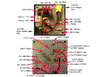
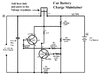
I'm new to electronics, and to the forums, nice to meet you all. Still learning as I go.I Recently constructed a 12V floating battery car charger, and ran into a few issues with its operation. I found this circuit on the net and figured I'd try it. Its charging properly, but the current limiting led does not go on at all, and it keeps charging beyond the 13.75V set point. Its supposed to work off a 17 to 19V DC wall transformer. I only have two of these, one has an output of 16.5V DC unloaded, and the other 19.5V DC unloaded. They both work, just the 19.5 charges the battery faster then the 16.5. Its supposed to work with a green LED, but it never lights at all. I replaced it with a white one and it does light, but never goes off, and the unit never stops charging as I said. I attached jacks for both power supplies, Charger-Schematic.gif PCB_1.gif just to see if the voltage was part of the problem, it only makes a difference in the charging rate. I attached images, hopefully someone can see a wiring problem, I haven't been able to identify. Thanks, to all for any help.
 

Bluejets

Oct 5, 2014
7,374
Joined
Oct 5, 2014
Messages
7,374
Do you have a link to where you found this..??

Any detail on the LED required and the one you used..?

Difficult to see some of the details of your board..... e.g. 1K resistor looks like it ends with a black band.

1N9001 seems a strange value .
 
Last edited:

Diodude

Apr 21, 2020
10
Joined
Apr 21, 2020
Messages
10
Do you have a link to where you found this..??

Any detail on the LED required and the one you used..?

Difficult to see some of the details of your board..... e.g. 1K resistor looks like it ends with a black band.

1N9001 seems a strange value .

The Diode is a 1N4001 - not 9001...that was an error. The 1k definetley is1K, brown/black/red/gold, hard to see clearly in the image, tested it to make sure before installation. Downloaded it about 3 weeks ago, but don't remember from where.
 

Diodude

Apr 21, 2020
10
Joined
Apr 21, 2020
Messages
10
Do you have a link to where you found this..??

Any detail on the LED required and the one you used..?

Difficult to see some of the details of your board..... e.g. 1K resistor looks like it ends with a black band.

1N9001 seems a strange value .
Led should be green, but green does not light, white does.
 

Cirkit

Oct 28, 2015
155
Joined
Oct 28, 2015
Messages
155
Led should be green, but green does not light, white does.
Have you proven the green LED works with a simple power supply and current limit resistor? Try comparing the forward voltage of both LEDs.
 

Diodude

Apr 21, 2020
10
Joined
Apr 21, 2020
Messages
10
Have you proven the green LED works with a simple power supply and current limit resistor? Try comparing the forward voltage of both LEDs.
Tested the green and white out of the circuit, both good, in the circuit, green has 1.5V across it, the white has 3.5V across it. White lights, green does not.
 

shrtrnd

Jan 15, 2010
3,901
Joined
Jan 15, 2010
Messages
3,901
I doubt it's the problem, but just to be sure:
Not all diodes have the same operating current.
You can test both LEDs out of circuit and see them work fine, but what is your circuit current through that green LED, and what is the operating current of that green LED?
After checking the obvious first, THEN I'd get down to the nitty-gritty of circuit analysis.
 

Harald Kapp

Moderator
Moderator
Nov 17, 2011
14,273
Joined
Nov 17, 2011
Messages
14,273
I doubt the LED is the issue.

First:
one has an output of 16.5V DC unloaded, and the other 19.5V DC unloaded.
Check the output voltages in the loaded state. The 16.v V supply probably goes quite a bit below 16 V, guess you'll see somewhere around 15 V when loaded.

Second:
The LM317 has a minimun input-to-output voltage differential of 3 V. For a 13.75 V output the input voltage needs to be at least 16.75 V. SO even without a drop of the output voltage of the 16.5 V source under load you can expect max. 13.5 V, not 13.75 V at the output of the circuit. If, as I assume, the input voltage drops to around 15 V, the situation gets even worse with approx. 12 V output voltage only.

With such a low output voltage the current naturally is lower than with a higher output (an therefore required input) voltage. The external current limiting circuit probably never becomes active, thus the LED doesn't light up (the adjust terminal current is not enough to light up the LED).
To test this assumption replace the 2.2 Ω current sense resistor by e.g. a 10 Ω resistor, which will reduce the threshold for current limiting by a factor of 4.5.
 

Bluejets

Oct 5, 2014
7,374
Joined
Oct 5, 2014
Messages
7,374
The Diode is a 1N4001 - not 9001...that was an error. The 1k definetley is1K, brown/black/red/gold, hard to see clearly in the image, tested it to make sure before installation. Downloaded it about 3 weeks ago, but don't remember from where.

2N3504 transistors are PNP not NPN as shown in your drawing.
I see you have 2N3904 in the board wiring which are NPN but it still raises the question on the original drawing and what you have changed.
 

Diodude

Apr 21, 2020
10
Joined
Apr 21, 2020
Messages
10
I doubt the LED is the issue.

First:
Check the output voltages in the loaded state. The 16.v V supply probably goes quite a bit below 16 V, guess you'll see somewhere around 15 V when loaded.

Second:
The LM317 has a minimun input-to-output voltage differential of 3 V. For a 13.75 V output the input voltage needs to be at least 16.75 V. SO even without a drop of the output voltage of the 16.5 V source under load you can expect max. 13.5 V, not 13.75 V at the output of the circuit. If, as I assume, the input voltage drops to around 15 V, the situation gets even worse with approx. 12 V output voltage only.

With such a low output voltage the current naturally is lower than with a higher output (an therefore required input) voltage. The external current limiting circuit probably never becomes active, thus the LED doesn't light up (the adjust terminal current is not enough to light up the LED).
To test this assumption replace the 2.2 Ω current sense resistor by e.g. a 10 Ω resistor, which will reduce the threshold for current limiting by a factor of 4.5.

Hi Harald,

Thanks for the reply, and the suggestions. I haven't tried your suggestion yet, but I did take some readings as you advised. I used the 19.5V supply. The loaded output is 13.6V, the 19.5V power supply is barely supplying enough voltage charge the battery.The drop across the green LED is 1.77V but the current is zero. The total current in the system is 305 ma. I think you are correct in that the power supply should be at least 15V when loaded. I'll try using the 10 Ohm R to see what happens, or should that be a different value when using the 19.5V supply?

Thanks,
PJ
 

Bluejets

Oct 5, 2014
7,374
Joined
Oct 5, 2014
Messages
7,374
Hi Harald,

Thanks for the reply, and the suggestions. I haven't tried your suggestion yet, but I did take some readings as you advised. I used the 19.5V supply. The loaded output is 13.6V, the 19.5V power supply is barely supplying enough voltage charge the battery.The drop across the green LED is 1.77V but the current is zero. The total current in the system is 305 ma. I think you are correct in that the power supply should be at least 15V when loaded. I'll try using the 10 Ohm R to see what happens, or should that be a different value when using the 19.5V supply?

Thanks,
PJ
Did you redraw this circuit or is it as originally supplied....??
 

Diodude

Apr 21, 2020
10
Joined
Apr 21, 2020
Messages
10
Did you redraw this circuit or is it as originally supplied....??
I printed the screen image, then redrew it exactly as it was in the image. Only mistake was the Number of the diode, it was hard to make out, looked like a 9001 but determined later it should have been a 4001. But the actual circuit is exactly as it was in the image, I checked it many times to make sure.
 

Bluejets

Oct 5, 2014
7,374
Joined
Oct 5, 2014
Messages
7,374
So you are saying that you have redrawn it incorrectly then...????
Transistors in your drawing are shown as 2N3504 which are, as I pointed out, PNP.
However you have the drawing showing NPN.
Also your board shows 2n3904.
So basically more errors than you think.
 

Diodude

Apr 21, 2020
10
Joined
Apr 21, 2020
Messages
10
So you are saying that you have redrawn it incorrectly then...????
Transistors in your drawing are shown as 2N3504 which are, as I pointed out, PNP.
However you have the drawing showing NPN.
Also your board shows 2n3904.
So basically more errors than you think.

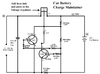
They are NPN, 2N3904. When I redrew it, I saved each file as I went along, in case windows crashed, I would have the last version I made. I just uploaded the wrong image and didn't notice it. The board is labeled correctly, the schematic has the errors. Thanks for pointing out.
 

Bluejets

Oct 5, 2014
7,374
Joined
Oct 5, 2014
Messages
7,374
Thanks for that...now I am totally confused.

You do see where we are going with this....??
 

Diodude

Apr 21, 2020
10
Joined
Apr 21, 2020
Messages
10
Schematic_Final.gif As I said the boards is labeled correctly. The corrected schematic is attached. Hope that clears things up.
 

Bluejets

Oct 5, 2014
7,374
Joined
Oct 5, 2014
Messages
7,374
Nope...asked for the original link as I'm certain you've mistaken some part somewhere, or it's come from some shonky site.
 
Top