Ampere/voltagemeter

Rockgirl

Aug 26, 2021
22
Joined
Aug 26, 2021
Messages
22
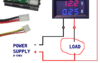
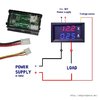
Hello, I have a problem that I need your help with. I bought an amp voltmeter. I want to connect it to show a small dc-motor with volts and amp. But the problem is that the meter will not work if I change the polarity. The direction of rotation of the motor is changed by reversing the polarity. So is there any way to get the meter to show readings even if the polarity changes? The picture shows how the meter should be connected but it won't really work if the polarity changes :(
 

Attachments

  • Voltage-amper-meter.jpg
    Voltage-amper-meter.jpg
    42.7 KB · Views: 18

Harald Kapp

Moderator
Moderator
Nov 17, 2011
14,273
Joined
Nov 17, 2011
Messages
14,273
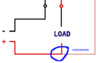
Reverse the polarity after the meter, before the load. See circled section:
upload_2022-2-15_12-6-17.png

This way the meter has always the correct polarity.
 

Harald Kapp

Moderator
Moderator
Nov 17, 2011
14,273
Joined
Nov 17, 2011
Messages
14,273
I don't think I can put the controller after the meter
Why not? The drawback is that the meter will measure also the power dissipation of the controller in addition to the motor's. If this contribution is relevant, you can subtract this from the readings.
 

Rockgirl

Aug 26, 2021
22
Joined
Aug 26, 2021
Messages
22
Why not? The drawback is that the meter will measure also the power dissipation of the controller in addition to the motor's. If this contribution is relevant, you can subtract this from the readings.
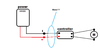
If I put a meter at this point like my drawing, then it shows power 24v? I want to see the volts that go to the motor after the controller.
I thought this meter would work like a multimeter and polarity wouldn't matter. Maybe I need to put two on this meter.
 

Attachments

  • 123.png
    123.png
    12.1 KB · Views: 8

ramussons

Jun 10, 2014
475
Joined
Jun 10, 2014
Messages
475
Such type of meters do not have the capability to sense both +ve and -ve voltages on its voltage sense input. You will have to cross connect the inputs on polarity reversal.
 

Rockgirl

Aug 26, 2021
22
Joined
Aug 26, 2021
Messages
22
Such type of meters do not have the capability to sense both +ve and -ve voltages on its voltage sense input. You will have to cross connect the inputs on polarity reversal.
That exchange doesn't seem to be very easy? I was wondering if it could somehow work using diodes. Perhaps it is only easiest to use two separate meters.
 

Alec_t

Jul 7, 2015
3,817
Joined
Jul 7, 2015
Messages
3,817
What speed controller do you have? If it's one that uses PWM then that may not play nicely with a digital meter.
 

Rockgirl

Aug 26, 2021
22
Joined
Aug 26, 2021
Messages
22
What speed controller do you have? If it's one that uses PWM then that may not play nicely with a digital meter.
Yes it is PWM. I have tried using this meter with it and it works. The only problem is when the polarity changes so the meter does not then show a read-out.
 

Harald Kapp

Moderator
Moderator
Nov 17, 2011
14,273
Joined
Nov 17, 2011
Messages
14,273
I want to see the volts that go to the motor after the controller.
Yes it is PWM
The meter will not show you "the voltage that goes to the motor" in any configuration. PWM means that the motor is supplied by a pulsed 24 V signal, not a voltage between 0 V ... 24 V as you seem to assume.
It is also questionable that this meter can indicate a useable measurement for current, as the current will also be pulsed, with a triangular waveform due to the inductance of the motor coil(s).
I have tried using this meter with it and it works.
... but what does it show?
- average voltage and current?
- RMS voltage and current?
- an arbitrary value being neither average nor RMS?

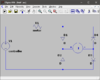
For current (and only for current) there is a solution to your problem, at the cost of 2 diode voltage drops:
upload_2022-2-16_12-15-29.png

If V1 > 0 V, then current passes through diodes D1 and D3 and through the ammeter in correct polarity.
If V1 < 0 V, the current passes through diodes D2 and D4 and again through the ammeter in correct polarity.
Voltage to the motor will be reduced by 2 diode voltage drops (~1.5 V).

With a separate voltmeter a similar setup could be made, but the measured voltage will be off by 2 diode voltage drops. Since ammeter and voltmeter in your instrument share a common terminal, this is not useable for both voltage and current at the same time with the above circuit.
Since the voltage is always 24 V (due to the PWM control, as I tried to explain above), measuring the current alone is imho a possible way out of your dilemma.
 

Rockgirl

Aug 26, 2021
22
Joined
Aug 26, 2021
Messages
22
The meter will not show you "the voltage that goes to the motor" in any configuration. PWM means that the motor is supplied by a pulsed 24 V signal, not a voltage between 0 V ... 24 V as you seem to assume.
It is also questionable that this meter can indicate a useable measurement for current, as the current will also be pulsed, with a triangular waveform due to the inductance of the motor coil(s).

... but what does it show?
- average voltage and current?
- RMS voltage and current?
- an arbitrary value being neither average nor RMS?

For current (and only for current) there is a solution to your problem, at the cost of 2 diode voltage drops:
View attachment 54273

If V1 > 0 V, then current passes through diodes D1 and D3 and through the ammeter in correct polarity.
If V1 < 0 V, the current passes through diodes D2 and D4 and again through the ammeter in correct polarity.
Voltage to the motor will be reduced by 2 diode voltage drops (~1.5 V).

With a separate voltmeter a similar setup could be made, but the measured voltage will be off by 2 diode voltage drops. Since ammeter and voltmeter in your instrument share a common terminal, this is not useable for both voltage and current at the same time with the above circuit.
Since the voltage is always 24 V (due to the PWM control, as I tried to explain above), measuring the current alone is imho a possible way out of your dilemma.
I know this is based on a pulse but for some reason this meter shows voltage?!. It will also show something in the amp when I hold the motor shaft and try to stop it, then the current will increase. I don’t know what these readings are but they are enough for me. This drawing of your attachment is exactly what I was looking for! I tried in the past to think about this that diodes have a solution but somehow my head didn't work. Thanks for this! :)
I just tried this still without diodes and by changing the meter wires the regulator came out after reversing (polarity changes) and it worked. So this use of diodes should work.
 

Alec_t

Jul 7, 2015
3,817
Joined
Jul 7, 2015
Messages
3,817
I know this is based on a pulse but for some reason this meter shows voltage?
It is likely a 'sort of' average of the pulse waveform, but only when the motor is running in one particular direction.
 

Bluejets

Oct 5, 2014
7,374
Joined
Oct 5, 2014
Messages
7,374
Some of those volt/ammeters share a common ground with the supply.
 

Rockgirl

Aug 26, 2021
22
Joined
Aug 26, 2021
Messages
22
It is likely a 'sort of' average of the pulse waveform, but only when the motor is running in one particular direction.
For some reason, this also shows readings, even without the load (motor) when I turn the potentiometer.
 

Harald Kapp

Moderator
Moderator
Nov 17, 2011
14,273
Joined
Nov 17, 2011
Messages
14,273
I don't know if this is the same thing.
It obviously is: 3 connections for I and V, one of them common.
upload_2022-2-17_18-19-54.png
That is why you can't use my diode circuit for I and V at the same time.

For some reason, this also shows readings, even without the load (motor) when I turn the potentiometer.
Which potentiometer? the one on the motor controller or an adjustment pot on the measurement module.

Btw: "it shows readings" - Since the motor is controlled by PWM and this kind of meter is usually not designed to easure PWM waveforms, the validity of the indicated "measurements" is questionable anyway.
 

hevans1944

Hop - AC8NS
Jun 21, 2012
4,968
Joined
Jun 21, 2012
Messages
4,968
I don't know if this is the same thing.
I believe @Bluejets is correct. These el-cheapo meters do share a common ground with the meter supply (thin red and black wires). They also do not measure negative voltages or negative currents with respect to "ground". Here is a link to a rather lengthy discussion of how (and how NOT) to wire these puppies into your circuit.

With regard to PWM motor control... PWM is a unipolar train of pulses, possibly reversing in polarity to change motor direction. Motor speed, OTOH, is determined by the duty cycle of the PWM signal applied. Zero duty cycle means no pulses, and therefore no voltage or current is applied to the motor. A one-hundred percent duty cycle also means no pulses, but with output voltage present and constant all the time. Any duty cycle in between 0% and 100% will produce an average voltage and an average current that is between zero and the maximum voltage/current that the PWM controller can provide. If you want to display this average voltage (or current) on a DC-responding meter, you must filter out the fundamental PWM switching frequency, and ideally all of its harmonics. However, usually all you need is a low-pass series resistor-parallel capacitor RC filter... something on the order of one thousand ohms and a few dozen microfarads will probably work. You can add increased capacitance if there is still too much "bounce" in the digital readout, but be careful if increasing the resistance... many of these imported meters have a relatively low input impedance which will lead to measurement errors if the resistance in series with the meter input is increased too much.

An oscilloscope is a virtual necessity when trying to troubleshoot pulse circuits. I would suggest you obtain an inexpensive one and learn how to use it. You may find, as I did in the previous century, that an oscilloscope is your "go to" test equipment, second only to your digital multimeter in usefulness. IIRC, my first o'scope was about a hundred bux or so in the 1960s. Much better, less expensive, more portable, new models are available today. My last purchase was for a digital storage oscilloscope (DSO) that cost less than three hundred dollars with free shipping.

All of this test equipment stuff is made much less expensively in Asia and Pacific Rim countries such as India, South Korea, China, and Japan, but you need to be careful which "brand" to purchase. Surf the Internet and visit support groups such as Electronics Point to get some advice on what to purchase and how much you should expect to pay for it. I usually buy only from a USA-based distributor who offers a "money back" guarantee if I am unsatisfied with my purchase, but your mileage (or kilometers) may differ.
 

Rockgirl

Aug 26, 2021
22
Joined
Aug 26, 2021
Messages
22
It obviously is: 3 connections for I and V, one of them common.
View attachment 54279
That is why you can't use my diode circuit for I and V at the same time.


Which potentiometer? the one on the motor controller or an adjustment pot on the measurement module.

Btw: "it shows readings" - Since the motor is controlled by PWM and this kind of meter is usually not designed to easure PWM waveforms, the validity of the indicated "measurements" is questionable anyway.
Okay, it really looks like this diode isn't working here. I'm a little lost with this, really annoying if I bought these meter in vain :( I mean the potentiometer that controls the motor.

I believe @Bluejets is correct. These el-cheapo meters do share a common ground with the meter supply (thin red and black wires). They also do not measure negative voltages or negative currents with respect to "ground". Here is a link to a rather lengthy discussion of how (and how NOT) to wire these puppies into your circuit.

With regard to PWM motor control... PWM is a unipolar train of pulses, possibly reversing in polarity to change motor direction. Motor speed, OTOH, is determined by the duty cycle of the PWM signal applied. Zero duty cycle means no pulses, and therefore no voltage or current is applied to the motor. A one-hundred percent duty cycle also means no pulses, but with output voltage present and constant all the time. Any duty cycle in between 0% and 100% will produce an average voltage and an average current that is between zero and the maximum voltage/current that the PWM controller can provide. If you want to display this average voltage (or current) on a DC-responding meter, you must filter out the fundamental PWM switching frequency, and ideally all of its harmonics. However, usually all you need is a low-pass series resistor-parallel capacitor RC filter... something on the order of one thousand ohms and a few dozen microfarads will probably work. You can add increased capacitance if there is still too much "bounce" in the digital readout, but be careful if increasing the resistance... many of these imported meters have a relatively low input impedance which will lead to measurement errors if the resistance in series with the meter input is increased too much.

An oscilloscope is a virtual necessity when trying to troubleshoot pulse circuits. I would suggest you obtain an inexpensive one and learn how to use it. You may find, as I did in the previous century, that an oscilloscope is your "go to" test equipment, second only to your digital multimeter in usefulness. IIRC, my first o'scope was about a hundred bux or so in the 1960s. Much better, less expensive, more portable, new models are available today. My last purchase was for a digital storage oscilloscope (DSO) that cost less than three hundred dollars with free shipping.

All of this test equipment stuff is made much less expensively in Asia and Pacific Rim countries such as India, South Korea, China, and Japan, but you need to be careful which "brand" to purchase. Surf the Internet and visit support groups such as Electronics Point to get some advice on what to purchase and how much you should expect to pay for it. I usually buy only from a USA-based distributor who offers a "money back" guarantee if I am unsatisfied with my purchase, but your mileage (or kilometers) may differ.
I'm really afraid I can't do this. My skills are not enough :(

Is there any easy way to get these meter to work? That's ok me if I put two meters on one motor, but does this even make it work? Meter readings are not so accurate, it's ok if they even show something.
 
Last edited:
Top