Voltage limiter 9V and above

tatsiistasdev

Jun 21, 2023
8
Joined
Jun 21, 2023
Messages
8
Hi, I'm looking for a schematic to achieve the following:

If input voltage is below 9V then output 0V, if voltage is above 9V then output input voltage.

Max current - 4-5A
Max voltage - 14V

I tried using tl431 with irf5305, but can get it working.


Could someone help with a nice schematic to achieve this?

Kind regards
 

kellys_eye

Jun 25, 2010
6,512
Joined
Jun 25, 2010
Messages
6,512
Show us what you did with the TL431 and IRF5305. Have you considered using a comparator?
 

tatsiistasdev

Jun 21, 2023
8
Joined
Jun 21, 2023
Messages
8
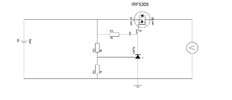
fvc.JPG
Here is my schematic, it works on a test board, but when I solder it behaves weirdly. Sometimes voltage is negative, sometimes MOSFET is open on any voltage applied.
Could you help to find the cause? or suggest another schematic.
 

crutschow

May 7, 2021
984
Joined
May 7, 2021
Messages
984
it works on a test board, but when I solder it behaves weirdly.
Then it would appear you have a bad (cold) solder joint or incorrect wiring on the soldered circuit.

This is a nit, but you don't have a voltage limiter circuit, that's a low-volage cutoff circuit with the TL431 acting as a comparator with a built-in reference voltage.

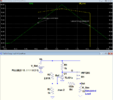
The schematic looks okay, except R3 should be 2.6kΩ if you want it to change states at 9V input.
Also you likely want to add some hysteresis to the trip point voltage, so it doesn't oscillate at the trip point.
R4 adds about 150mV of hysteresis (positive feedback) in the simulation of the circuit below:

1687374413478.png
 
Last edited:

tatsiistasdev

Jun 21, 2023
8
Joined
Jun 21, 2023
Messages
8
Then it would appear you have a bad (cold) solder joint or incorrect wiring on the soldered circuit.

This is a nit, but you don't have a voltage limiter circuit, that's a low-volage cutoff circuit with the TL431 acting as a comparator with a built-in reference voltage.

The schematic looks okay, except R3 should be 2.6kΩ if you want it to change states at 9V input.
Also you likely want to add some hysteresis to the trip point voltage, so it doesn't oscillate at the trip point.
R4 adds about 150mV of hysteresis (positive feedback) in the simulation of the circuit below:

View attachment 59582
Thank you so much for your help! Will try it tomorrow!
 

danadak

Feb 19, 2021
1,063
Joined
Feb 19, 2021
Messages
1,063
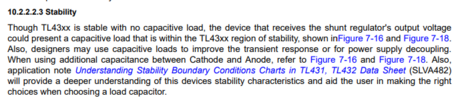
Caution about C loading of this part and its stability :

1687385217526.png

Regards, Dana.
 

danadak

Feb 19, 2021
1,063
Joined
Feb 19, 2021
Messages
1,063
That's when using the device as part of a linear regulator.
Here it's being used as a comparator.

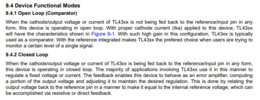
This seems to imply there is in fact feedback in that circuit :

1687395617389.png

Some simple bench testing should show phase margin problems from transient response,
if there is a problem.


Regards, Dana.
 

crutschow

May 7, 2021
984
Joined
May 7, 2021
Messages
984
This seems to imply there is in fact feedback in that circuit :

View attachment 59587

Some simple bench testing should show phase margin problems from transient response,
if there is a problem.


Regards, Dana.
9.4.1 Clearly states that as comparator, it is operating open-loop and thus cannot have phase-margin problems, since it has no negative feedback.
Why do you keep implying otherwise?
 

danadak

Feb 19, 2021
1,063
Joined
Feb 19, 2021
Messages
1,063
When the cathode/output voltage or current of TL43xx is not being fed back to the reference/input pin in any form, this device is operating in open loop.

I was looking at original OP posted schematic, now I see yours has a control loop 180
thru MOSFET, MOSFET C loading Vout pin of 431, then back thru load and its C (if any)
and MOSFET Rds and then R4.

Maybe a transient sim as well as a bench test ?

Regards, Dana.
 

crutschow

May 7, 2021
984
Joined
May 7, 2021
Messages
984
I see yours has a control loop 180
thru MOSFET,
As I noted, that provides a small amount of positive feedback for hysteresis of the trip point, not negative feedback.
Only negative feedback would give a possible concern about stability.
Since the circuit is acting as a comparator with only two stable states, your continuing concern about stability has no basis.
 

crutschow

May 7, 2021
984
Joined
May 7, 2021
Messages
984
Thanks again for schematic. But in that case I have an output voltage equal to voltage drop on the R4 resistor it is about 1.4-2.5 when the mosfet is closed. Is it ok?
Yes, the current through that resistor due to that voltage drop is what generates the hysteresis voltage change at the Ref input to the TL431.
 
Last edited:

tatsiistasdev

Jun 21, 2023
8
Joined
Jun 21, 2023
Messages
8
I still have an issue with an open mosfet, when I solder the schematic. (I have about 40pcs of TL431 and 20pcs of IRF mosfets). It is really strange, I've never faced the similar issue.
Everything works on a sample board, but when I solder it behaves unpredictably, but in most cases, it is an open mosfet, so I get the input to output.
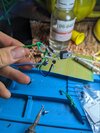
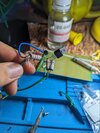
I've just soldered it as on the attached images, the same behavior, but when I add R4 it has an output voltage of about 2.7 (when the input is below 9V), which is acceptable, but would be great if it remains 0. Actually, this schematic is for a car bulb, I think it won't shine with 2V.
But I am really disappointed with this behavior (


photo_2023-06-22_23-32-06.jpg
photo_2023-06-22_23-38-37.jpg
 

tatsiistasdev

Jun 21, 2023
8
Joined
Jun 21, 2023
Messages
8
Yes, the current through
I've just tested it soldered in directly as on the image above, without R4 it gets crazy it even showed once voltage -15V (negative voltage) when input was 12V.
Could you suggest any other simple schematics to achieve this. I've spent about 4 days trying to get it working stable(
 

crutschow

May 7, 2021
984
Joined
May 7, 2021
Messages
984
Do you have a load on the MOSFET output?
It could act erratically without some load.
 

danadak

Feb 19, 2021
1,063
Joined
Feb 19, 2021
Messages
1,063
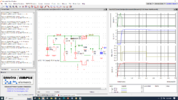
@crutschow, I played with sim, values, etc., seems totally stable.
Note a load step is invoked at 2 mS of ~ .5A I can see now how 150K essentially stops
loop closure effectively.

1687527044595.png


Regards, Dana.
 
Top