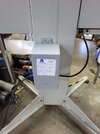
What are specs on this cap?

kellys_eye

Jun 25, 2010
6,512
Joined
Jun 25, 2010
Messages
6,512
This looks like C4 - and it's typical of a 'motor start' type capacitor which do have a tendency towards failure.

If it changes VALUE it will also cause issues. Doesn't necessarily have to be shorted (or open) to give a fault condition.
 

Attachments

  • Screenshot from 2024-01-21 23-28-38.png
    Screenshot from 2024-01-21 23-28-38.png
    99.7 KB · Views: 3

kellys_eye

Jun 25, 2010
6,512
Joined
Jun 25, 2010
Messages
6,512
BTW the line voltage (248V) should be ok if all else is working properly. You shouldn't need a buck-boost transformer (show it please, I'm guessing you mean VARIAC?) - is it suitably rated?
 

Stamey

Apr 28, 2023
44
Joined
Apr 28, 2023
Messages
44
The melted plastic on the spade connector seems to be from the dodgy switch contact causing arcing/heat and melting - nothing we haven't all seen before.


Polarity? What about the stop switch? Did you check the contacts

Seems to me you got the wiring wrong on the STOP switch.
The replacement of the stop switch was tech support's idea, to see if it would help this problem. I changed each switch in the "stop switch" (it's some kind of modular switch system where there are two NC switches and an NO switch connected together) wire for wire, being very careful not to change anything as I changed the switches. I took pictures before to make sure all the wires went back where they are supposed to, and the length of the wire coming out of the harness helped, as they would not reach to the other side of the switch. I am being extra careful since many of the wires in this unit carry 220v. The behavior before and after the switch change, and rectifier change, is the same.
I have not checked the switch contacts since I put all new switches in, trusting that the new ones are good.

Thanks,
Chris
 

Stamey

Apr 28, 2023
44
Joined
Apr 28, 2023
Messages
44
This looks like C4 - and it's typical of a 'motor start' type capacitor which do have a tendency towards failure.

If it changes VALUE it will also cause issues. Doesn't necessarily have to be shorted (or open) to give a fault condition.
I will recheck that one in the morning.

Thanks,
Chris
 

Stamey

Apr 28, 2023
44
Joined
Apr 28, 2023
Messages
44
BTW the line voltage (248V) should be ok if all else is working properly. You shouldn't need a buck-boost transformer (show it please, I'm guessing you mean VARIAC?) - is it suitably rated?
It is way overrated for this application, I believe. If you need a better pic of the label, let me know.
I am just going by the warning in the manual:
IMPORTANT: To achieve proper performance and prevent damage, the power supplied to this machine must be 220VAC ±5% (209VAC to 231VAC). Failure to comply will damage the machine and void the warranty. If needed, contact Baileigh Industrial at 920-684-4990 to purchase a Buck Boost transformer. The service personal will be able to assist in placing the order for the transformer or provide specifications so that you will be able to obtain the proper transformer for your application. Buck-Boost transformers are small single phase transformers designed to lower (buck) or raise (boost) line voltage from 5-20%.
Thanks,
Chris
 

Attachments

  • 20240105_103629.jpg
    20240105_103629.jpg
    205.7 KB · Views: 4

Stamey

Apr 28, 2023
44
Joined
Apr 28, 2023
Messages
44
Have you tested the thyristor according to the method I mentioned in #14?

The 'half clamping' voltage comes from capacitor dropper C4 and that may be dodgy. If it's gone short you'll always have full clamping.

If the thyristor tests faulty and needs replacing that's no real problem. The physical aspect is irrelevant although I appreciate your desire to replace like-for-like, getting a thyristor suitably rated - in a different package - is easy-peasy. You'd be looking for a STUD package device - here's a load of them:


Providing it has a max voltage rating of AT LEAST 400V you can pick one that is capable of carrying the maximum current (and then some) for your needs and I'd guess the OEM device marking means "20A" (it won't be 200V - too low) but ensure you get one of the right polarity in respect to anode-case or cathode-case. The datasheets applicable to the devices shown above are all beside the items.
My thyristor test results are in #11. Not knowing exactly what was needed (you had not posted this yet), I explained in detail the tests I did, and how I did them. Do those numbers tell you what you want to know?

Thanks,
Chris
 

kellys_eye

Jun 25, 2010
6,512
Joined
Jun 25, 2010
Messages
6,512
Good for you following the recommended manufacturers advice as this would have been invaluable had the unit still been in warranty. Now that it is out of warranty I can say that there's nothing in there that would suffer in ANY way from the mains voltage being 248V i.e. 10% higher than recommended and, probably, varying over the day due to local loads??? If there WAS stuff in there that couldn't cope then it was poorly designed equipment in the first place.

Why do I say this? Because the controlling devices (mainly ONLY the solenoid) is driven via transformed voltages - in the case of the lower holding magnetism this is from a 10:1 mains supply reduction via an internal transformer so the volts to the holding coil will be either 220/10 (22V - lets discount the rectification) or 248/10 (24.8V), the differences being 'negligible'. When it comes to FULL hold you'd want as much as possible without exceeding the dissipation of the coil. Again, the +10% wouldn't seem to make much difference in my estimation.

That said, it's not my machine so your own approach and caution isn't derided in any way and the additional expense of the buck-boost is yours to bear.

The thyristor test in #14 shows the actual SWITCHING of the device rather than just the relevant P-N junctions so try the test as I described and post the results. I suspect it will be OK.

The main concern should be C4 and you will need to determine its value. If you can't then just replace it anyway as they are cheap in the scheme of things.

The holding coil is magnetised by the pure DC from bridge rectifier ZL2 and smoothing cap C1 via the thyristor switch but the HALF clamping is due to the inclusion of C4 in series with the AC to ZL2 which acts as a DROPPER and gives the lower DC voltage.

The demagnetising by the application of fullwave (but unsmoothed) voltage delivered by ZL1 bridge rectifier.
The problem is that when I turn the power on it is immediately clamping, pulling a lot of current though the thyristor, even though the contactors are in the off position.
That state is ONLY possible if there is AC to ZL2 and that would require SB2, SB3 KM1 or the FOOTSWITCH to be activated - have you checked the footswitch?

SB2 and SB3 are the green start switch and are normally-open contacts wired in parallel - get that wrong and you'll have permanent AC to ZL2 when the power is on.

To test all this SAFELY:

Remove wires 20 and 21 (the DC from ZL2) and the wires 10 and 11 (the AC to ZL1).
You can now test for AC and DC at those wires to check that all the power, start and operation buttons deliver the correct AC/DC to those terminals with the appropriate POWER, START and FOOTSWITCH operation without actually passing DC to the control board and holding coil thus preventing any damage and removing them all from suspicion for now.

Check that you get the 120VAC/220VAC to ZL2 (low hold/firm hold) and 12VAC to ZL1 on release. Report back.
 

Stamey

Apr 28, 2023
44
Joined
Apr 28, 2023
Messages
44
  • To test the SCR, connect the positive output lead of the ohmmeter to the anode and the negative lead to the cathode. 279.4 K ohms
  • The ohmmeter should indicate no continuity.
  • Touch the gate of the SCR to the anode. 107 ohms. (done by bridging the positive lead between the anode and gate) Note: There is 107 ohms between the gate and cathode as well.
  • The ohmmeter should indicate continuity through the SCR.
  • When the gate lead is removed from the anode, conduction may stop or continue depending on whether the ohmmeter is supplying enough current to keep the device above its holding current level.
  • If the ohmmeter indicates continuity through the SCR before the gate is touched to the anode, it indicates that the SCR is shorted.
  • If the ohmmeter will not indicate continuity through the SCR after the gate has been touched to the anode, it indicates that the SCR is open.
Numbers inline above. Does 279.4 K ohms equate to a short in this instance?

Side question: Is a "short" a variable value, depending on the component/situation? In this case, I have conductivity between the anode and cathode with some resistance, and to me, that is technically not a short, but for this case may still cause a problem because it should not conduct anything until the gate is activated. A short, to me, is somewhere less than 5 ohms, meaning that the only resistance is in the conductors or connection of the test leads.

Thanks,
Chris
 

Stamey

Apr 28, 2023
44
Joined
Apr 28, 2023
Messages
44
This looks like C4 - and it's typical of a 'motor start' type capacitor which do have a tendency towards failure.

If it changes VALUE it will also cause issues. Doesn't necessarily have to be shorted (or open) to give a fault condition.
It measures 18.4 micro farads.

Thanks,
Chris
 

Stamey

Apr 28, 2023
44
Joined
Apr 28, 2023
Messages
44
Good for you following the recommended manufacturers advice as this would have been invaluable had the unit still been in warranty. Now that it is out of warranty I can say that there's nothing in there that would suffer in ANY way from the mains voltage being 248V i.e. 10% higher than recommended and, probably, varying over the day due to local loads??? If there WAS stuff in there that couldn't cope then it was poorly designed equipment in the first place.

Why do I say this? Because the controlling devices (mainly ONLY the solenoid) is driven via transformed voltages - in the case of the lower holding magnetism this is from a 10:1 mains supply reduction via an internal transformer so the volts to the holding coil will be either 220/10 (22V - lets discount the rectification) or 248/10 (24.8V), the differences being 'negligible'. When it comes to FULL hold you'd want as much as possible without exceeding the dissipation of the coil. Again, the +10% wouldn't seem to make much difference in my estimation.

That said, it's not my machine so your own approach and caution isn't derided in any way and the additional expense of the buck-boost is yours to bear.

The thyristor test in #14 shows the actual SWITCHING of the device rather than just the relevant P-N junctions so try the test as I described and post the results. I suspect it will be OK.

The main concern should be C4 and you will need to determine its value. If you can't then just replace it anyway as they are cheap in the scheme of things.

The holding coil is magnetised by the pure DC from bridge rectifier ZL2 and smoothing cap C1 via the thyristor switch but the HALF clamping is due to the inclusion of C4 in series with the AC to ZL2 which acts as a DROPPER and gives the lower DC voltage.

The demagnetising by the application of fullwave (but unsmoothed) voltage delivered by ZL1 bridge rectifier.

That state is ONLY possible if there is AC to ZL2 and that would require SB2, SB3 KM1 or the FOOTSWITCH to be activated - have you checked the footswitch?

SB2 and SB3 are the green start switch and are normally-open contacts wired in parallel - get that wrong and you'll have permanent AC to ZL2 when the power is on.

To test all this SAFELY:

Remove wires 20 and 21 (the DC from ZL2) and the wires 10 and 11 (the AC to ZL1).
You can now test for AC and DC at those wires to check that all the power, start and operation buttons deliver the correct AC/DC to those terminals with the appropriate POWER, START and FOOTSWITCH operation without actually passing DC to the control board and holding coil thus preventing any damage and removing them all from suspicion for now.

Check that you get the 120VAC/220VAC to ZL2 (low hold/firm hold) and 12VAC to ZL1 on release. Report back.
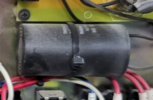
I assume I will need to re-solder the caps back to the board and re-install the board to complete this testing, right?

Thanks,
Chris
 

kellys_eye

Jun 25, 2010
6,512
Joined
Jun 25, 2010
Messages
6,512
I assume I will need to re-solder the caps back to the board and re-install the board to complete this testing, right?
No. The tests I suggest can be done without the board - indeed, the disconnects that I mention disable it completely.
 

Stamey

Apr 28, 2023
44
Joined
Apr 28, 2023
Messages
44
While testing, I found that I had reversed 11 and 12. I put them back correctly and got the following values:
Supply to ZL2 rectifier:
Power on: 30 VAC
After press start button, and contactor KM1 engages: 42 VAC
I did not operate the leaf, to engage KM2.

Supply to ZL1 rectifier:
Press Start button: 14.6 VAC
Press Stop button: 14.6 VAC
Hold Stop button: 14.6 VAC

Note: the foot switch is not connected. It was eliminated first thing for this troubleshooting and is not in the equation.

Thanks,
Chris
 

kellys_eye

Jun 25, 2010
6,512
Joined
Jun 25, 2010
Messages
6,512
With SA on (power switch) you immediately get AC to ZL1.

AC cannot pass any further in the equipment as SB2, SB3 and KM1 are all OPEN. The only way to get AC to go further is to press the footswitch or the start button. This passes the AC (mains) to KM1 (contactor) where one of its contacts bypasses the footswitch (locking the AC on even if you remove your foot).

AC will then go to ZL2. The level of AC to ZL2 depends on the setting of the clamping force toggle switch AND the limit switch SQ. When it is ON there is full clamping. When OFF the AC goes via the 'dropper' capacitor C4 and you get a lower clamp force. You get max clamp force when the limit switch is activated.
 
Last edited:

kellys_eye

Jun 25, 2010
6,512
Joined
Jun 25, 2010
Messages
6,512
Sorry for all the editing - too late at night for my brain to work properly......
 

kellys_eye

Jun 25, 2010
6,512
Joined
Jun 25, 2010
Messages
6,512
So, you should have ZERO VOLTS at 20/21 until the START switch (or footswitch) is pressed.

You will have (some low) DC volts at 20/21 when the start is active or footswitch is pressed (low clamp).

You will have ~240V DC at 20/21 when the limit switch is activated (lever down, high clamp)

All these voltages can be checked without the control board fitted.
 

kellys_eye

Jun 25, 2010
6,512
Joined
Jun 25, 2010
Messages
6,512
The control board delivers the clamping voltage to the magnet coil as soon as ZL2 gets power - the amount of clamping as per above. The voltage to the magnet coil is only released when KM1 and KM2 are released and the STOP button pressed. This applies the low AC (actually pulsed DC) from ZL1 to demagnetise the metal.

The STOP button also reverse biases the thyristor (switches it off), removing the clamping voltage from ZL2.
 

Stamey

Apr 28, 2023
44
Joined
Apr 28, 2023
Messages
44
So, you should have ZERO VOLTS at 20/21 until the START switch (or footswitch) is pressed.

You will have (some low) DC volts at 20/21 when the start is active or footswitch is pressed (low clamp).

You will have ~240V DC at 20/21 when the limit switch is activated (lever down, high clamp)

All these voltages can be checked without the control board fitted.
I have 28VDC between 20 and 21 with power on, nothing else activated, no buttons pressed, toggle switch in "Clamping for bending" position. That's my problem, as it is activating the magnet when it is not supposed to.
I checked both rectifiers and they are fine. The diodes pass current in one direction. I learned how to check a rectifier from a youtube video.

Thanks,
Chris
 

Bluejets

Oct 5, 2014
7,374
Joined
Oct 5, 2014
Messages
7,374
Check the solenoid armature hasn't lost or broken the copper shorting ring.
 

kellys_eye

Jun 25, 2010
6,512
Joined
Jun 25, 2010
Messages
6,512
With the power off, measure the resistance across the footswitch teminals (wires 1 and 2). It should measure open circuit.

If it IS open circuit then there is no way you should measure DC at 20/21 - how would it get the power? SB2, SB3, KM1 or the footswitch MUST be closed to get power to 20/21.
 
Top