Blown amplifier part.

ZJS

Sep 2, 2023
79
Joined
Sep 2, 2023
Messages
79
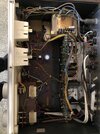
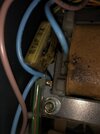
Hi, does any one know what this component is which unfortunately has blown on this amplifier.
It’s a 1980 Ferguson 3939 amplifier which someone in the past did something and it cut out fully. Upon opening it up I see this and It looks to be the issue.
If anyone could tell me what I need (replacement) then that would be excellent.
Thanks
 

Attachments

  • image.jpg
    image.jpg
    222.6 KB · Views: 14

Delta Prime

Jul 29, 2020
2,987
Joined
Jul 29, 2020
Messages
2,987
It tells you right there 0.1 microfarad capacitor non-polarized.
someone in the past did something and it cut out fully.
That's okay! Now you know what not to do...
;)
I'm on break I can't go shopping right now but I'll be back...
 

Delta Prime

Jul 29, 2020
2,987
Joined
Jul 29, 2020
Messages
2,987
You you going to have to measure that capacitor the dimensions. I could be wrong but more likely a metal film capacitor. And it looks like 3x or X3 this is important... The link below is only one of many sources for electronic components shop around you might get a better price...
Veni, Vidi, Visa-Delta Prime

Translation:
I came, I saw, I did a little shopping. :)

photo_1719953972668.pngphoto_1719953690479.png
 

Harald Kapp

Moderator
Moderator
Nov 17, 2011
14,271
Joined
Nov 17, 2011
Messages
14,271
This type of capacitor is typically used to suppress noise and it is constructed to go "open circuit" in case of a defect. In that case the rest of the circuit usually continues to operate, only noise suppression is reduced.
You can even remove it completely and the unit will still work. Note, however, that you should re-insert or replace it to keep the unit within specs with regard to noise suppression - not only with respect to the unit but also wit respect to emission of noise which may disturb other nearby units.

I see this and It looks to be the issue.
I doubt that this capacitor is responsible for "blowing" the amplifier, see explanation above. For a simple test remove it temporarily and check whether the amplifier then works.

Other notorious culprits are the electrolytic capacitors in the power supply. After 44 years of operation these are likely to have dried out. See here for more detail.
Also check all fuses.
 

Delta Prime

Jul 29, 2020
2,987
Joined
Jul 29, 2020
Messages
2,987
Different venue round 1. Get in the ring!!

1655918365583.jpg
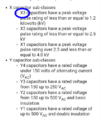
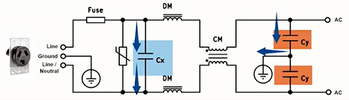
: X capacitors (blue) are designed to filter (noise) specifically EMI (Electromagnetic Interference) as you can see since the capacitor is in parallel as stated before" it can be removed" your particular capacitor has failed (shorted) from line-to-line . Potentially that is why your unit is not working. It is inferred that you know how to solder hence desolder.
Provide me the lead spacing and dimensions and I'll supply you with three separate distributors to choose from on your new capacitor. Y capacitors (orange) filter line-to-ground interference. (Image source: KEMET
1719984628232.png
 
Last edited:

Delta Prime

Jul 29, 2020
2,987
Joined
Jul 29, 2020
Messages
2,987
Maybe you can help me....
Take that sucker out and plug it in.
I just have to know....please.
Because you see if it's designed to fail open that's the same as physically taking it out of circuit.
:)
 

ZJS

Sep 2, 2023
79
Joined
Sep 2, 2023
Messages
79
I’ll take it out and then try it without it to see.
As the blown capacitor is connected to a major coil, I’m hoping that it has just blown and broken the circuit. If it works without it that means I need a replacement one.
Thanks
 

Delta Prime

Jul 29, 2020
2,987
Joined
Jul 29, 2020
Messages
2,987
Do you think you could take it wider photo of the board there will be safety support circuitry as well that may have been damaged just a precaution it's up to you.
 

ZJS

Sep 2, 2023
79
Joined
Sep 2, 2023
Messages
79
Yes I’m struggling believe that the noise capacitor that’s gone would affect the whole power of the unit… although I cannot find a fuse… there has to be one somewhere…?
 

ZJS

Sep 2, 2023
79
Joined
Sep 2, 2023
Messages
79
Here’s the photo
 

Attachments

  • image.jpg
    image.jpg
    372.3 KB · Views: 10

Delta Prime

Jul 29, 2020
2,987
Joined
Jul 29, 2020
Messages
2,987
Not all fuses are made like the classic Glass tube.
Sorry about that I'm on speeches to text
 
Last edited:

Delta Prime

Jul 29, 2020
2,987
Joined
Jul 29, 2020
Messages
2,987
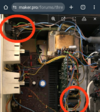
Closer please red circles.
And that is a well-designed board.
It's late for me now I got to go...
@ HaraldKapp 's assessment is spot on!
Darn it.... It's late for me I got to go to bed.

photo_1719988997926.png
 

Delta Prime

Jul 29, 2020
2,987
Joined
Jul 29, 2020
Messages
2,987
capacitors (blue) are designed to filter (noise) specifically EMI (Electromagnetic Interference) as you can see since the capacitor is in parallel as stated before" it can be removed" your particular capacitor has failed (shorted) from line-to-line
Post number five!
But what does it matter, the point is to help.
Not who's right and who's wrong.
I sit, I stand, I Tower, over all y'all.
See how stupid that is...
It's about contributing to the person requesting help.
Screenshot_20240703_090755.jpg
Nick Davis holds a Bachelor of Science degree in Electrical Engineering from the University of Idaho located in beautiful Moscow, ID
What do you think Mr Davis got his information?
He regurgitated textbooks..
 
Last edited:

Delta Prime

Jul 29, 2020
2,987
Joined
Jul 29, 2020
Messages
2,987
I stand corrected
This is real world...Let's see... To the thread starter.
If you got a multimeter confirm the status of that capacitor get your multi-meter put on the lowest level lowest setting measure the resistance of your leads by shorting them out, note the lead resistance
Then take your leads across that capacitor
Subtract that value from the lead resistance show the results. That will confirm open or short and remove one leg of the capacitor leads for measuring.
 

ZJS

Sep 2, 2023
79
Joined
Sep 2, 2023
Messages
79
Hello. I put the multimeter on each end of the blown capacitor exposed wire part and it read nothing when the unit was turned off but when I turned it on it read around 20 k ohms.
After further inspection… the capacitor is connected to a direct neutral wire coming straight from the mains.
So it’s nothing to do with audio. The neutral wire goes into the dodgy capacitor and then to the major coil.

Could I have the exact name of what I need to buy and a suitable place to buy it from please.

I miss listening to my records…
 

ZJS

Sep 2, 2023
79
Joined
Sep 2, 2023
Messages
79
I now strongly think that this is why my unit is showing no sign of life. I now think that when someone wazzed the volume up to fast it created a surge which blew it.
 

Bluejets

Oct 5, 2014
7,374
Joined
Oct 5, 2014
Messages
7,374
If you got a multimeter confirm the status of that capacitor get your multi-meter put on the lowest level lowest setting measure the resistance of your leads by shorting them out, note the lead resistance
Then take your leads across that capacitor
Subtract that value from the lead resistance show the results. That will confirm open or short and remove one leg of the capacitor leads for measuring.
Appears the cap would be across the transformer line and neutral as one would expect so any measurement may be null and void unless the cap is disconnected at least one leg.
 
Top