I want to know all of the maths concerning this scissor mechanism!

Delta Prime

Jul 29, 2020
2,987
Joined
Jul 29, 2020
Messages
2,987
I've been to woo woo land & back.
I agree with your entire statement.
I'm learning partner..
I don't know have the stuff you talking about!
I'm just glad you don't go to 32 decimal points. :p Many scientists have been shunned by their esteemed colleagues for pursuing their interests. Finding it interesting is how progress is made.One that comes to mind only because it is a tragic story, is about Ludwig Boltzmann who developed equations and formulas which explain the properties of atoms and how they determine the physical nature of matter.
His theories disproved other laws of physics that in his time, scientists thought were correct. Unfortunately the only one I use is better known as the Boltzmann constant.
But what I'm getting at is... I think this is a damn good thread.
Bravo!
By the way I'm jealous of you...
You have acquired @Alec_t attention.
He's a heavy hitter... One of the greats!
But great ones are always too humble.
To accept such accolades...
Just like that kitty cat watching over us.
 
Last edited:

Maglatron

Jul 12, 2023
2,025
Joined
Jul 12, 2023
Messages
2,025
so I blundered at the first step going to write out again correct this time
 
Last edited:

Maglatron

Jul 12, 2023
2,025
Joined
Jul 12, 2023
Messages
2,025
now need to add losses - weight of scissor and inertia of the cam plus friction, but, I'm getting there!
 

Maglatron

Jul 12, 2023
2,025
Joined
Jul 12, 2023
Messages
2,025
so... Modified (missed out the 4 seconds on the force equation in part (5) and forgotten about gravity constant and so subsequent math following had to be adjusted I now believe that this is correct


1) so say the flywheel is accelerated to pi rad/s (3.141592654) and it turns the cam 4 times slower 0.7853981634rad/s when the cam turns half a turn it'll take 4 seconds

2) Ravg = halfway between minimum and maximum radii Rmin, Rmax (0.45+0.324) / 2 = 0.387m

3) as previously described the slope of the lobes on the cam, (2 lobes) the slope is (Rmax - Rmin) / (pi * Ravg) = (0.45 - 0.324) / (pi * 0.387) = 0.1036357769

4) v = (0.95 * 1.26) / (0.95 *4) 0.315m/s

5) F = v / (0.05 * 4) = 0.315 / 0.2 = 1.575 kgm/s^2 along with gravity + 9.80665 gives 11.38165N - units Newton N (the 0.2 represents 5% of 4seconds)

6) 11.38165N * slope (0.1036357769) = 1.17954614N

7) multiply by 0.324 (lowest point on cam gives 0.3821729494Nm needed at cam

8) -0.3821729494 / 4 (for the torque at flywheel) = -0.09554323735Nm

9) -0.09554323735 / 10.8 (inertia of flywheel) this gives the deceleration of the flywheel = T = I * alpha so, T/I = alpha = -0.008846596051rad/s^2

10) 3.141592654rad/s - 0.008846596051 * 0.2 = 3.139823334rad/s


Now


11) 2.7N * slope (0.1036357769) = 0.2798165976

12) multiply 0.2798165976 by 0.45 (highest point on cam) = 0.1259174689Nm for torque at cam

13) 0.1259174689 / 4 (for the torque at the flywheel) = -0.0314793623Nm

14) -0.0314793623Nm / 10.8 (this gives the deceleration of the flywheel) -0.002914756225rad/s^2

15) 3.139823334rad/s - 0.002914756225 * 3.8sec (the rest of the 4 seconds) = 3.128747261rad/s

16)starting speed of flywheel is 3.141592654 and corresponding energy = 53.29586377J

after lifting the weight back up to the top 1.26m through the scissor and cam; the flywheel speed is 3.128747261 and corresponding energy = 52.86092088J

difference 0.4349428939J that the flywheel loses

3.392920065 / 0.4349428939 = 7.800840322 : 1


approx 8 steps forward 1 step back!

3.392920065J is the energy added to the flywheel by falling weight and the flywheel shunts the scissor mechanism via the cam setup in 4 seconds and only expends 0.4349428939J in doing this action
Ta Da...
 
Last edited:

Maglatron

Jul 12, 2023
2,025
Joined
Jul 12, 2023
Messages
2,025
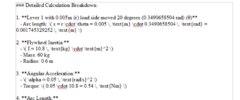
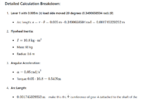
so I've tried to neaten the explanation up with chatgpt but when i copy it to a text document it looks like thisanyone know how to sort it so it looks like this
1720027752955.png1720027877188.png
 

Maglatron

Jul 12, 2023
2,025
Joined
Jul 12, 2023
Messages
2,025

MAGLATRON​

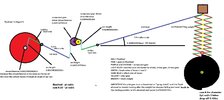
this is a Detailed Calculation Breakdown: (of what I have so far)proggress velocity ratio.jpg

  1. Lever 1 with 0.005m (r) load side moved 20 degrees (0.3490658504 rad) (θ)
    • Arc length: s = r * θ = 0.005 m * 0.3490658504 rad = 0.001745329252 m
  2. Flywheel Inertia:
    • I = 10.8 kg * m^2
    • Mass: 60 kg
    • Radius: 0.6 m
  3. Angular Acceleration:
    • α = 0.05 rad/s^2
    • Torque: 0.05 * 10.8 = 0.54 Nm
  4. Arc Length:
    • 0.001745329252 m – make this the circumference of gear A (attached to the shaft of the flywheel)
    • Radius: 0.001745329252 / 2π = 0.0002777777778 m
  5. Torque Formula:
    • T = F * r
    • Therefore F = T / r = 0.54 / 0.0002777777778 = 1944 N
  6. Torque Calculation:
    • T = F * r
    • 1944 * 0.005 = 9.72 Nm
  7. Force on Effort Side of Lever 1:
    • T = F * r
    • F = T / r
    • 9.72 / 0.3 = 32.4 N
  8. Arc Distance for Effort Side of Lever 1:
    • s = r * θ
    • 0.3 * 0.3490658504 = 0.1047197551 m
  9. Radius of Driving Gear (Larger Gear):
    • 0.1047197551 / 2π = 0.01666666666 m
  10. Torque Confirmation:
    • 32.4 * 0.01666666666 = 0.54 Nm
  11. Smaller Gear and Increased Force:
    • Radius: 0.01666666666 / 5 = 0.003333333332 m
    • Force: 32.4 * 5 = 162 N
  12. Torque on Smaller Gear:
    • 162 * 0.003333333332 = 0.54 Nm
  13. Circumference of Second Gear:
    • 2π * 0.003333333332 = 0.02094395102 m
  14. Lever 2 Load Side Radius:
    • 0.02094395102 / 0.3490658504 = 0.06 m
  15. Effort Side of Lever 2:
    • Length: 3.6 m
    • Force: 162 / 60 = 2.7 N
    • Mass: 2.7 / 9.80665 = 0.2753233775 kg
  16. Height of Effort Side:
    • 3.6 * 0.4390658504 = 1.256637061 m
  17. Torque and Energy:
    • Torque: 2.7 * 3.6 = 9.72 Nm
    • Energy: 2.7 * 1.256637061 = 3.392920065 J
    • Energy: 9.72 * 0.3490658504 = 3.392920065 J
    • Energy: 0.2753233775 * 9.80665 * 1.256637061 = 3.392920065 J
  18. Angular Velocity:
    • ω2^2 = ω1^2 + 2 * α * θ
    • For θ = 2π: ω2 = sqrt(ω1^2 + 2 * α * 2π) ω2 = sqrt(0 + 2 * 0.05 * 2π) ω2 = sqrt(0.6283185308) = 0.7926654595 rad/s
    • Energy: E = 1/2 I ω2^2 = 1/2 * 10.8 * 0.7926654595^2 = 3.392920065 J
TimeVelocityEnergyMomentum
15.850.793.398.56
6.571.126.7912.11
5.041.3710.1814.89
4.251.5913.5717.12
3.741.7716.9619.14
3.381.9420.3620.97
3.112.123.7522.65
2.92.2427.1424.21
2.722.3830.5425.68
2.62.533.9327.07
2.452.6337.3228.39
2.342.7440.7229.66
2.242.8944.1130.87
2.162.9747.532.03
2.083.0750.933.16
2.013.1754.2834.24
1.953.2757.6835.3
1.93.3661.0736.32
So the time adds to 67.29s and it's moving at 3.36 rad/s α = 3.36 / 67.29 ≈ 0.05 rad/s^2, which correlates nicely!

CAM and SCISSOR​

First off, there is no mechanical advantage, meaning the applied upward force = 1 x the downward load. Nonetheless, if I moved an upward force up at that pivot, a distance dy, then at stage 10, it would have moved 10 * dy. And it is true that if the cam's max distance from the axis of rotation is 0.126 and has 10 levels, then the top of the scissor will have moved 1.26m = 10 * dy. So the torque into the cam is positive, but the same torque is negative to the flywheel, and negative torque divided by inertia of the flywheel gives deceleration. I need to find the torque required to give a force of 2.7N because:

F = m * g = 9.80665 * 0.2753233775 kg = 2.7 N

At the top of the snail/drop of cam, this torque will be efficient enough because it's the max radius of the cam! So the flywheel is turning π rad/sec and its inertia is 10.8 kgm^2.

Consider the spiral has an average radius Ravg halfway between the minimum and maximum radii Rmin, Rmax: (0.45 + 0.324) / 2 = 0.387 m

The spiral length would then be π * Ravg: π * 0.387 = spiral length 1.215796357 m

Over that length, the cam-follower moves a vertical distance Rmax - Rmin: 0.45 - 0.324 = 0.126 m

Average radius of (0.324 m + 0.45 m) / 2 = 0.387 m Slope is (Rmax - Rmin) / (π * Ravg): (0.45 - 0.324) / (π * 0.387) = 0.1036357769 Weight: 2.7 N Lateral force: 2.7 N * 0.1036357769 = 0.2798165976 N Max Torque (taken at the biggest radius): 0.2798165976 N * 0.45 m = 0.1259174689 Nm

But we use the max radius of the cam: 0.2798165976 N * 0.45 = torque of 0.1259174689 Nm

  1. Flywheel Accelerated to π rad/s (3.141592654) and Turns the Cam 4 Times Slower 0.7853981634 rad/s
    • When the cam turns half a turn, it will take 4 seconds.
  2. Average Radius (Ravg):
    • Halfway between minimum and maximum radii Rmin, Rmax: (0.45 + 0.324) / 2 = 0.387 m
  3. Slope of the Lobes on the Cam:
    • (Rmax - Rmin) / (π * Ravg) = (0.45 - 0.324) / (π * 0.387) = 0.1036357769
  4. Velocity Calculation:
    • v = (0.95 * 1.26) / (0.95 * 4) = 0.315 m/s
  5. Force Calculation:
    • F = v / (0.05 * 4) = 0.315 / 0.2 = 1.575 kgm/s^2 along with gravity + 9.80665 gives 11.38165 N 0.2 represents 5% of 4 seconds
  6. Force with Slope:
    • 11.38165 N * 0.1036357769 = 1.17954614 N
  7. Torque Needed at Cam:
    • Multiply by 0.324 (lowest point on cam): 0.3821729494 Nm
  8. Torque at Flywheel:
    • -0.3821729494 / 4 = -0.09554323735 Nm
  9. Deceleration of Flywheel:
    • -0.09554323735 / 10.8 (inertia of flywheel): α = T / I = -0.008846596051 rad/s^2
  10. Flywheel Speed After Deceleration:
    • 3.141592654 rad/s - 0.008846596051 * 0.2 = 3.139823334 rad/s
Now

  1. Force with Slope:
    • 2.7 N * 0.1036357769 = 0.2798165976 N
  2. Torque at Highest Point on Cam:
    • 0.2798165976 * 0.45 = 0.1259174689 Nm
  3. Torque at Flywheel:
    • 0.1259174689 / 4 = -0.0314793623 Nm
  4. finding Deceleration of Flywheel:
    • -0.0314793623 / 10.8 = -0.002914756225 rad/s^2
  5. Flywheel Speed After Deceleration:
    • 3.139823334 rad/s - 0.002914756225 * 3.8 sec = 3.128747261 rad/s 3.8 sec represents the other 95% of the time (4sec)
  6. Energy Calculation:
    • Starting speed of flywheel: 3.141592654 rad/s and corresponding energy: 53.29586377 J
    • After lifting the weight back up to the top 1.26m through the scissor and cam, the flywheel speed is 3.128747261 rad/s and corresponding energy: 52.86092088 J
    • Difference: 0.4349428939 J that the flywheel loses.
  7. Energy Efficiency:
    • 3.392920065 / 0.4349428939 = 7.800840322 : 1
    • Approx 8 steps forward, 1 step back!
3.392920065J is the energy added to the flywheel by falling weight and the flywheel shunts the scissor mechanism via the cam setup in 4 seconds and only expends 0.4349428939J in doing this action.
 
Last edited:

Maglatron

Jul 12, 2023
2,025
Joined
Jul 12, 2023
Messages
2,025
I've been to woo woo land & back.
I agree with your entire statement.
I'm learning partner..
I don't know have the stuff you talking about!
I'm just glad you don't go to 32 decimal points. :p Many scientists have been shunned by their esteemed colleagues for pursuing their interests. Finding it interesting is how progress is made.One that comes to mind only because it is a tragic story, is about Ludwig Boltzmann who developed equations and formulas which explain the properties of atoms and how they determine the physical nature of matter.
His theories disproved other laws of physics that in his time, scientists thought were correct. Unfortunately the only one I use is better known as the Boltzmann constant.
But what I'm getting at is... I think this is a damn good thread.
Bravo!
By the way I'm jealous of you...
You have acquired @Alec_t attention.
He's a heavy hitter... One of the greats!
But great ones are always too humble.
To accept such accolades...
Just like that kitty cat watching over us.
anyway I'm not claiming overunity or free energy, and not selling either do the math yourself come to your own conclusion!
 
Last edited:

Maglatron

Jul 12, 2023
2,025
Joined
Jul 12, 2023
Messages
2,025
heres the updated pdf went through with fine tooth comb and wrote it out a couple of times in different ways hope you get it folks!!!
 

Attachments

  • new project ammended.pdf
    278.2 KB · Views: 1

Maglatron

Jul 12, 2023
2,025
Joined
Jul 12, 2023
Messages
2,025
sorry guys for the constant editing but I think this one is now correct after going through with a finer comb :) changed the order abit too for easier reading!
 

Attachments

  • MAGLATRON-3.pdf
    278.5 KB · Views: 0

Maglatron

Jul 12, 2023
2,025
Joined
Jul 12, 2023
Messages
2,025
so with a bit of messing around managed to get this looks better but need a pdf editor to add pictures and edit the format a bit
 

Attachments

  • MAGLATRON-1.pdf
    104.3 KB · Views: 0

Maglatron

Jul 12, 2023
2,025
Joined
Jul 12, 2023
Messages
2,025
so by the way anyone know of a free pdf editor
its ok, found libreoffice draw!
 
Last edited:

Maglatron

Jul 12, 2023
2,025
Joined
Jul 12, 2023
Messages
2,025
Learning Solidworks and will soon be developing some really nice diagrams!
 

Maglatron

Jul 12, 2023
2,025
Joined
Jul 12, 2023
Messages
2,025
so I want a inertia of 10.8kgm^2, 100mm thick made of steel with density Density of steel (ρ\rhoρ) = 7850 kg/m³ I want to work out the radius that the wheel should be to satisfy the parameters given also want the weight to equal 60kg when the radius is 0.6m chatgpt tells me the thickness will be 6.75mm dont even know if that is correct but I need it to be a bit more substantial between 0.06 and 0.1 metres in thickness any help would be greatly welcomed
I think it should be a simple equation. and I have now aquired solidworks so am going to build a really cool image
not sure if I'm correct but my thinking is that if the radius goes down then the thickness value will go up!
on thinking about it I might even have to make a ring flywheel to keep the inertia at 10.8kgm^2 and have a depth of 100mm and the same weight of 60kg the thickness to the ring would also need to be calculated
however it's made it needs to be 10.8kgm^2 moment and needs to be at least 6cm thick if not thicker!
 
Last edited:

Maglatron

Jul 12, 2023
2,025
Joined
Jul 12, 2023
Messages
2,025
Mr Delta Prime perhaps you might know about this subject??
so I want a inertia of 10.8kgm^2, 100mm thick made of steel with density Density of steel (ρ\rhoρ) = 7850 kg/m³ I want to work out the radius that the wheel should be to satisfy the parameters given also want the weight to equal 60kg when the radius is 0.6m chatgpt tells me the thickness will be 6.75mm dont even know if that is correct but I need it to be a bit more substantial between 0.06 and 0.1 metres in thickness any help would be greatly welcomed
I think it should be a simple equation. and I have now aquired solidworks so am going to build a really cool image
not sure if I'm correct but my thinking is that if the radius goes down then the thickness value will go up!
on thinking about it I might even have to make a ring flywheel to keep the inertia at 10.8kgm^2 and have a depth of 100mm and the same weight of 60kg the thickness to the ring would also need to be calculated
however it's made it needs to be 10.8kgm^2 moment and needs to be at least 6cm thick if not thicker!

I've been to woo woo land & back.
I agree with your entire statement.
I'm learning partner..
I don't know have the stuff you talking about!
I'm just glad you don't go to 32 decimal points. :p Many scientists have been shunned by their esteemed colleagues for pursuing their interests. Finding it interesting is how progress is made.One that comes to mind only because it is a tragic story, is about Ludwig Boltzmann who developed equations and formulas which explain the properties of atoms and how they determine the physical nature of matter.
His theories disproved other laws of physics that in his time, scientists thought were correct. Unfortunately the only one I use is better known as the Boltzmann constant.
But what I'm getting at is... I think this is a damn good thread.
Bravo!
By the way I'm jealous of you...
You have acquired @Alec_t attention.
He's a heavy hitter... One of the greats!
But great ones are always too humble.
To accept such accolades...
Just like that kitty cat watching over us.
 

Maglatron

Jul 12, 2023
2,025
Joined
Jul 12, 2023
Messages
2,025
Hmm cool so is there a way I can distribute the 60kg in a ring format that will have a thickness of 100mm if so can you enlighten me? cheers Mr Alec_t or perhaps provide the formula, thanks
my instinct tells me if the weight is distrbuted in to a ring and the width is 100mm then the radius goes down! I dont know how thick the 100mm width steel ring would be (ie the inner and outer radius) can you give it a crack?
the sooner I get this figured then the sooner I can get on with the design in solidworks!!
 
Last edited:

Martaine2005

May 12, 2015
5,276
Joined
May 12, 2015
Messages
5,276
Woo Woo land exists for a reason.
Physics as we know it in 2024 hasn’t changed.
There is a weird chap on YouTube called Robert Murray Smith that claims to have reinvented the wheel!.
Reality begs to differ. I can get 1000v from 12v but it’s useless!. You can get more voltage from a static whack!. Still useless!.
The current involved here wouldn’t even entertain an LED.
 
Top