I want to know all of the maths concerning this scissor mechanism!

Maglatron

Jul 12, 2023
2,025
Joined
Jul 12, 2023
Messages
2,025
hmm I thought about that (the two variables) ok I'll think about it for a bit
Obviously you can't, why else would you ask ;)

makes for Ravg = 1/2 × (Rmax+Rmin).
Insert into
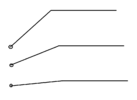
slope = (Rmax - Rmin) / (2×Pi × 1/2×(Rmax+Rmin)) = (Rmax - Rmin) / (Pi × (Rmax+Rmin)) = 0.05.
You now have an equation with two variables: Rmax and Rmin. You need to define one of the two, e.g. Rmin, then solve the equation for Rmax. Or vice versa.
I want it to work out that the slope = 5% but also want the Rmin and Rmax to be a difference of 10cm, do you get my problem? thanks

is it just trial and error?
 
Last edited:

Harald Kapp

Moderator
Moderator
Nov 17, 2011
14,272
Joined
Nov 17, 2011
Messages
14,272
also want the Rmin and Rmax to be a difference of 10cm
So Rmax -Rmin = 10 cm or Rmax = Rmin +10 cm
With that you get Rmax + Rmin = (Rmin +10 cm) +Rmin = 2×Rmin + 10 cm or
Insert these into slope = (Rmax - Rmin) / (Pi × (Rmax+Rmin)) = 0.05
to get
slope = 0.05 = 10 cm / (Pi × (2×Rmin + 10 cm))
and solve for Rmin.
 

Maglatron

Jul 12, 2023
2,025
Joined
Jul 12, 2023
Messages
2,025
ok so is that Rmin 26.8309cm and Rmax 36.8309cm
I put those figures into the equation and sure enough equals 0.05 (or 5%) thanks
 
Last edited:

Maglatron

Jul 12, 2023
2,025
Joined
Jul 12, 2023
Messages
2,025
so been wondering for a while now
so now I'm thinking 3.3929J / 0.3m (height) = f 11.3097N approx 1.1528kg, and have a cam that varies with 1 lobe 10cm drop off (need to design the cam so that the slope is 5%) and have the scissor have only 3 levels, this way Fv will be 3*f and then so Fv = 3 * 11.3097 = 33.9292, and the Hf will be = 5% of Fv, 33.9292 * 0.05 = Hf = 1.6964N

Re-thinking the maximum torque needed, it won't occur at the maximum radius of the cam as assumed so far; it will actually be at the minimum radius by my reckoning, for the following reason.
You want the weight to rise at constant velocity; but when the weight falls to its lowest point it instantly has zero velocity and then has to reverse to have a positive (upward) velocity. Let's assume that for 90% of the 0.5sec rise time the velocity v is constant. So v=(0.9 x 1.26m)/(0.9 x 0.5s) m/s = 2.52m/s. That means v has to reached from zero by an acceleration f in the first 10% of the 0.5sec, so f= v/(0.1 x 0.5) = 2.52/0.05 = 50.4m/s^2. That's about 5g which the cam has to provide at or near the minimum radius, in addition to the 1g to counteract gravity.
is the force dependent of the speed of the cam?? I want it to turn round once in 2 seconds?
ok so is that Rmin 26.8309cm and Rmax 36.8309cm
I put those figures into the equation and sure enough equals 0.05 (or 5%) thanks
 
Last edited:

Maglatron

Jul 12, 2023
2,025
Joined
Jul 12, 2023
Messages
2,025
"do I need to add 1g?" I think not because the starting point of the 11.3097N has gravity in it intrinsically
No additional gravitational force:
If the 11 Newtons downward already includes gravitational effects, then you need an equal and opposite 11 Newtons upward to balance it. and so the other side of the scissor Fv =33.9292N but along with the slope of 5% the Fh equals1.6964N
HOW FAST does the cam need to be turning to produce the desired Fh of 1.696N??
mt thinking is the slower the cam rotates then the less force will be produced, is this correct thinking?
 
Last edited:

Maglatron

Jul 12, 2023
2,025
Joined
Jul 12, 2023
Messages
2,025
Force = mass x acceleration.
okay so i have the force Fh of 1.696N what then is the mass and acceleration, sorry if this sounds stupid but it requires less force to lift the weight of 1.1528kg
 

Maglatron

Jul 12, 2023
2,025
Joined
Jul 12, 2023
Messages
2,025
do I accelerate the weight above the scissor and relay it back through the scissor to Fh
 

Maglatron

Jul 12, 2023
2,025
Joined
Jul 12, 2023
Messages
2,025
v = (0.95 * 0.3) / (0.95 * 2) = 0.15m/s
a = v / (0.05 * 2) = 1.5m/s^2
add up accelerations 9.80665m/s^2 + 1.5m/s^2 = 11.30665m/^2
F = ma 1.1528kg * 11.30665m/s^2 = F of 13.0343N to accelerate in the 5% of the 2 secs and for the remainder of the time 11.3097N

so the accelerating force at the cam is f 13.0343 * 3 = Fv = 39.1029 and for Fh, multiply Fv by 0.05 equals 1.95515N in the first 5% of the time and for the remainder of the 2 seconds 1.696N
correct?

I still need to know how fast the cam needs to turn
I think I've answered it myself it needs to turn once every 2 seconds!!
however I have doubts because how do I know that the cam will provide the force needed at this velocity
heres a thought experiment if the cam was turning at 1 turn per second it would shove the scissor and ultimately the weight up in a second this would have a higher force than if you turned the cam round in 10 minutes the force would be so small, so this is why it's important to match the speed of the cam to the desired force!!
 
Last edited:

Maglatron

Jul 12, 2023
2,025
Joined
Jul 12, 2023
Messages
2,025
Force = mass x acceleration.
the equal and opposite force of 11.3097N keeps it still or at a constant speed so this tells me that the cam has to be moving at a constant speed how do I work it out?? thanks this force at the cam is Hf = 1.6964N
 

Maglatron

Jul 12, 2023
2,025
Joined
Jul 12, 2023
Messages
2,025
look at this site
and scroll down to input speed this will be 2pi from the flywheel
output speed is where the cam speed should go
the output torque is what will be Fh * smaller radius of the cam
then it will give the required torque from the flywheel
then we divide the torque we find by the inertia this will give a deccelation
the we use this formula w2 = w1 + at = flywheel rad/s + (-acceleration) * (0.05 * 2)

we do this twice for each torque and how long they act for - there corrosponding times
remember to change from RPM to rad/s

I should be able to link the angular velocity of the cam to the velociy of the weight
any ideas??
thanks
 
Last edited:

Maglatron

Jul 12, 2023
2,025
Joined
Jul 12, 2023
Messages
2,025
v = (0.95 * 0.3) / (0.95 * 2) = 0.15m/s
a = v / (0.05 * 2) = 1.5m/s^2
add up accelerations 9.80665m/s^2 + 1.5m/s^2 = 11.30665m/^2
F = ma 1.1528kg * 11.30665m/s^2 = F of 13.0343N to accelerate in the 5% of the 2 secs and for the remainder of the time 11.3097N

so the accelerating force at the cam is f 13.0343 * 3 = Fv = 39.1029 and for Fh, multiply Fv by 0.05 equals 1.95515N in the first 5% of the time and for the remainder of the 2 seconds 1.696N
correct?
I want to relate this 0.15m/s to the rad/s of the cam!

I think it's just pi rad/s sorry for the stupidity I don't know what I was thinking 1 revolution in 2 seconds!
 
Last edited:

Maglatron

Jul 12, 2023
2,025
Joined
Jul 12, 2023
Messages
2,025
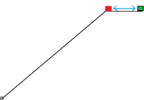
so I've had a radical idea does anyone know of a mechanism the keeps the flat part flat as the lever rotates clockwise around the circle (pivot)if you can't understand the drawing just ask my idea is to have a shiftable weight that sits on the flat part and when lifting up the weight would be over to the left of the flat part and then when it's been lifted then move it over to the righteffectivly elongating the lever arm and thus torque and whe it gets to the bottom move it back over to the left and restart the process
IF the weight is on near frictionless rollers bover the weight from side to side would require very little effort
1722521634038.png
1722522847817.png
 
Last edited:

Maglatron

Jul 12, 2023
2,025
Joined
Jul 12, 2023
Messages
2,025
so I've been through the maths and it doesn't work out the way I wanted - but not going to give up! I'm going to build it and see if it might work how I imagined!
 

madisonshaw660

Nov 17, 2025
1
Joined
Nov 17, 2025
Messages
1
You're working on an interesting setup. To observe how the load reacts, it could be useful to sketch out the force profile throughout a single rotation using the 3-lobe cam and the timing you mentioned. You should have a better idea of what the follower would truly experience even if the velocity isn't constant.
 
Top