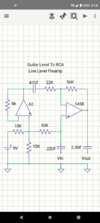
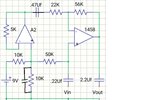
Connect the audio output of this circuit, to the RCA line level inputs found on Home Stereo, P.A. , or D.J. equipment. Do not connect to Microphone, Phono, or 600 Ohm line inputs.
Hi Dave, the + side of the 9V supply connects to the Vcc pin, and the - side of the 9V supply connects to the Vee pin. A .1Uf capacitor connects to the Vcc and Vee pins, on the 1458 of amp. A2 provides a buffered version of 1/2 the supply voltage, as ground potential for the negative feedback of 1458.
That buffering serves no purpose. That .47 uF capacitor blocks the DC anyway.
Unless the circuit is modified relocating that capacitor as shown below. Not sure what purpose it serves. You need only that 1458.
Should there be any noise on the D.C. output of the power supply, equal amounts of noise appears at both inputs of 1458. That being said, there is no potential difference in noise to be amplified by 1458.
Okay, I see what you're saying. The 1458 is a dual op amp, basically two 741 op amps in the same package. I suppose I could use a 741 op amp, or a TL081 op amp.
In terms of output strength, a Guitar level signal is stronger than a Microphone level signal, but weaker than a Line level signal. RCA Line level inputs require a -10 db signal. Pro Audio Line level inputs require a +4 db signal.
Yeah in terms of output strength. What you just said was gibberish you just contradicted. yourself.
It's okay just stop talking you're here asking questions and I haven't answered anything so... Sorry about that
What is it you would like to do? Connect your guitar? Hook it up to a preamp terminating into a final power amplifier for speaker?
Maybe a Marshall guitar amp speaker?
Marshall (pun intended) your thoughts...
The main purpose of my circuit, is to use Home Stereo equipment as a Guitar Amp, for home use. Mixer amps have both +4 and -10 db line inputs on them. My circuit can be plugged into the -10 db line inputs, to serve as an emergency backup Guitar Amp. You never know when a Tube Guitar Amp may fail at a Live Gig.
Looks like A2 may be 'bootstrapping' the input impedance of the 1458, and that bootstrapping may have a variation over frequency. In which case you do NOT want to bypass that 10K with a capacitor.
Looks like A2 may be 'bootstrapping' the input impedance of the 1458, and that bootstrapping may have a variation over frequency. In which case you do NOT want to bypass that 10K with a capacitor.
A2 provides a buffered version of 1/2 the supply voltage, as ground potential for the gain of 1458. In addition, A2 also buffers 9.1% of my audio input signal, which will cause a slight reduction at the output of 1458. I'm glad that you mentioned not using a bypass cap on the 10K.
The two 10K resistors provide 1/2 Vcc to BOTH opamps. A2 is not used as a buffer for that voltage - do not short the capacitor on the output of A2. Yes, the output of A2 is 9.1% of the input signal, and it's signal is fed to the inverting input of the 1458. The phase is such that it follows the direct signal input at the non-inverting input - Thereby increasing the input impedance of the 1458.
The two 10K resistors provide 1/2 Vcc to BOTH opamps. A2 is not used as a buffer for that voltage - do not short the capacitor on the output of A2. Yes, the output of A2 is 9.1% of the input signal, and it's signal is fed to the inverting input of the 1458. The phase is such that it follows the direct signal input at the non-inverting input - Thereby increasing the input impedance of the 1458.