LEADING Power Factor Correction Problem

oh_well1500

Jul 30, 2024
2
Joined
Jul 30, 2024
Messages
2
QUESTION,
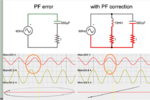
I can get into specifics later, but on a conceptual level, I have 277 V 60 Hz from a three phase source powering a low pass filter that has enough capacitance that dozens of them at the same facility are causing a LEADING power factor and the utility company is demanding a fix. Could I fix this simply by introducing a shunted inductor with the right amount of inductance to lower the apparent power to more acceptable levels?20240730144530123-1.png
 

Bluejets

Oct 5, 2014
7,374
Joined
Oct 5, 2014
Messages
7,374
I very much doubt any power supply authority would be concerned about your "toy".
 

Delta Prime

Jul 29, 2020
2,987
Joined
Jul 29, 2020
Messages
2,987
It takes an electrical engineer to appreciate the complex power factor characteristics of Alternating Current.
Electronic equipment present either a resistive load, heaters and incandescent light bulbs or inductive load, transformers & motors.
By adding external reactive components, like inductors, to cancel out the effects of the load's reactance.This equal & opposite load brings the circuit's total impedance closer to its total resistance, making the impedance phase angle closer to zero.
Inductive loads are of concern because they use the magnetic properties of electricity.
The magnetic effect disrupts the smooth waveform of alternating current and voltage, causing the current to lag behind the voltage. Power Factor is a metric that expresses the degree of “disruption” in the alternating current.
An active PFC circuit , there are a voltage & a current loop.The voltage loop has very slow dynamics when changing the input conductance, actively balancing the input & output powers.The output voltage is compared to a reference voltage to obtain an error signal, which directly actuates on the current loop. The current loop has faster dynamics than the Voltage loop & is responsible for making the input current proportional to the voltage, correcting the power factor. Dynamic equilibrium.
You could just have noise current which would lower your (THD) Total Harmonic Distortion.
You have to know the equipment in your facility
You can measure and see the waveform itself with an oscilloscope.
If the current waveform has considerable
distortion relative to a sine wave and therefore the power factor drop well below 1.0.To bring the power factor close to1.It is necessary to reduce harmonic current.
 

Harald Kapp

Moderator
Moderator
Nov 17, 2011
14,271
Joined
Nov 17, 2011
Messages
14,271
@Delta Prime : ???
This:
  1. doesn't answer the op's question.
  2. is not relevant to the op's question. A power factor |= 1 doesn't necessarily mean a distorted waveform. When you connect a rectance to a perfect sinusoidal source, voltage and current will both have perfect sinusoidal waveforms, too. But they will be out of phase and thus the power factor will be |= 1.

The op's circuit, being a passive LC filter (@oh_well1500 : show us the circuit diagram of the filter, please), will show sinusoidal, non-distorted waveforms being phase shifted. Obviously he wants to correct the phase shift by adding an inductor. This is not unreasonable. In today's electrical distribution networks the load is mainly inductive and capacitor banks are used to correct the resulting phase shift aks power factor |= 1 (example). The op is simply doing the opposite.
 

Delta Prime

Jul 29, 2020
2,987
Joined
Jul 29, 2020
Messages
2,987
By adding an inductor in series with the capacitance allows the impedance to rise with the increase in frequency. That means the impedance offered to the harmonic current is more and thus less harmonic current flows through capacitor.
 

Delta Prime

Jul 29, 2020
2,987
Joined
Jul 29, 2020
Messages
2,987
You are my Achilles heel. @Martaine2005
There is no belief in electronic engineering.
I did not answer the question until after the moderators. Any of which is my Superior.
Provided guidance to keep everyone on track. With that said in the schematic provided by the thread starter the inductance is in parallel with the load.
I can get into specifics later
Now's the Time for specifics.
You should always start out with specifics.
This way you can receive an in-depth explanation within 100 posts.
 

oh_well1500

Jul 30, 2024
2
Joined
Jul 30, 2024
Messages
2
@Delta Prime : ???
This:
  1. doesn't answer the op's question.
  2. is not relevant to the op's question. A power factor |= 1 doesn't necessarily mean a distorted waveform. When you connect a rectance to a perfect sinusoidal source, voltage and current will both have perfect sinusoidal waveforms, too. But they will be out of phase and thus the power factor will be |= 1.

The op's circuit, being a passive LC filter (@oh_well1500 : show us the circuit diagram of the filter, please), will show sinusoidal, non-distorted waveforms being phase shifted. Obviously he wants to correct the phase shift by adding an inductor. This is not unreasonable. In today's electrical distribution networks the load is mainly inductive and capacitor banks are used to correct the resulting phase shift aks power factor |= 1 (example). The op is simply doing the opposite.
Harald,

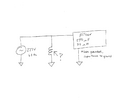
Thank you for the understanding, sorry the filter was messy and I wanted to strip this down to the fundamentals so I could better assess what was going "wrong" or more likely what I was misunderstanding. Below is the actual representation of what I built in the lab today, I moved away from the filter (being almost one big capacitance bank) and really just have capacitors in series represented by the capacitor below, and in parallel I really have a 13 mH inductor in parallel. It performed a little better than the simulation, in terms of total amperage decreasing (that was the original goal of the project, to PF correction in order to get less no load current draw) reading at 20 amps compared to the simulations 24 amps. My question is this Harald, why is this the limit? Why am I not able to achieve lower total current if the current on the inductor line is reading 60 amps and the current on the capacitor line is reading 60 amps in practice, why is this 20 amps present?
1722466073345.png
 

Harald Kapp

Moderator
Moderator
Nov 17, 2011
14,271
Joined
Nov 17, 2011
Messages
14,271
The "culprits" are the 1 Ohm series resistors. Plus the LC combination is close but not exactly at resonance for 60 Hz.
When you set C=541µF and R=0.001 (R=0 will most likely not work in a simulator), you'll see a drastic reduction in current.
 
Top