Basic circuit, but is this possible??

Dandanna

Oct 13, 2024
4
Joined
Oct 13, 2024
Messages
4
Hello All,

I am new to the lovely world of electronics and have a question.

Is it possible to make a tiny light FLASH after 15 seconds, after giving the circuit a 2 second charge of a 3volt button battery.

(In other words closing the circuit for 2 seconds then opening it)

I need the circuit to be simple, with the least amount of components at the smallest possible sizes of .

My thoughts were to put together a..........

555 timer
Two resistors or a variable resistor (ohms?)
Capacitor (rating?)
3v button battery
Transistor (BC547)
And maybe a diode?

------------------------------
Also, sorry to sound ignorant, but if the charge is only for 2 seconds, will the light only flash for 2 seconds? Is there a way to extend that?

Any help will be greatly appreciated. Thank you in advance.

Dan
 

73's de Edd

Aug 21, 2015
3,730
Joined
Aug 21, 2015
Messages
3,730
Dandanna ? . . . . . . . .?

OR . . . . . . with this showing up and being a first time post . . . . .
OR . . . . . . . .it even possibly being a "BOT" generated post . . . . . . . . .
OR . . . . . . . .it being an A.I. generated post . . . . with its I aspect, having no Intelligence whatsoever !

What is the 3V button battery charging ?

RE-CONFIRM
After a 2 second 3V battery charge is applied . . . . . .there is then a 15 second wait and then the light (a LED is presumed) flashes.

Flashes . . . . .for wording used . . . .suggests of an on and off action . . . . . . . versus Lights .
If flashing, being at what on-off time intervals.

555 Timer . . . . . .how are you going to get a 555 timer working on 3VDC supply ?

WHY?
What EXACTLY is this circuit to be used for ? and the / its related "miniaturization" aspect?

73's de Edd . . . . .
 

AnalogKid

Jun 10, 2015
3,045
Joined
Jun 10, 2015
Messages
3,045
Yes this is possible.

The big unknown is the light. Assuming it is an LED, we need the part number and datasheet.

Next, determine how bright you want the LED to be. This (plus the datasheet) tells us how much current it needs.

Next, tell us how long you want the LED to light. With this we can calculate the size of the capacitor that the battery will charge up. This cap probably will be the largest component in the circuit.

A battery can dump charge into an electrolytic capacitor way faster than the LED will draw it out, so yes, the LED can stay let for longer than 2 seconds.

Give us more information about the project. What is the circuit for? What will it be housed in? Is the LED to be seen in darkness? In inside lighting? In outside sunlight?

This is an energy storage project. Energy is accumulated for 2 seconds. Then a small amount of it runs a timer for 15 seconds. Then the rest of it goes to the LED.

ak
 

Bluejets

Oct 5, 2014
7,374
Joined
Oct 5, 2014
Messages
7,374
Yes this is possible.
I'd argue that it is wayyyyyy too early to be that confident given many details are not up front.

One limiting factor would be the internal R of the "button cell" (type not shown).
Another being the "555" as it normally needs between 4.5 and 15v to operate successfully.

There are naturally cmos but there is a limit to what it will drive and at what voltage on the output. (sink or source)

Unless the Op is familiar with many data sheets and how to apply the details, I'd say best of luck.
 

Bluejets

Oct 5, 2014
7,374
Joined
Oct 5, 2014
Messages
7,374
TI has variations of the 555 that are rated for operation down to 1.0 V.
ak

I'll have to take your word for it although it would be the decent thing to point to exactly what you refer to without having to troll through 50 items in your link.

There still remains the effect the internal resistance , depending on button cell type, on the transfer of charge to any cap.

Then one needs to take in to consideration the vd on whatever LED the Op has in mind and how to current limit the discharge. Consider the absolute maximum PD the cap can charge to is the button supply less any losses.

I still say it's like pushing the proverbial uphill with a toothpick.
 

AnalogKid

Jun 10, 2015
3,045
Joined
Jun 10, 2015
Messages
3,045
No trolling (or scrolling) expressed or implied. All 50 items have a minimum operating voltage of 3.0 V or less, as indicated in the Voltage-Supply search parameter and the Voltage-Supply column in the results table. We know nothing about the OP's preference for DIP or SMT parts, budget limits, delivery type (bulk, tube, reel) etc, and the table can be sorted for them.

These are 16 parts that will operate down to 1.5 V, which is less than a visible LED's Vf. Only 2 of them are DIPs. Sorted by cost.


An interesting possibility is for the timer circuit to power a joule thief circuit. This might wring a little a little more illumination time out of the storage cap, possibly reducing its size. One tradeoff is the extra low voltage operation of the joule circuit versus the power loss in its less-than-100% efficiency. Clearly this would be a larger overall assembly, and we already know that size is a thing. Just a thought.

Preliminary calculations indicate that the physical size of the storage cap will be a problem.

ak
 
Last edited:

Dandanna

Oct 13, 2024
4
Joined
Oct 13, 2024
Messages
4
Hello guys,

Thanks for the responses, and no! I am not an AI, as far as I am SELF AWARE. lol

Yes, it is a small led bulb that will hopefully blink.
The speed of the blink and the strength of the lumens isn't important at this stage.....
Maybe a variable resistor would be a way of adjusting blink speed and/or brightness??

The main thing for me is what components i could use and how to arrange them, bearing in mind the miniture aspect, so less is definately more.

I believe Ak got it right with ...
This is an energy storage project. Energy is accumulated for 2 seconds. Then, a small amount of it runs a timer for 15 seconds. Then, the rest of it goes to the LED.

I was wondering if the charge could be held for around 15 seconds, AFTER a charge of around 2 seconds to the capacitor from a 3v button battery (CR1225) if thats even enough power?

I.e. a open circuit that is then closed for 2 seconds then opened again, but the power still reaches the bulb, circa 15 seconds later and of course flashes.

The components I previously mentioned are not absolute, other then the 3volt battery. Any suggestions, formulas, or component configurations will be greatly appreciated.

This is just a pet project of mines guys. I know very little about Electronics and just need a bit of guidance.

Thanks in advance.

Dan
 

AnalogKid

Jun 10, 2015
3,045
Joined
Jun 10, 2015
Messages
3,045
An R-C network on the CMOS 555 Reset input will cause it not to oscillate for 15 seconds. After that, a separate R-C network sets the flash rate. These low-voltage 555 output stages can sink way more current than they can source, which is unfortunate for you because the Reset state has the output low, and it is the weaker output high state that drives the LED.

ak
 

Dandanna

Oct 13, 2024
4
Joined
Oct 13, 2024
Messages
4
Final question AK and thanks for the response, so does that mean it cannot be done?

Dan
 

AnalogKid

Jun 10, 2015
3,045
Joined
Jun 10, 2015
Messages
3,045
Without simulating or prototyping anything, yes, I *think* it can be done. But the tradeoffs of LED on-time versus brightness versus capacitor size might yield unsatisfactory results.
 

Dandanna

Oct 13, 2024
4
Joined
Oct 13, 2024
Messages
4
A.k,
Thank you buddy, I will continue until successful.
I'll close this chat, thank you for all comments everyone.

Peace ✌️
 

AnalogKid

Jun 10, 2015
3,045
Joined
Jun 10, 2015
Messages
3,045

AnalogKid

Jun 10, 2015
3,045
Joined
Jun 10, 2015
Messages
3,045
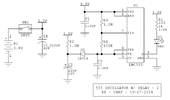
Here is a first pass at a *concept* schematic. It uses parts already in my design libraries that are not necessarily correct for this application.

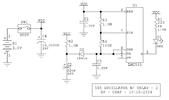
R3, R4, and C3 are the timing components for a standard 555 astable circuit.

When power first is applied, C2 is in parallel with timing capacitor C3 (through D2). C2 charges much more slowly than C3, extending the first half-cycle of the 555 oscillator. This holds the output high for over 10 seconds. When the voltage across C3 reaches 2/3Vcc, the oscillator starts running normally. The 555 output goes low and the LED comes on. From here on the 555 oscillates normally, with a 90% duty cycle. Because the LED is lit when the output is low, it is on only 10% of the time; this gets a lot more flashes out of the storage cap.

Once C2 is charged up to (1/2Vcc - 0.6 V), D2 stops conducting, disconnecting C2 from C3. The voltage across C2 increases to Vcc. R2 and C2 are now out of the circuit. Their only current is the C2 leakage current.

C4 is the storage cap. Even with a 6 V part it will be a large component.

ak

!!555-Osc-Delay-2-c.gif
 

Harald Kapp

Moderator
Moderator
Nov 17, 2011
14,271
Joined
Nov 17, 2011
Messages
14,271
C4 is the storage cap. Even with a 6 V part it will be a large component.
Use a supercapacitor. Yes, they are not the smallest parts but reliable. These have been used in bicycle rear lights for years and are quite reliable.
 

AnalogKid

Jun 10, 2015
3,045
Joined
Jun 10, 2015
Messages
3,045
Since I can't edit my previous post, here is an updated schematic. Click on the image to enlarge.

ak

!!555-Osc-Delay-2-c.gif
 
Top