Schematic question ...

AnalogKid

Jun 10, 2015
3,045
Joined
Jun 10, 2015
Messages
3,045
when a signal crosses a component, the polarity changes

No, it does not.

Positive ---component--- Negative

Nope.

The term "negative" has specific meanings and applications in electronics, and this one is not correct. A better way to see things is:

Positive --- component --- less Positive

A direct current does not "become negative" by going through a component, and it is the direction of the current that determines the polarity of the voltage across a component.

I think what you are saying is that the voltage on one end of a component is negative ***with respect to the other end of the component***. That is very different from saying it is negative with respect to the circuit ground. It is important to understand this concept before wandering into AC circuits, oscillators, power supplies, etc. where negative voltages (with respect to GND) are indeed possible in a circuit with only positive power supply voltages.

ak
 

roughshawd

Jul 13, 2020
616
Joined
Jul 13, 2020
Messages
616
Try dis..
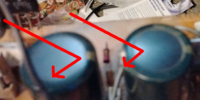
Electricity always travels one way until it hits terminating resistance. Generally any resistance... Then it swaps direction. Any resistance is released as heat. So when the component is installed in series, it is generally accepted that one terminal is positive, and the other is negative. See the light reflection on the top of the caps? The right has a light running across the top and the other is diffused? The right cap has a bulged top.
 

Attachments

  • 17308299116854967051289949701862.jpg
    17308299116854967051289949701862.jpg
    273.2 KB · Views: 6

AnalogKid

Jun 10, 2015
3,045
Joined
Jun 10, 2015
Messages
3,045
Electricity always travels one way until it hits terminating resistance.

No.

Then it swaps direction.

No.

when the component is installed in series, it is generally accepted that one terminal is positive, and the other is negative.

Only for some components and some voltages in some circuits - nothing close to a universal rule.

See the light reflection on the top of the caps? The right has a light running across the top and the other is diffused? The right cap has a bulged top.

Absolutely no clue what this means.

ak
 

Harald Kapp

Moderator
Moderator
Nov 17, 2011
14,271
Joined
Nov 17, 2011
Messages
14,271
The right has a light running across the top and the other is diffused? The right cap has a bulged top.
I can agree with this observation.
Light coming from the left is reflected on the right side of the left capacitor, indicating an indentation.
The same light is reflected in he left side of the right capacitor, indicating a bulge.
1730876206421.png
 

roughshawd

Jul 13, 2020
616
Joined
Jul 13, 2020
Messages
616
Just to clarify.... Schematic diagrams are based on ideal circuits...
Where the diagrams is more of a guide than it is the actual circuit, as this will vary a bit based on the type of circuit and it's use....
 

roughshawd

Jul 13, 2020
616
Joined
Jul 13, 2020
Messages
616
I can agree with this observation.
Light coming from the left is reflected on the right side of the left capacitor, indicating an indentation.
The same light is reflected in he left side of the right capacitor, indicating a bulge.
View attachment 65150
The bulging capacitor in the image is 5uf lower than the one on the right, and will trigger sooner than the one on the left.
 

AnalogKid

Jun 10, 2015
3,045
Joined
Jun 10, 2015
Messages
3,045
Just to clarify.... Schematic diagrams are based on ideal circuits...
Where the diagrams is more of a guide than it is the actual circuit, as this will vary a bit based on the type of circuit and it's use....

Again, no.

Outside of a teaching environment, a schematic indicates how real components are connected to perform a real function. Each component has a reference designator that is linked to a real Bill Of Materials (BOM), that has component manufacturers and part numbers that have datasheets. Those parts have tolerances and other operating parameters that affect how the circuit performs in the very real world. If the variations caused by those parameters affect how a circuit functions, the circuit has other parts to compensate. An example of this would be adding an extra diode to a simple 1-transistor constant-current circuit, to compensate for the temperature coefficient of the base-emitter junction forward voltage.

ak
 
Last edited:

Harald Kapp

Moderator
Moderator
Nov 17, 2011
14,271
Joined
Nov 17, 2011
Messages
14,271
The bulging capacitor in the image is 5uf lower than the one on the right,
Compared to which nominal value? As these seem to be rather big capacitors, a difference of 5 µF is most likely well within the specified tolerance of the capacitors.
As for the bulging: that is another matter and as @Alec_t rightly noted this capacitor should probably be replaced. Even better: replace both capacitors as the other one is likely to experience the same fate as the bulging one the not too far future.
What do you mean? Trigger what?
+1 for this question.
@roughshawd : stick to the language of the trade. Nobody understands your personal lingo.
 
Top