0-30 Vdc Stabilized Power Supply

audioguru2

Apr 6, 2004
12,026
Joined
Apr 6, 2004
Messages
12,026
Simply test voltages in the circuit with a voltmeter. The opamp U2 controls output voltage regulation and it has an extremely high internal voltage gain (220 thousand times for a TLE2141).

The negative feedback of the circuit detects any output voltage loss and directs U2 to correct it.

I think your poor voltage regulation is caused by the wiring from the output of the circuit to your load is too thin and causes the voltage loss.
 

detonatorinf

Sep 24, 2017
16
Joined
Sep 24, 2017
Messages
16
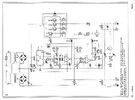
Hello everybody. What modifications should i consider for making this project? My idea is:

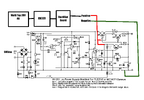
1- A huge transformer with two 28v secondarys. One secondary has a low current for only driving the current and power regulation. Another secondary will deliver the high current and has multiples taps. Both have their own rectifier boards.

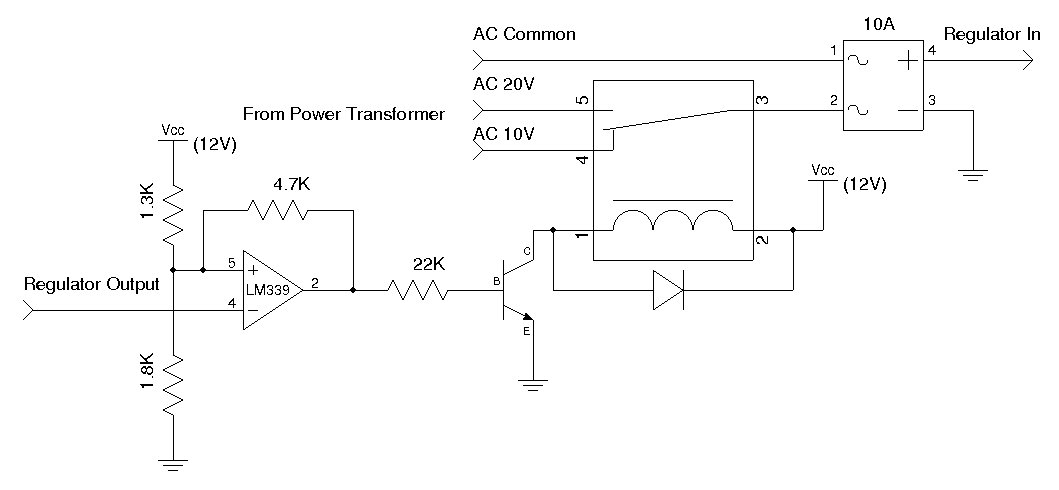
2- A voltage comparator will take care of the tap selection based on the output voltage of the power supply. A way to reduce power dissipation. I'm thinking about the lm339 or three lm311 and relays.

I already made the transformer and i'm following the guide of a Youtube user who made the same modifications on the tl081 version of this power supply.  This is basically how he explained the concept. This approach is similar to the elektor power supply but without the tap selection circuit.

Clipboard01.jpg

MULTITAP.png


audioguru2

Apr 6, 2004
12,026
Joined
Apr 6, 2004
Messages
12,026
Each comparator in an LM339 has an output current of only 4mA. Relay coils need more current so transistors or Fets must be in between.

Your block diagram is missing the huge filter capacitor needed that might burn out the relay contacts when the relays switch taps.


detonatorinf

Sep 24, 2017
16
Joined
Sep 24, 2017
Messages
16
Each comparator in an LM339 has an output current of only 4mA. Relay coils need more current so transistors or Fets must be in between.

Your block diagram is missing the huge filter capacitor needed that might burn out the relay contacts when the relays switch taps.
I

InputVoltageSelector.jpg


I was thinking about the tap selection circuit being done before the rectifier diodes and filter capacitors. This image relates to a similar aproach using the lm338. Since the mc34071 needs a stable 40v supply and -1,4v. Another 28vac 600ma transformer is used for powering the opamps and generating the negative supply. Most of my concerns are about the right way to connect the second transformer.


audioguru2

Apr 6, 2004
12,026
Joined
Apr 6, 2004
Messages
12,026
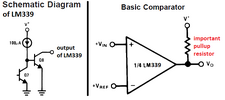
How can you use an LM339 without reading its datasheet? Since its output is "open collector" then it cannot turn on the transistor unless you add a "pullup resistor".

The output of your 10A rectifier does not connect to "regulator in". Instead it has a huge filter capacitor (12000uF) and it powers the driver and output transistors of the regulator circuit.

R13 should connect to the fixed +40V.

When you switch taps then the huge filter capacitor must instantly charge with an enormous current that will burn out or weld the relay contacts.

LM339 output pullup resistor.png

 
Last edited by a moderator:

detonatorinf

Sep 24, 2017
16
Joined
Sep 24, 2017
Messages
16
Sorry. I was aware of the pullup resistor. I will stop from here and stay with the standard project. I will stick with the lm311 and a lm35 for cooling the heatsink.

Once again, thank you for your help and patience, audioguru.


Jeff A.

Jul 29, 2018
7
Joined
Jul 29, 2018
Messages
7
Simply test voltages in the circuit with a voltmeter. The opamp U2 controls output voltage regulation and it has an extremely high internal voltage gain (220 thousand times for a TLE2141).

The negative feedback of the circuit detects any output voltage loss and directs U2 to correct it.

I think your poor voltage regulation is caused by the wiring from the output of the circuit to your load is too thin and causes the voltage loss.
I understood your explanations and I already know what I did wrong.
Thank you very much.


Jeff A.

Jul 29, 2018
7
Joined
Jul 29, 2018
Messages
7
Gentlemen,
I know I have a specific topic for the improved project, but I'm still trying to understand some things in the original project.
I can not understand the operation of transistor Q1 in the circuit. It has been said here in the forum that this transistor works as a protection system, could someone explain to me how this works?
Does the power supply need no protection fuse in the output? How does it protect itself in the case of a simple polarity change, for example: a battery being connected with the polarities exchanged in the output with the whole circuit without power in its entrance? Or even if it is powered, but with the polarities of a load on its output inverted? That is, is she going to protect herself against dodgems like me?
Thank you again,
Algot.


audioguru2

Apr 6, 2004
12,026
Joined
Apr 6, 2004
Messages
12,026
The original old Greek kit used TL081 opamps that have a problem called "Opamp Phase Inversion" where the output goes positively as high as it can if an input voltage gets within a few volts from its negative supply voltage. The improved project used newer opamps that do not have this problem.

When the power supply is turned off then the huge positive filter capacitor for the rectifiers takes time to discharge but the low current negative supply capacitor discharges quickly. Then the output of this power supply project will have opamp U2 to force the output of the project to go positively as high as it can which will probably destroy whatever you were powering with it.

The resistors on the base of Q1 detect that the negative supply voltage is dropping and causes it to conduct and short the output of opamp U2 to 0V so that it cannot cause the output of the power supply to go positively as high as it can.

The circuit does not have a huge high current diode at its output to block a negative high current at its output from damaging it. A huge high current diode might be too slow to protect against damage.


Jeff A.

Jul 29, 2018
7
Joined
Jul 29, 2018
Messages
7
The original old Greek kit used TL081 opamps that have a problem called "Opamp Phase Inversion" where the output goes positively as high as it can if an input voltage gets within a few volts from its negative supply voltage. The improved project used newer opamps that do not have this problem.

When the power supply is turned off then the huge positive filter capacitor for the rectifiers takes time to discharge but the low current negative supply capacitor discharges quickly. Then the output of this power supply project will have opamp U2 to force the output of the project to go positively as high as it can which will probably destroy whatever you were powering with it.

The resistors on the base of Q1 detect that the negative supply voltage is dropping and causes it to conduct and short the output of opamp U2 to 0V so that it cannot cause the output of the power supply to go positively as high as it can.

The circuit does not have a huge high current diode at its output to block a negative high current at its output from damaging it. A huge high current diode might be too slow to protect against damage.
Now, finally, I have been able to understand the function of Q1 and resistors R13 and R14.

I'm doing tests on a Prontoboard, and during the power-off, the output voltage goes to the maximum when the transistor Q1 is removed from the circuit.

Thank you very much for your new explanations, I had not been able to understand them in the past.


chauat1

Dec 24, 2017
1
Joined
Dec 24, 2017
Messages
1
hi all, i have design pcb. what do you think ?

 
Last edited by a moderator:

audioguru2

Apr 6, 2004
12,026
Joined
Apr 6, 2004
Messages
12,026
Lots of people made pcb designs for this modified circuit. I did not use one and I did not look at them. Sorry, I also did not look at yours.


repairman2be

Dec 7, 2016
15
Joined
Dec 7, 2016
Messages
15
@chauat

Hi there, why don't you just build your design and then share your experience with us.

Cheers, Repairman


Jeff A.

Jul 29, 2018
7
Joined
Jul 29, 2018
Messages
7
Gentlemen,

Some time ago I asked you to help me solve a voltage drop, but now I come again to ask for your help to solve a completely opposite problem: voltages are rising when I connect small loads at different voltages. Below is a short report:

voltage without load               voltage whith load             current
3V                                          3.11V                                372mA
5V                                          5.24V                                462mA
10V                                        10.67V                              641mA
5V                                          5.06V                                127mA
10V                                        10.19V                              188mA
20V                                        20.5V                                279mA
24V                                        24.8V                                311mA

For transistor Q1 I am using the TIP31C.
The R 15 resistor is 100 ohms.
The resistor R4 is with 1K.
The zener D8 is a common type of 5.6V, as I can not find the one recommended by you.
All other components are in accordance with your recommendations.

Your answers will be very well received,

Algot.


audioguru2

Apr 6, 2004
12,026
Joined
Apr 6, 2004
Messages
12,026
Opamp U2 has a DC voltage gain of typically 200 thousand and its negative feedback connects directly to the output with R12. The negative feedback sets the actual gain at 2.68 times so if the output tries to decrease 1V then the actual output decrease will be only 13.4 micro volts which is almost nothing.

Maybe your wiring (solderless breadboard?) has a voltage drop that the opamp is correcting.

Transistor Q1 is simply an on-off switch that should be off when the power supply is powered and working. The TIP31 is larger than it needs to be but should work fine. your changed values of R15 and R4 are fine. 


audioguru2

Apr 6, 2004
12,026
Joined
Apr 6, 2004
Messages
12,026
The TIP31 is 83 times slower than the BD139 that I recommend that has almost the same speed as the original 2N2219 that got too hot as Q2. Then the TIP31 will probably cause oscillation. 


Mate_Well

Dec 29, 2018
6
Joined
Dec 29, 2018
Messages
6
•This project seems great&rugged, and very confusing due to the changes, I was trying to figure for last 2 days what is the newest part list. There were lots of changes on it, few rewirings that were causing few components to heat up, and for same  reasson added 1 transistor,

•Also the 5A version was not easy to find (and i did not found it yet),

•I would love to get the newest part list and diagram if it is possible, thank you all in advance, and i wonder if there is any way to make it reliably with this transformer ( https://cz.mouser.com/datasheet/2/410/media-845489.pdf ) ?, also thanks in advance <3

Edit #1, i would go that route of look on component's datasheet and step it up (if needed), soo it won't go boom. but considering all the changes to it, i probably need actual part list&diagram&and some time to think it all up, Thanks soo much for patience and help from someone in advance [Off topic but not too much offtopic: i'm fairly new to electronics now, but i would love to make this project to test my skills, and make something that actualy works, and is actually more usefull than an unstabilized power supply i finished some time ago ]

 
Last edited by a moderator:

audioguru2

Apr 6, 2004
12,026
Joined
Apr 6, 2004
Messages
12,026
The 24VAC transformer has an output voltage too low for this power supply to produce 30VDC at 3A. The regulation will fail and there will be lots of ripple in the output at and above about 25V at 3A. I recommended a 28VAC or 30VAC transformer and higher voltage opamps years ago.

For an output up to 5A then the transformer max output current should be 7A or more, the main filter capacitor C1 value should be about 17000uF or more, there should be 3 output transistors each with its own emitter resistor, a larger heatsink for the output transistors and change the value of R7 from 0.47 ohms to 0.27 ohms.

I finished making improvements on this project in July, 2014 but others have made more changes.

 
Last edited by a moderator:

Mate_Well

Dec 29, 2018
6
Joined
Dec 29, 2018
Messages
6
•Thank you for the information, but the transformer is center tapped, 24Vac+24Vac, that should not cause troubles, expect the fact it will not be 30VAC total but 48VAC, thats why i might need to beaf up few componenents,
•I will look on the newest version you posted (and into the detailed version with measurements by Tintin (Alimentation0_30V.pdf)), and go from there, thanks a lot, if it heats up too much after, i will make the heat desipiate into more than one as you did on the 5A one

 
Top