How to make Audio power Amplifier Circuit

Aman bharti

Apr 11, 2018
31
Joined
Apr 11, 2018
Messages
31
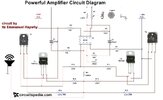
4558 ic Audio Power Amplifier Circuit Diagram


circuitspedia.com

This is circuit diagram of powerful audio amplifier. This circuit is given by Emmanuel. In this circuit one ic 4558 and 4 Power transistors are used with some discrete components. Use 20v-to 60v for operating this circuit. This is a single channel audio amplifier circuit. Use capacitor of minimum 50v value. Positive supply voltage is given at the middle pin of both transistor TIP41C and D718. Negative supply is given at middle terminal of D688and TI42C Transistor. R1 is the variable resistor potentiometer for volume control. This vol. control may be value of 50k to 100k. Use Big size speaker with this circuit. 4558 Audio Amplifier Circuit Diagram.

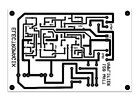
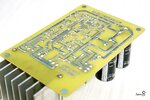
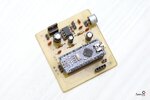
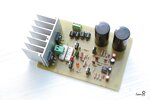
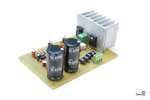
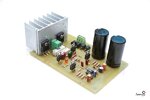
In image of assembled kit there is no 5w resistor connected                               

42204400_1049286311896546_4297286355001540608_n.png
 for more Amplifier circuit click here   

Powerful audio amplifier circuit with 4558.jpg

 
Last edited by a moderator:
audioguru2

Apr 6, 2004
12,026
Joined
Apr 6, 2004
Messages
12,026
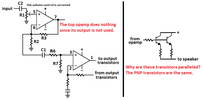
The circuit shown is a block diagram, not a schematic. The inputs and outputs of the opamps are not shown and the collectors, emitters and bases of the transistors are not shown.

An important capacitor between the positive and negative power supply pins of the IC is missing.

Diodes or a transistor to bias the output transistors into class-AB is also missing then there is severe crossover distortion. The volume control is wired backwards and shorts the signal source. The transistors are not connected as a Darlington, they are simply paralleled, why?

Hey, the amplifier has no specifications about its output power or distortion, the impedance of the speaker is also missing.

The datasheet for the RC4558 by Texas Instruments recommends a maximum supply of plus and minus 15V then why does this circuit have supply voltages that are twice too high?

With a plus and minus 15V supply, the maximum output voltage swing of the opamps is plus and minus 12.5V and the output transistors reduce the amplifier output to plus and minus 11V which is 7.8V RMS. Then the output power is only 7.6W into 8 ohms or about 13.7W into 4 ohms.

I made a proper schematic of this nightmare of an audio amplifier showing everything wrong with it:

EDIT: The same website Circuitspedia has an inverter circuit that is also completely wrong.  

odd amplifier.png

 
Last edited by a moderator:
Aman bharti

Apr 11, 2018
31
Joined
Apr 11, 2018
Messages
31
100% working

This diagram was given by one user that used already this circuit at home by implement from This diagram.

No Direct supply given on ic. capacitor may only one issue

Which inverter circuit is wrong , please tell me , I will checked and modifiy

This diagram is given by one user that used already this project at home by implement from This diagram. 

Which inverter circuit is wrong , please tell me , I will check and modify

 
Last edited by a moderator:
audioguru2

Apr 6, 2004
12,026
Joined
Apr 6, 2004
Messages
12,026
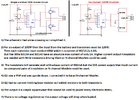
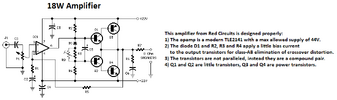
I am showing a CORRECTED audio amplifier circuit and a CORRECTED simple inverter circuit:

inverter.png

18W amplifier.png


audioguru2

Apr 6, 2004
12,026
Joined
Apr 6, 2004
Messages
12,026
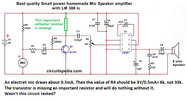
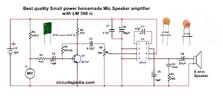
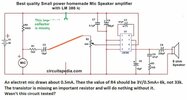
Here is another Circuitspedia circuit that has serious errors. Also, its text says to use a 3V to 6V supply but the datasheet for its LM386 says that its minimum supply is 4V or 5V.

mic speaker amplifier.png


Aman bharti

Apr 11, 2018
31
Joined
Apr 11, 2018
Messages
31
mic audio amplifier circuit diagram 1.jpg

photo.JPG

-----------------------------------------------------

This Inverter circuit is given from a trusted youtube channel on the robotics. He is  showing in video on breadboard using this circuit. 

As name this is a simple inverter, so how this can powerful and regulated  ???? Output Power is Also Depend on Transformer Ampere.

In text also advised to use minimum of 1 A Transformer, not only 1 A

Your corrected circuit is correct but my circuit is not wrong. One BD140 PNP transistor was also connected as here on that video.

 
Last edited by a moderator:
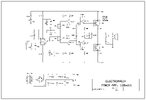
audioguru2

Apr 6, 2004
12,026
Joined
Apr 6, 2004
Messages
12,026
You talk about adding a resistor to make the transistor amplify but it reduces the signal and you do not say the value of the resistor. Of course it will not amplify if the resistor value is calculated wrong. What value did you use for the added collector resistor?

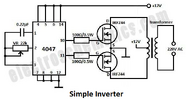
The inverter was completely wrong but my corrections with the Mosfets is also completely wrong because both conduct at the same time. The original circuit will produce a low output power with the PNP shown as an emitter-follower without the NPN transistor working. Most simple inverters use a CD4047 IC instead of a 555 IC. The CD4047 has two outputs that have opposite polarities to drive the same kind of transistor on each output. The transistors are used as switches instead of as emitter-followers.

An inverter uses a voltage sensor and negative feedback for voltage regulation.

Didn't you look at the datasheet of the LM386 that says its minimum allowed supply is 4V to 5V, not 3V? Maybe you are lucky to find one that works at 3V but its output power will be extremely low.

Here is a simple inverter with a CD4047 oscillator and Mosfets: 

simple inverter.png


ELECTROMAGIX

Jun 30, 2017
6
Joined
Jun 30, 2017
Messages
6
Here is another Circuitspedia circuit that has serious errors. Also, its text says to use a 3V to 6V supply but the datasheet for its LM386 says that its minimum supply is 4V or 5V.

View attachment 43087
That transistor itself is not required, LM386 will amplify mic input while 386 in high gain mode (1and 8 connected with capacitor).

ELECTROMAGIX said:
That transistor itself is not required, LM386 will amplify mic input while 386 in high gain mode (1and 8 connected with capacitor).


1.jpg

RIA v2 sc.jpg

ELECTROMAGIX said:
That transistor itself is not required, LM386 will amplify mic input while 386 in high gain mode (1and 8 connected with capacitor).

1.jpg

RIA v2 sc.jpg


1.JPG


audioguru2

Apr 6, 2004
12,026
Joined
Apr 6, 2004
Messages
12,026
The output of the voltage regulator and positive supply for the LM386 and Arduino all need a capacitor to ground to prevent oscillations.


ELECTROMAGIX

Jun 30, 2017
6
Joined
Jun 30, 2017
Messages
6
The output of the voltage regulator and positive supply for the LM386 and Arduino all need a capacitor to ground to prevent oscillations.
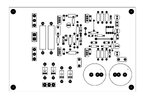
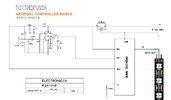
Capacitor is present on board, forgot to draw in the plan.... :D …. Scrooj, that's my neopixel controller board, I made board first  schema very recently. happy to meet you still alive … after six years... this site seems deserted, only the old people like you still dedicating time to educate people....and the people are running behind digital and IOT apps without the knowledge of fundamental electronics. Ha !!

 
Top