help with series RLC circuit

Status
Not open for further replies.

seeeei

Nov 2, 2023
18
Joined
Nov 2, 2023
Messages
18
ll.png
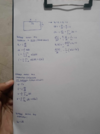
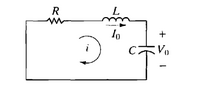
determine the characteristic equation for the voltage across the capacitor (iC), the voltage across the inductor (iL) and the voltage across the resistor (iR).
 

seeeei

Nov 2, 2023
18
Joined
Nov 2, 2023
Messages
18
1698991951268.png


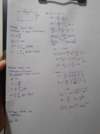
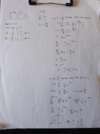
this is my attempted solution but I'm not sure, also I am not confident in solving the voltage across the capacitor.
 

Harald Kapp

Moderator
Moderator
Nov 17, 2011
14,271
Joined
Nov 17, 2011
Messages
14,271
VR + VL + VC = 0 V is o.k.
WIth the current direction as shown this directly translates to
[math] i \times R + L \times \frac{di}{dt} + \frac{q}{C} = 0 V[/math]I don't know why you use negative values in your equation, but this is a mere formal complaint as both your and my equation are equivalent since the result is 0 V and in your 4th line on the left you miraculously come to the same a similar result, but why do you change the integral from [math]\int i dt[/math] to [math]\int v dt[/math]? This is wrong.

Coming to the right side: you make matters unnecessarily complicated by distinguishing IR, IL and IC. Since this circuit has only one loop, IR = IL = IC = I simplifies writing down the equations. You furthermore make it very difficult to follow your writeup when you e.g. [math]V = L \times \frac{di}{dt}[/math] without using the subscript "L" for VL.

Please correct your writeup so we can follow your reasoning without headaches.


By the way: It is imho good practice to keep the units into the calculations. This allows to check the result: If the units don't match there is definitely an error in the calculation.
 

seeeei

Nov 2, 2023
18
Joined
Nov 2, 2023
Messages
18
no that is ∫idt, im sorry if my writing is bad
 
Last edited:

seeeei

Nov 2, 2023
18
Joined
Nov 2, 2023
Messages
18
VR + VL + VC = 0 V is o.k.
WIth the current direction as shown this directly translates to
[math] i \times R + L \times \frac{di}{dt} + \frac{q}{C} = 0 V[/math]I don't know why you use negative values in your equation, but this is a mere formal complaint as both your and my equation are equivalent since the result is 0 V and in your 4th line on the left you miraculously come to the same a similar result, but why do you change the integral from [math]\int i dt[/math] to [math]\int v dt[/math]? This is wrong.

Coming to the right side: you make matters unnecessarily complicated by distinguishing IR, IL and IC. Since this circuit has only one loop, IR = IL = IC = I simplifies writing down the equations. You furthermore make it very difficult to follow your writeup when you e.g. [math]V = L \times \frac{di}{dt}[/math] without using the subscript "L" for VL.

Please correct your writeup so we can follow your reasoning without headaches.


By the way: It is imho good practice to keep the units into the calculations. This allows to check the result: If the units don't match there is definitely an error in the calculation.
1699009481940.png


is it okay now?
 

Harald Kapp

Moderator
Moderator
Nov 17, 2011
14,271
Joined
Nov 17, 2011
Messages
14,271
Looks o.k up to this point:
1699010844609.png
The next 2 equations are imho not helpful.

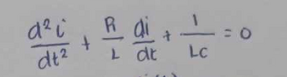
The equation now has the form x''+ax'+bx = 0 with a = R/L and b = 1/(LC). This second order differential equation can now be solved using with some help from the internet, see e.g. this page. Once you have the solution, you can re-substitute a and b by the respective expressions.


Btw: Your thread headers are not very informative. Instead of "help meeee I have my answer but I'm not sure" something like "help me solve an LR-circuit" immediately gives our members a hint what your question is about.
 

seeeei

Nov 2, 2023
18
Joined
Nov 2, 2023
Messages
18
Looks o.k up to this point:
View attachment 61345
The next 2 equations are imho not helpful.

The equation now has the form x''+ax'+bx = 0 with a = R/L and b = 1/(LC). This second order differential equation can now be solved using with some help from the internet, see e.g. this page. Once you have the solution, you can re-substitute a and b by the respective expressions.


Btw: Your thread headers are not very informative. Instead of "help meeee I have my answer but I'm not sure" something like "help me solve an LR-circuit" immediately gives our members a hint what your question is about.
but the question is "determine the characteristic equation for the voltage across the capacitor (iC), the voltage across the inductor (iL) and the voltage across the resistor (iR)." did I just solved the problem asked?
 

seeeei

Nov 2, 2023
18
Joined
Nov 2, 2023
Messages
18
that is first order, the circuit i have provided is 2nd order circuit
 

Harald Kapp

Moderator
Moderator
Nov 17, 2011
14,271
Joined
Nov 17, 2011
Messages
14,271
You sure know how to look up other websites which explain how to solve 2nd order equations. I can't do your work.
 

Ratch

Mar 10, 2013
1,102
Joined
Mar 10, 2013
Messages
1,102
View attachment 61341
determine the characteristic equation for the voltage across the capacitor (iC), the voltage across the inductor (iL) and the voltage across the resistor (iR).
Using Laplace transforms, we can write the equation as Is1 (R1 + L1 s + 1/(C1 s)) - L1 Io + Vo/s == 0. Solving for Is1 we get Is1=(C1 (Io L1 s - Vo))/(1 + C1 R1 s + C1 L1 s^2), Usng the many computer programs we can find the inverse Laplace transform as
i=(E^(-(((R1+Sqrt[-4 L1+C1 R1^2]/Sqrt[C1]) t)/(2 L1))) ((1+E^((Sqrt[-4 L1+C1 R1^2] t)/(Sqrt[C1] L1))) Io Sqrt[-4 L1+C1 R1^2]-Sqrt[C1] (-1+E^((Sqrt[-4 L1+C1 R1^2] t)/(Sqrt[C1] L1))) (Io R1+2 Vo)))/(2 Sqrt[-4 L1+C1 R1^2]). "E" represent the natural log constant.

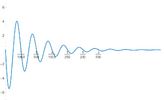
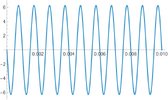
Putting in some numbers R1=3;L1=0.0025330;C1=10µF;Io=1 ma;Vo=100;
And plotting the current, we get


1763659227973.png

Notice that I selected L1 and C1 to resonate at 1000 Hertz. The decay is caused by the resistance of course.
 

Harald Kapp

Moderator
Moderator
Nov 17, 2011
14,271
Joined
Nov 17, 2011
Messages
14,271
AI says the equation looks like this when written as a formula:
[math]i = \frac{ e^{-\frac{\left(R_1 + \frac{\sqrt{-4 L_1 + C_1 R_1^2}}{\sqrt{C_1}}\right)t}{2 L_1}} \Bigg[ \left(1 + e^{\frac{\sqrt{-4 L_1 + C_1 R_1^2} \, t}{\sqrt{C_1} L_1}}\right) I_0 \sqrt{-4 L_1 + C_1 R_1^2} - \sqrt{C_1} \left(-1 + e^{\frac{\sqrt{-4 L_1 + C_1 R_1^2} \, t}{\sqrt{C_1} L_1}}\right)(I_0 R_1 + 2 V_0) \Bigg] }{ 2 \sqrt{-4 L_1 + C_1 R_1^2} }[/math]To be honest, I haven't checked the result thoroughly.
@Ratch : in case you haven't noticed: this thread is from 2023 with no further reply from the op. In fact the op has been seen here the last time on November 3, 2023.
 

Ratch

Mar 10, 2013
1,102
Joined
Mar 10, 2013
Messages
1,102
AI says the equation looks like this when written as a formula:
[math]i = \frac{ e^{-\frac{\left(R_1 + \frac{\sqrt{-4 L_1 + C_1 R_1^2}}{\sqrt{C_1}}\right)t}{2 L_1}} \Bigg[ \left(1 + e^{\frac{\sqrt{-4 L_1 + C_1 R_1^2} \, t}{\sqrt{C_1} L_1}}\right) I_0 \sqrt{-4 L_1 + C_1 R_1^2} - \sqrt{C_1} \left(-1 + e^{\frac{\sqrt{-4 L_1 + C_1 R_1^2} \, t}{\sqrt{C_1} L_1}}\right)(I_0 R_1 + 2 V_0) \Bigg] }{ 2 \sqrt{-4 L_1 + C_1 R_1^2} }[/math]To be honest, I haven't checked the result thoroughly.
@Ratch : in case you haven't noticed: this thread is from 2023 with no further reply from the op. In fact the op has been seen here the last time on November 3, 2023.

Yes, I know the post is two years old and the OP has probably died by now. I solved this problem to show others how much easier Laplace Transforms make the the problem. That is because the initial conditions are carried along with the solution process and no back substitution algebra is necessary. That saves a lot of work. Who would think that two simple initial conditions would result is such a complicated current equation. I chose the values of L1 and C1 to resonate at 1 kHz. If we set R1 to zero, notice how the oscillations go on forever.

1763740862143.png
 

Ratch

Mar 10, 2013
1,102
Joined
Mar 10, 2013
Messages
1,102
Yes, I know the post is two years old and the OP has probably died by now. I solved this problem to show others how much easier Laplace Transforms make the the problem. That is because the initial conditions are carried along with the solution process and no back substitution algebra is necessary. That saves a lot of work. Who would think that two simple initial conditions would result is such a complicated current equation. I chose the values of L1 and C1 to resonate at 1 kHz. If we set R1 to zero, notice how the oscillations go on forever.

View attachment 69545

You do not solve anything you just regurgitated a textbook or AI did good for you.
Lock her up!

You are wrong! I did solve a stated problem using principles found in many textbooks on Laplace Transforms. I also used a commercial program to find the Inverse Laplace Transform, as I also admitted. I did not use any AI. I hope my solution was a edification to those who wondered how to solve the problem.
 

lalan45

Dec 22, 2025
3
Joined
Dec 22, 2025
Messages
3
View attachment 61341
determine the characteristic equation for the voltage across the capacitor (iC), the voltage across the inductor (iL) and the voltage across the resistor (iR).
You’ll need to specify the circuit (series or parallel RLC) and what variables are defined, otherwise it’s not fully solvable.
That said, for a standard series RLC, the characteristic equation is the same for iCi_CiC, iLi_LiL, and iRi_RiR because they share the same current:

s2+RLs+1LC=0s^2 + \frac{R}{L}s + \frac{1}{LC} = 0s2+LRs+LC1=0
 
Status
Not open for further replies.
Top