0-30 Vdc Stabilized Power Supply

audioguru2

Apr 6, 2004
12,026
Joined
Apr 6, 2004
Messages
12,026
It is amazing that the kit maker uses a little 2N2219 that has a very low power dissipation.
With only 32V across it then it is at its max power dissipation (with a heatsink) with a current of only 56mA. Then the 2N3055 transistor needs to have a current gain of 54. The minimum gain of a 2N3055 is only 25 when it has a current of 3A. Maybe the kit maker selected high gain 2N3055 transistors.


AN920

May 15, 2005
359
Joined
May 15, 2005
Messages
359
Yes, with so many pirated and cloned parts around today you never know what you will get!


AN920

May 15, 2005
359
Joined
May 15, 2005
Messages
359
indulis said:
How does the TIP31A introduce a LF pole? It has a 3MHz gain bandwidth product and if the supply is running a max Iout of 3A, and the 2N3055 is at it's min beta of 5 (On-semi datasheet and that's at a Ic of 10A not 3A), the TIP31A isn't working "that hard" and your no where near it's bandwidth limit. If the high frequency zero due to the cap ESR is an issue, add a high frequency pole a decade earlier.
Let's analyze the TIP31A from a S-parameter view as measured on a network analyzer using the actual components . We will look at the response of it operating as a simple emitter follower alone with only resistive terminations. This is normally considered to be a very stable configuration. Surprise! :eek:

Good paper here for IEEE members
http://ieeexplore.ieee.org/xpl/freeabs_all.jsp?tp=&arnumber=1082247&isnumber=23381

Looking at the first plot of a sweep between 0-10 MHz we see that this transistor is unstable with a K factor < 1 for operation above 50 kHz all the way up to 10 MHz. This transistor will oscillate without compensation. We normally aim for a K factor of at least >= 1.2
We can see a very good comparison between the measured S-param data and the model used by the simulator. We can thus assume the model is quite accurate.

Next we add a common 10uF capacitor with an ESR of 7 ohm on the output. Now we see that this setup is unstable for anything  over 70 kHz

Next we take a look at the BD139 in the same configuration. This will be stable under 1.9 MHz (big difference from 50 kHz).

Adding the same output cap we can see stability is not much affected with ample stability at 1 MHz (K = 1.9). Looking at the plot of the original 2N2219 we see a similar trend.

The original designer may have had good reason for selecting the driver he did. Maybe he was aware of the problems like I am. The importance to select a fast driver is just as important in PSU design as in audio amplifiers.

I can't make it any clearer than this.

View attachment 40499

View attachment 40500

View attachment 40501

 
Last edited by a moderator:

audioguru2

Apr 6, 2004
12,026
Joined
Apr 6, 2004
Messages
12,026
Hi aN920,
You are talking about high frequency changes in load current. Or quick changes in load current.

I think that C9 rolls off the response so that the overall gain is only 2 at 89kHz. Then C6 straightens out the phase response.


AN920

May 15, 2005
359
Joined
May 15, 2005
Messages
359
audioguru said:
I think that C9 rolls off the response so that the overall gain is only 2 at 89kHz. Then C6 straightens out the phase response.
That was the intention in the original design with a much better transistor. The whole picture changed. The situation will be the most problematic during load switching of high currents. It will be the worst at high output voltage settings and will get worse with lower ESR values. As-is, a 10uF cap with any ESR lower than 5 ohm will cause oscillation when switching.
 

AN920

May 15, 2005
359
Joined
May 15, 2005
Messages
359
I think I found a possible replacement. Look at the MJE180 from Fairchild.
http://www.fairchildsemi.com/ds/MJ/MJE182.pdf

Good, Ft (50 MHz), gain (50 min) and Ic (3A)

Initial simulations look very good. Very stable with low ESR values and very fast loop load-step response (200nS).

I will analyze this further, but it looks good.

Mouser have them for $0.60 ea.


audioguru2

Apr 6, 2004
12,026
Joined
Apr 6, 2004
Messages
12,026
Hi AN920,
Digikey don't have any MJE180 transistors, maybe because it is old and is hardly used anymore. It might become obsolete soon.

I haven't seen transistors with that old Motorola case since the '60s.


AN920

May 15, 2005
359
Joined
May 15, 2005
Messages
359
Future Electronics have 10,000 + in stock at $0.18 ea.

FC shows it is still in full production
http://www.fairchildsemi.com/pf/MJ/MJE180.html

 
Last edited by a moderator:

Thomas1

Feb 20, 2005
29
Joined
Feb 20, 2005
Messages
29
Hello everybody

I finished building my modified project maybe a year ago and promised back then to post some pictures as soon as i could get my hands on a digicam :)
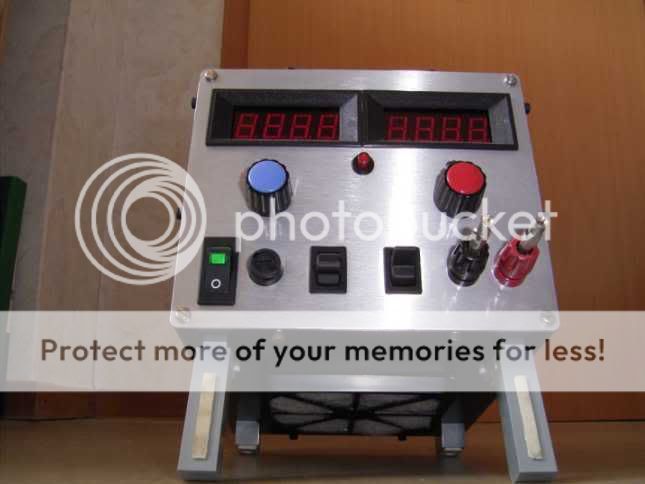
Well, here they are:

Outside:
RIMG0029k.jpg


The output can be shortened and switched off by two flick switches. This allows adjusting of voltage and current limiter before feeding it to the circuit.

In order to prevent heating problems, I used a sandwich design for the bottom of the case. The 92mm fan sits directly behind the filter on the bottom. It blows up to the mounting plate, which has several holes in it to allow fresh air to get to the board, the trafo, and some other places. The rest of the airflow goes to the back and is forced through the heatsink.

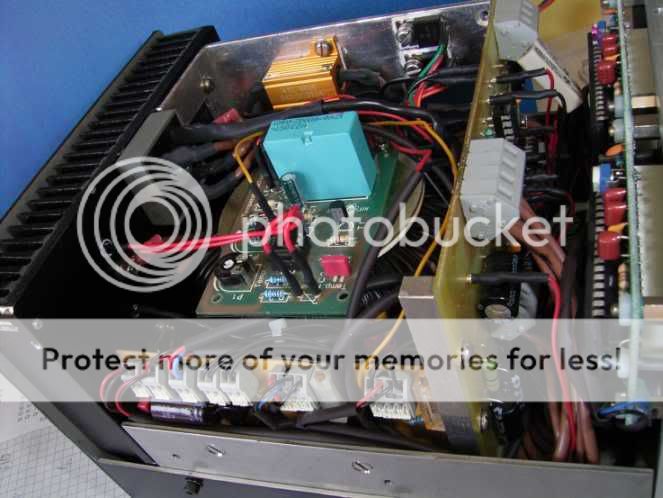
Inside:
RIMG0037k.jpg

Looks shocking, but at least there's no space wasting ;)

Both BD 241 and the 0,47R resistor are mounted on the sheet of aluminium bolted to the black heatsink.
The 10.000

 
Last edited by a moderator:

audioguru2

Apr 6, 2004
12,026
Joined
Apr 6, 2004
Messages
12,026
Hi Thomas,
Your project looks neat, tidy, compact and very nice.
I am glad to hear that it works perfectly. ;D


mvs sarma

Feb 12, 2006
234
Joined
Feb 12, 2006
Messages
234
Hi Thomas,

Nice outcome for the effort put in,

Siiting here in India, I really love it.

All the best and wish you best future in your personal professional life

Sarma


indulis

Nov 21, 2005
488
Joined
Nov 21, 2005
Messages
488
AN920

A quick question... when you generated (simulated) the bode plots, where was your signal injection point?


AN920

May 15, 2005
359
Joined
May 15, 2005
Messages
359
If you are referring to the bode plots of the PSU loop stability, that was injected with a current transformer inserted into the feedback path. I could have injected in the error amp's own feedback path as preferred by some people. In this case I don't think it will make much difference.

 
Last edited by a moderator:

indulis

Nov 21, 2005
488
Joined
Nov 21, 2005
Messages
488
The problem is that there is only one point in the feedback path that contains all the feedback information from both loops, and that would be between the R12, C6 & C9 node and the R11 and U2 pin 4 node... but I'm not sure it's a legitimate injection point. The same rules should apply here as for DC-DC's and per Dr Venable and Dr Ridley, specific criteria have to be met in regards to the injection point, and if not followed, the results are not exactly accurate.


audioguru2

Apr 6, 2004
12,026
Joined
Apr 6, 2004
Messages
12,026
Somebody who has the project made with the slow TIP31A driver transistor could 'scope its output while it was loaded and unloaded with a 3A load.

IC voltage regulators have overshoot and ringing at their outputs but the capacitor to ground on their output reduces it very well.
The LM723 regulator has a horrible step in its response when it is loaded:

View attachment 40502


AN920

May 15, 2005
359
Joined
May 15, 2005
Messages
359
The current probe or current transformer method was suggested by Dr. Middlebrook long ago. Every injection point has its pros and cons. I think where a loop is very marginally stable various methods may make a small difference, but where it shows obvious instability it won't make much of a difference. By using the better driver we can get it unconditionally stable, so why not? The price is only $0.18

Someone who tests the supply for load switching may see no oscillation, because of high ESR output cap. He will see a voltage dip and overshoot when the load is removed. The real test will be with a high grade (switchmode type) electrolytic with low ESR.


audioguru2

Apr 6, 2004
12,026
Joined
Apr 6, 2004
Messages
12,026
Hey all.... i'm  from brazil and here dont sell mc34071 and rs1506, someone can tell a website that i can buy this??
ty...
The TLE2141 opamps can also be used.

Go to www.farnell.com and click on the flag of Brasil. But they also don't have either opamp.
Maybe they can order them for you.
They are in many countries. The Canadian/American one has EVERYTHING.View attachment 40510


kvakva

Apr 2, 2009
3
Joined
Apr 2, 2009
Messages
3
Audioguru, thanks for good advices. I did measure U1 output and it is approximately constant (10.2V without load, and 10.1V with 3A load ). Also I realized that I need thicker wires on output. Now my supply really works good. There is negligible voltage drop. Thanks again!!!

Mayhem, maybe You should take same advices...

Best regards!


audioguru2

Apr 6, 2004
12,026
Joined
Apr 6, 2004
Messages
12,026
Could someone please decsribe what Op Amp circuits U1, U2 and U3 are please just to get a better understanding. I have a fair idea what the are but just want to clarify it.
U1 is an 11.2V voltage reference. The opamp has a gain of 2 and it multiplies and feeds the 5.6V zener diode D8.
U2 is the main amplifier for the voltage regulator. It has a voltage gain of 3.074. It has a variable input voltage.
U3 is the current regulator. It compares the voltage drop across R7 caused by load current with the setting of the current pot. If the load current is higher than the current pot then U3 reduces the output voltage through D9 until it is the same as the current pot.
 
Top